Get Full Government Meeting Transcripts, Videos, & Alerts Forever!
Get email alerts on the Wildfire Recovery topic
No spam. Unsubscribe anytime.
Oregon outlines $422 million federal wildfire‑recovery grant, says state bridge funding left some survivors waiting
Summary
Oregon Housing and Community Services told a legislative subcommittee the state received a $422 million Community Development Block Grant–Disaster Recovery (CDBG‑DR) to rebuild homes and support community recovery from the 2020 Labor Day wildfires, described program structure and said delays and federal rules have slowed some local awards.
The Transportation and Economic Development Subcommittee of Ways and Means heard March 25 that Oregon received a $422,000,000 Community Development Block Grant–Disaster Recovery (CDBG‑DR) for rebuilding housing and community infrastructure after the 2020 Labor Day wildfires, and that a separate 2021 state appropriation of about $150,000,000 served as a temporary bridge until federal funds were available.
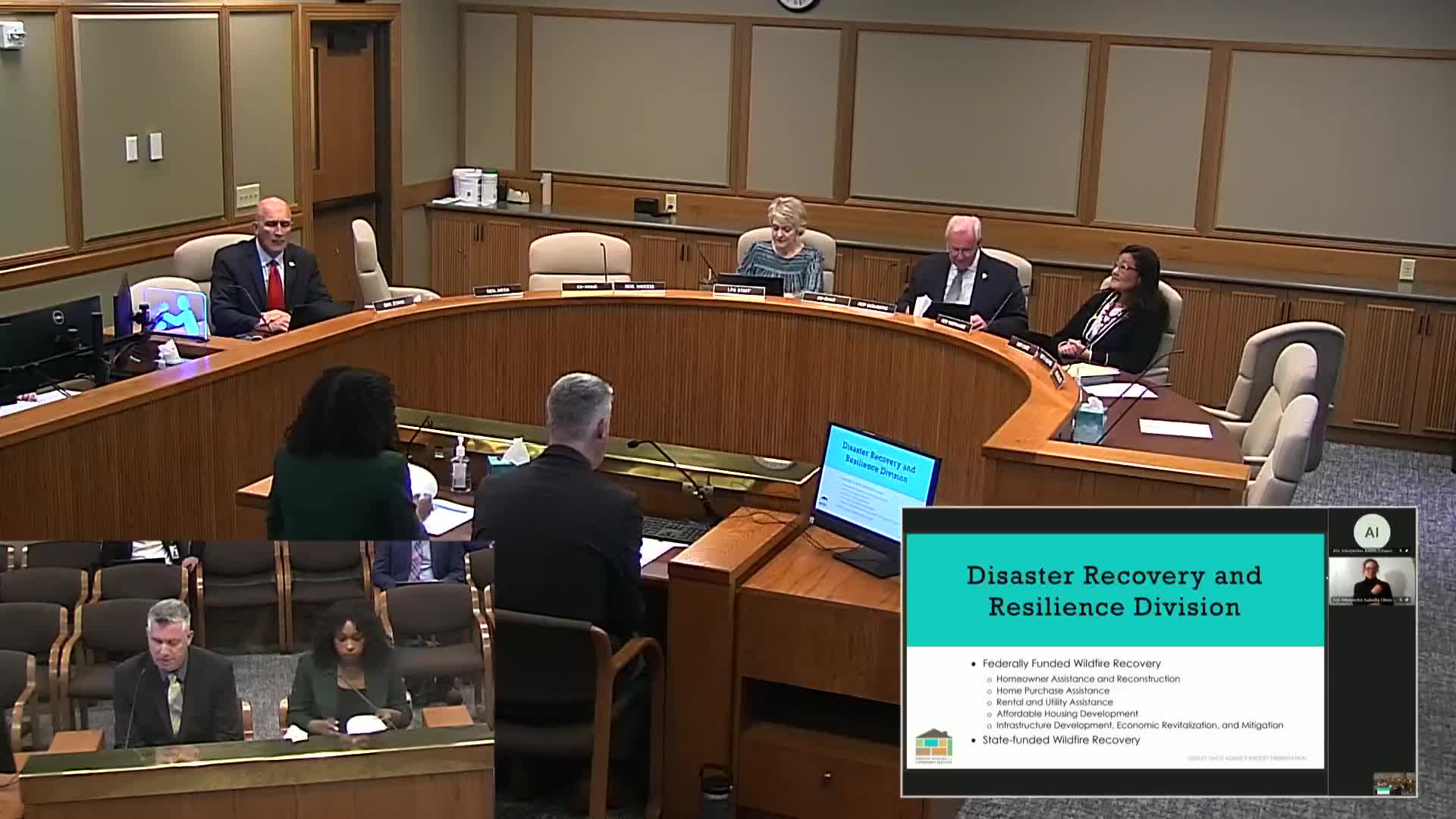
The subcommittee was told those dollars fund several program streams — the Homeowner Assistance and Reconstruction Program (HARP), an affordable housing development allocation, housing support services (including rental and down‑payment assistance), a planning/infrastructure and economic revitalization (PEER) program, resilience planning and public services — and that the funds are subject to HUD rules that shape how and when money can be used.
Why it matters: the grant is the largest federal recovery resource Oregon has received for the Labor Day fires, but agency leaders said federal timing, program complexity and the requirement that HUD funding be “last resort” have delayed full deployment of funds and left some survivors waiting years for permanent housing.
Andrea Bell, executive director of Oregon Housing and Community Services (OHCS), and Kayla Biant, the agency’s deputy director, walked the committee through how state and federal dollars were allocated and where projects stand.
Biant noted the origin and scale of the work: “This is the newest programmatic division of our agency. It was built in the wake of the 2020 Labor Day wildfires,” and she told the committee about the 4,300 homes lost in those fires. She described the 2021 state package (about $100 million general fund and $50 million in lottery revenue bond proceeds) as a bridge until the federal grant arrived.
The agency described the CDBG‑DR funding as follows: about 80% of the $422 million is allocated to housing programs; roughly 11% to the PEER (planning, infrastructure and economic revitalization) program; and the remainder to public services, planning and administration. OHCS emphasized HUD rules that apply to the grant, including a requirement that 70% of program dollars go to low‑ and moderate‑income households (generally households at or below 80% of area median income) and that 15% be used for mitigation activities to “build back better.”
HARP and reimbursement waiver: OHCS said the HARP program covers a wide range of homeowner recovery needs — from repair and full reconstruction of stick‑built homes to purchase and placement of manufactured homes — and includes a newer reimbursement option intended to repay survivors who spent their own money. Biant told the committee that HUD approved a plan amendment to allow reimbursement, but the agency said HUD limited reimbursements to costs incurred before February 2023; OHCS has requested a waiver to expand eligibility and is awaiting HUD’s response. The agency said the reimbursement portion was not part of the program when initially designed and required the amendment to accommodate survivor needs.
PEER program status: the PEER program sets up local selection committees in fire‑impacted communities to nominate local infrastructure or economic revitalization projects for federal funding. OHCS reported about 15 projects had been forwarded by local committees; roughly eight have active grant agreements and can draw funds, while seven have committee approval but lack executed agreements — largely because they remain in environmental review or are completing federal capacity checks. Co‑Chair Gomberg asked whether the 15 projects would exhaust the roughly $45.6 million PEER allocation; OHCS said those 15 represent about half the PEER pot and that holdbacks were retained to address cost overruns.
Reimbursement process and federal draw: OHCS told the committee federal draws are reimbursement‑based through HUD’s Disaster Recovery Grant Reporting system (DRGR). Biant said the agency had worked with HUD to ensure PEER obligations are secured in DRGR and that, to date, the agency has not experienced access problems.
Implementation and timeline: OHCS traced the grant timeline — authorization in September 2021, a grant agreement signed in February 2023, initial program solicitations later in 2023, and the March 2024 launch of the homeowner reconstruction (HARP) program. The agency said one program stream — housing counseling and down‑payment assistance aimed at renters who want to become homeowners — had not yet launched but that requests for administrator applications were open.
Policy package and staffing: OHCS presented a policy option package asking for expenditure limitation authority for federal funds (about $171,000,000 anticipated to be spent in the 2025‑27 biennium) and authorization to continue 29 limited‑duration staff positions the agency currently employs to administer the grant. OHCS clarified that the positions are already working but require legislative reauthorization because they are limited duration.
Agency reflections: Bell and Biant told the committee OHCS had learned lessons about program design and community collaboration during recovery work. Bell acknowledged the state’s initial plans “did not pan out to services on the ground that had the impact that we intended” and said the agency executed a substantial reset to better align implementation with community needs.
What wasn’t decided: the hearing was informational; committee members did not take a vote. Co‑Chair Gomberg opened the information hearing on House Bill 50 11 at the start of the session but no formal action on the bill or the policy option packages occurred at this meeting.
Next steps: OHCS said it will continue to work with HUD on the reimbursement waiver, finalize additional grant agreements as environmental reviews and capacity checks complete, and pursue the biennial budget reauthorization for expenditure limitation and limited‑duration staff.
Sources and attribution: comments and program details above are drawn from presentations by Andrea Bell, executive director of Oregon Housing and Community Services; Kayla Biant, deputy director; and questions and comments from Co‑Chair Gomberg and other subcommittee members during the March 25 information hearing.
Ending note: the agency asked the subcommittee to consider the policy option package during the budget process so staff and program administration can continue while award and implementation work proceeds.