Get Full Government Meeting Transcripts, Videos, & Alerts Forever!
Get email alerts on the Revenue Film Tax Credit topic
No spam. Unsubscribe anytime.
Panel hears proposal to raise annual film tax‑credit auction cap to $28 million
Summary
Supporters from Oregon Film and filmmakers told the House Committee on Revenue that increasing the auction cap for film tax credits would help attract multi‑season TV series and sustain local industry jobs; a Tax Fairness Oregon witness urged converting credits to direct grants and warned of fiscal cost and inefficiency
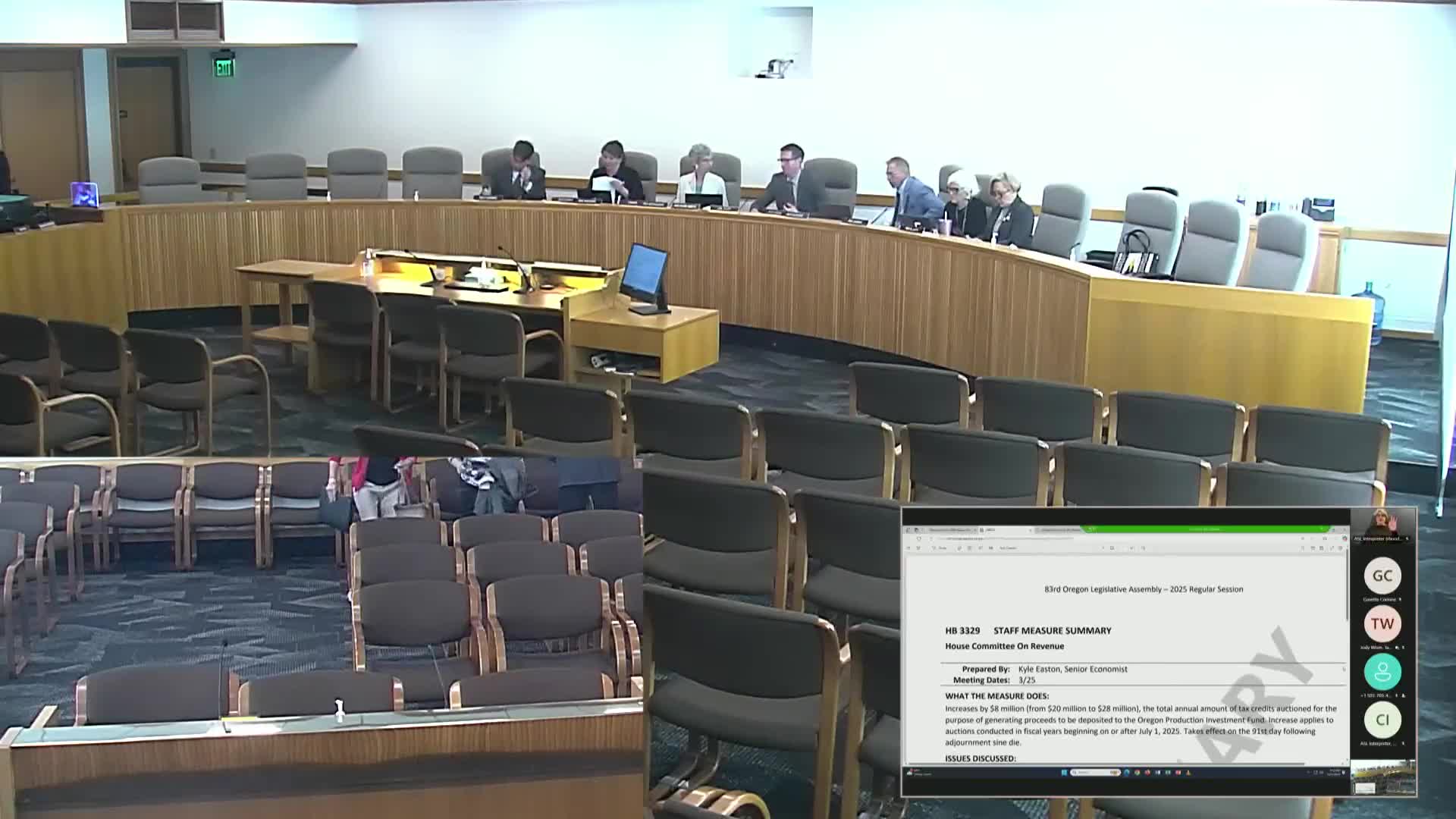
The House Committee on Revenue held a public hearing March 25 on House Bill 3,329, which would increase the annual auction cap on Oregon’s film tax credit from $20 million to $28 million beginning with auctions held on or after July 1, 2025.
Tim Williams, executive director of Oregon Film, described the state’s production incentives and industry growth and said the program is modest compared with larger programs elsewhere but has generated jobs and spending across Oregon. “These programs ... provide an approximate 25% rebate on projects that are being produced throughout the state,” Williams told the committee.
Williams and several industry witnesses said raising the cap would help Oregon better compete for multi‑season television series, which bring repeated local spending over multiple years. Devon Faiza Antal, a Portland filmmaker, said the program helps local independent filmmakers keep projects and jobs in Oregon: “This rebate isn't a handout. It's an investment in Oregon's creative future,” she said. Location managers, production managers and other crew members described local vendor spending and jobs, with one location manager citing $8.5 million in on‑site rentals and vendor spending associated with a recent five‑and‑a‑half month series.
Opposition testimony questioned the funding mechanism. Jody Weiser, testifying for Tax Ferris Oregon, said auctioned tax credits with a discount to buyers represent an inefficient subsidy and recommended converting the program to direct appropriations rather than tax credits sold at auction. “This mechanism is throwing money away,” Weiser said, adding that buyers typically purchase credits at a discount and the differential represents a cost to the general fund.
Committee members asked about program administration, the statute’s sunset date and how projects are evaluated. Williams said the office evaluates producers’ budgets and verifies spending through audits before rebates are paid; he described a statutory list of evaluation factors and said the program pays incentives only after in‑state spending is verified. Legislative members also asked how Oregon’s incentives compare with other jurisdictions; Williams said Oregon’s program is competitive among nearby states but smaller than funds in California, British Columbia and Georgia.
The committee received broad testimony from industry workers describing local economic spillovers and workforce impacts, as well as from a public‑interest witness raising fiscal concerns. There was no committee vote; the committee closed the hearing and moved to later items on the agenda.