Get Full Government Meeting Transcripts, Videos, & Alerts Forever!
Get email alerts on the Revenue Investments topic
No spam. Unsubscribe anytime.
House hearing examines bill to let school districts form their own investment pool
Summary
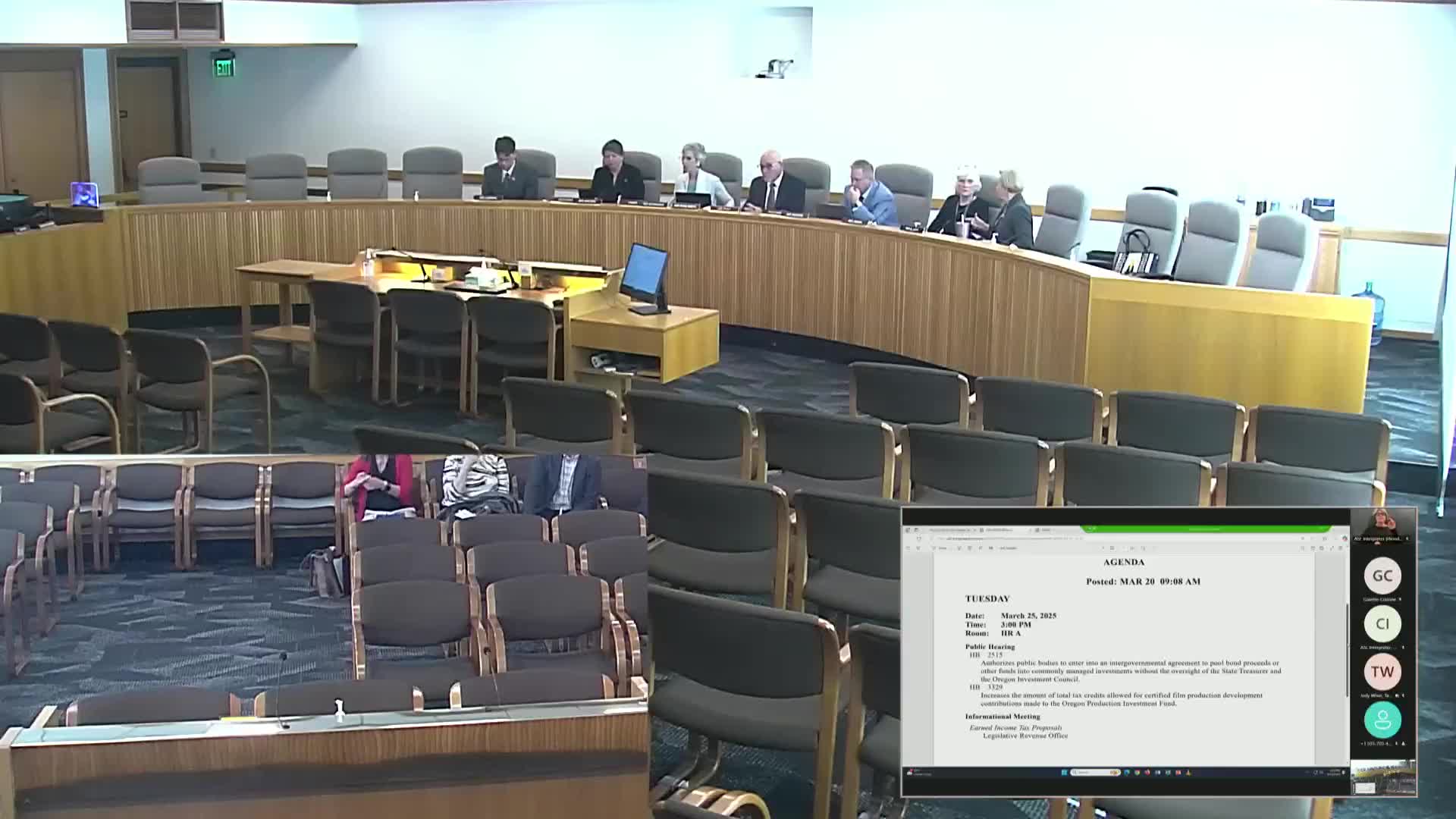
The House Committee on Revenue opened a public hearing March 25 on House Bill 2,515, which would allow local governments, including school districts, to form intergovernmental investment pools as an alternative to the State Treasurer’s short‑term pool.
The House Committee on Revenue opened a public hearing March 25 on House Bill 2,515, which would allow local governments — including school districts and education service districts — to enter into intergovernmental agreements to form their own investment pool rather than use the Oregon State Treasurer’s short-term local government investment pool.
Proponents told the committee the change is optional and aimed at giving districts tailored investment and technical supports. “The goal for us is to create an investment pool, a school pool, specifically designed for schools and education service districts to provide investment options,” Lori Satinspiel said during testimony supporting the bill.
Why it matters: witnesses said many school business offices receive large, lumpy state and local revenues (for example, much of the state school fund arrives in November and December) and need shorter‑term investment strategies matched to payroll and construction draw schedules. David Moore, who recently retired after 29 years in school finance and served 12 years as chief financial officer at Tigard Tualatin School District, described how his district maximized returns by timing Treasury and Treasury‑eligible investments to match payroll and bond schedules. “These investments over five months enhance investment earnings revenue in the district’s general fund, allowing the district to maintain programs and services for students,” Moore said.
Supporters said a school‑specific pool could combine districts’ balances and add practical services (software dashboards, pooled advisory services) that small districts cannot afford on their own. Cecilia Coontz, director of finance and operations for Central School District, said her department of 1.5 full‑time employees lacks capacity for active treasury management and would benefit from pooled services: “Having programming services that provide me with the support would replace that expense and time of working with a financial advisor,” she said.
Committee members pressed on oversight, risk and transparency. Representative Reschke asked where school funds are held today; witnesses agreed state school fund receipts currently go to the state’s local government investment pool (the short‑term fund) and districts draw as needed. Representative Rob Walters asked how the pool would perform across economic cycles and whether private managers would reduce transparency or accountability compared with the state Treasurer’s daily‑managed structure. Satinspiel and district witnesses said governance and board oversight would be key design features and that district boards must maintain investment policies and approve changes at the district level.
Legislative Revenue Office staff and others flagged statutory limits on investments managed by the State Treasurer and said the bill’s purpose is to create a statutory pathway if local governments choose to invest outside the Oregon State Treasurer’s short‑term pool. Committee members and witnesses noted that the State Treasurer’s office had provided a letter describing concerns about risk and asked staff to review that letter as the committee considers changes.
No vote or committee action was taken; the committee closed the public hearing on HB 2,515 at the conclusion of testimony.
Ending: The bill’s proponents said the legislation is intended to be permissive and to provide optional technical supports and governance structures that make active treasury management feasible for small and mid‑sized districts. Committee members signaled a desire for further input from the State Treasurer’s office and for language clarifying oversight, allowable investments and reporting requirements before the measure would advance formally.