Get Full Government Meeting Transcripts, Videos, & Alerts Forever!
Get email alerts on the Oda Programs Operations topic
No spam. Unsubscribe anytime.
ODA reports reduced inspection backlogs, high-path avian influenza testing, and realignment savings in informational hearing
Summary
At the March 25 informational hearing on SB 5502 and SB 5503, ODA division directors described operational changes: reduced food-safety inspection backlog, expanded animal-disease testing, a new Ag Services division that generated travel-cost savings for grasshopper suppression, and the lab move to Wilsonville’s North Valley Complex.
Deputy directors and division leaders from the Oregon Department of Agriculture told the Joint Committee on Ways and Means Subcommittee on Natural Resources March 25 that the agency has reduced COVID-era inspection backlogs, is performing expanded disease surveillance, and has realigned field inspection work to increase efficiency.
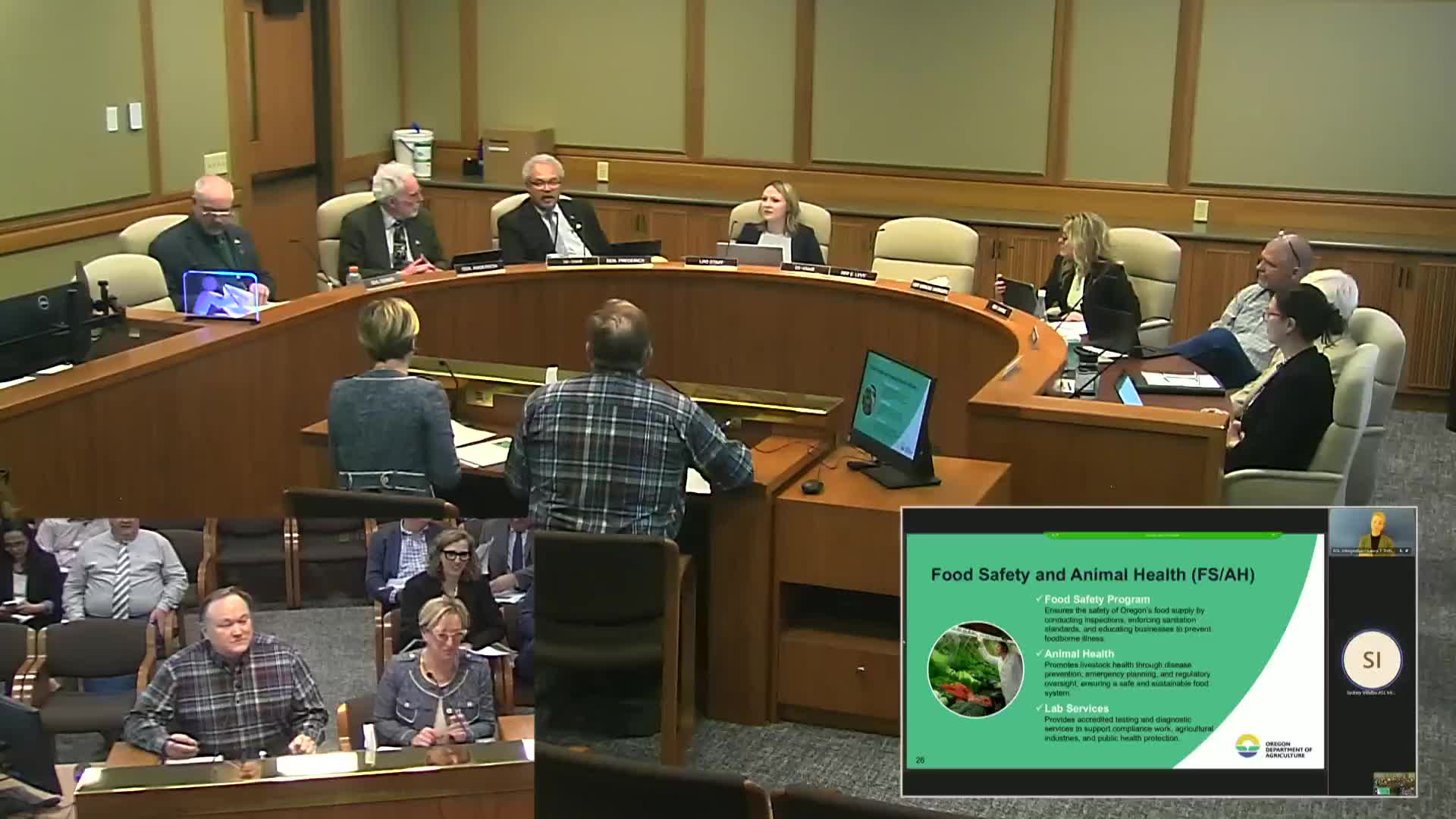
Rusty Rock, division director for Food Safety, Animal Health and Lab Services, said ODA inspects about 12,000 licensed facilities statewide with 38 inspectors. He told the committee that after COVID the agency had roughly 5,000 overdue inspections (defined as more than 90 days past expected), and staff have completed about 60–65% of that backlog by focusing on older and higher-risk facilities.
Rock described the agency’s regulatory divisions and their scope: food manufacturing and distribution, dairy and shellfish, pet-food and edible cannabis testing, the new state meat inspection program, animal disease control and emergency response, and a regulatory lab that supports enforcement actions. On disease surveillance, Rock said ODA handled about 81 disease calls in 2020 but has seen more than 311 disease calls in the current quarter—“primarily related to highly pathogenic avian influenza,” he said—and noted the agency is conducting about 700 dairy-related samples weekly as part of monitoring for avian influenza impacts to dairy.
The agency’s plant health and seed services and export certifications remain significant: presenters said the department wrote sanitary certificates for seed exports and that plant services inspected large commodity volumes across the state.
Casey Prentice, director of the new Agriculture Services Division, explained the division’s purpose is to consolidate Certification and Inspection, Weights and Measures, Plant Health and Seed, Livestock Identification and other programs into one customer-fee-for-service division. Prentice said the realignment allowed staff to operate from five offices statewide and cross-train employees, producing local cost savings—for example, he told the committee the agency saved nearly $400,000 in travel and mileage by staging grasshopper suppression work from multiple locations and training brand inspectors to assist.
Lindsay Ng and other presenters described the state meat inspection program: the legislature provided roughly $11,000,000 in grants to help custom-exempt facilities adopt state inspection so they can slaughter, cut and process meat for sale within Oregon. Ng said six firms have started processing under the state program and an additional 11 were expected to come online in 2025. The agency also told lawmakers that the federal match for state meat inspection hours has shifted over time and that future federal policy could change the share the federal government funds.
Agency leaders discussed fee structures: ODA’s food safety program has an industry advisory committee and a statutory provision allowing an annual 3% fee adjustment; ODA said the program has not needed to use that authority to date. Weights and Measures and the brands (livestock identification) program were presented as areas where fee or statutory changes may be needed; Senate Bill 1019 was referenced in conversation as a potential vehicle for brand-fee changes.
Several performance metrics were raised: ODA reported 13 key performance measures (KPMs), nine on-target or within 5% and four off target. The agency cited a third-party inspection KPM where ODA was 71% on time (target 80%) because timeliness depends on USDA returning results; a pest-response KPM that fell to 0% after 2023 because the state no longer produces a top-100 pest list; declines in an ag water-quality KPM tied to streamflow and temperature data supplied by DEQ; and a customer-service KPM that has fallen into the 70% range. Lisa Sharplow Hanson, ODA director, said the agency intends to revisit some KPM measurements and report alternative measures in future budget materials.
Directors also raised workforce and vacancy concerns. The agency described long-term vacancies in other-funded positions, recruitment difficulties for specialized roles (example: CAFO manager), and succession-planning challenges as many staff are recent hires and some senior staff are approaching retirement. The department said that many of the long-term vacant positions were other-funded (industry fee funded) and that eliminating them would not produce large general-fund savings but could affect on-the-ground inspection and certification capacity.
ODA concluded by summarizing the realignment, program workload, and ongoing budget risks tied to federal funds and industry-funded positions; the committee did not take votes during the informational hearing.