Get Full Government Meeting Transcripts, Videos, & Alerts Forever!
Seattle committee briefs on state 'missing middle' law, interim rules and timeline
Summary
SEATTLE — The Seattle City Council Select Committee on the Comprehensive Plan received a detailed briefing March 19 on state House Bill 1110 and related 2023–24 laws that require the city to allow “missing middle” housing in areas now zoned for single‑family homes.
SEATTLE — The Seattle City Council Select Committee on the Comprehensive Plan received a detailed briefing March 19 on state House Bill 1110 and a package of 2023–24 laws that together require the city to allow “missing middle” housing in areas now zoned for single-family homes.
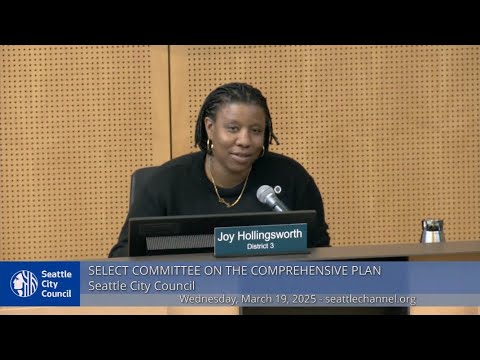
Committee Chair Joy Hollingsworth opened the meeting by noting public comment would be limited to written submissions for the March 28 presentation of interim legislation. “Today, public comment will only be accepting written public comment,” she said. Council central staffers Lish Whitson and Keto Freeman then summarized what the state requires, how Seattle’s current neighborhood residential (NR) rules work, and the options the city will have for interim and permanent changes.
The briefing explained key statutory requirements: jurisdictions must allow a set of multifamily housing types (including duplexes, triplexes, four‑ and six‑plexes, courtyard apartments, cottage housing, townhouses and stacked flats); permit at least four units per lot as a baseline; allow up to six units on a lot either within a quarter‑mile of a “major transit stop” or when at least two of the units are restricted as affordable. Rental affordability must target households at or below 60 percent of area median income (AMI); ownership affordability must target 80 percent AMI. Affordable units must remain restricted for at least 50 years.
Whitson and Freeman reviewed how those requirements interact with current Seattle rules: most of the city’s neighborhood…
Already have an account? Log in
Subscribe to keep reading
Unlock the rest of this article — and every article on Citizen Portal.
- Unlimited articles
- AI-powered breakdowns of topics, speakers, decisions, and budgets
- Instant alerts when your location has a new meeting
- Follow topics and more locations
- 1,000 AI Insights / month, plus AI Chat