Get Full Government Meeting Transcripts, Videos, & Alerts Forever!
Get email alerts on the Missing Middle Housing topic
No spam. Unsubscribe anytime.
Seattle committee briefs on state 'missing middle' law, interim rules and timeline
Summary
SEATTLE — The Seattle City Council Select Committee on the Comprehensive Plan received a detailed briefing March 19 on state House Bill 1110 and related 2023–24 laws that require the city to allow “missing middle” housing in areas now zoned for single‑family homes.
SEATTLE — The Seattle City Council Select Committee on the Comprehensive Plan received a detailed briefing March 19 on state House Bill 1110 and a package of 2023–24 laws that together require the city to allow “missing middle” housing in areas now zoned for single-family homes.
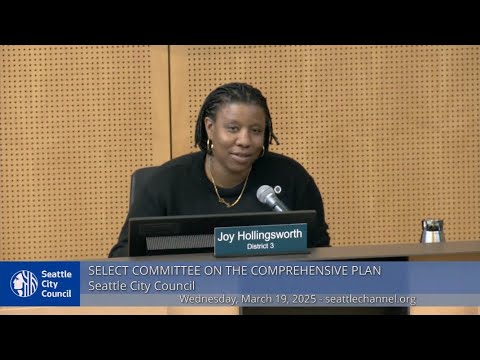
Committee Chair Joy Hollingsworth opened the meeting by noting public comment would be limited to written submissions for the March 28 presentation of interim legislation. “Today, public comment will only be accepting written public comment,” she said. Council central staffers Lish Whitson and Keto Freeman then summarized what the state requires, how Seattle’s current neighborhood residential (NR) rules work, and the options the city will have for interim and permanent changes.
The briefing explained key statutory requirements: jurisdictions must allow a set of multifamily housing types (including duplexes, triplexes, four‑ and six‑plexes, courtyard apartments, cottage housing, townhouses and stacked flats); permit at least four units per lot as a baseline; allow up to six units on a lot either within a quarter‑mile of a “major transit stop” or when at least two of the units are restricted as affordable. Rental affordability must target households at or below 60 percent of area median income (AMI); ownership affordability must target 80 percent AMI. Affordable units must remain restricted for at least 50 years.
Whitson and Freeman reviewed how those requirements interact with current Seattle rules: most of the city’s neighborhood residential land (about 65 percent of the city) is in NR zones of varying intensity (NR1, NR2, NR3 and residential small lot, RSL). Current NR3 rules (the most common NR zone) generally have minimum lot sizes of about 5,000 square feet, a typical floor area ratio (FAR) of about 0.5 (roughly 2,500 square feet of buildable area on a 5,000 square‑foot lot), maximum height near 30 feet, typical front/side/rear setback rules, and a general one parking space per unit requirement. The state model code tied to HB 1110 includes different dimensional rules (for example, a 35‑foot height benchmark in the model code) and scaling of FAR, setbacks and lot coverage by the number of units on a lot.
The staffers cautioned that the model code issued by the state Department of Commerce would take effect in the city if Seattle does not adopt its own implementing regulations. That model code allows the nine missing‑middle building types, ties allowable density to unit count, and removes some local constraints unless the city enacts its own tailored code.
Committee members asked technical and policy questions about how the state requirements will apply to existing zone types (including RSL zones), historic districts, alley access, tree protections, and whether accessory dwelling units (ADUs) count toward the four‑ or six‑unit caps. Whitson and Freeman said ADU rules from House Bill 1337 require the city to allow up to two ADUs per lot (attached and detached), to permit ADUs up to 1,000 square feet in many zones, and to allow conversion of existing structures to ADUs. They also noted HB 1337 limits local restrictions the city can adopt — for example, jurisdictions may not require owner occupancy of one unit or bar ADU conversions to condominiums.
Other state bills the committee must implement include HB 1293 (design review reform), which requires clearer, objective design guidelines and may limit public meetings related to design review; HB 1042 (residential conversions of commercial buildings), which the committee noted is already implemented; and a permitting‑timelines bill the briefing called out as a procedural change that SDCI must meet. Seattle’s mandatory housing affordability (MHA) program (Seattle Municipal Code chapter 23.58) was discussed as one possible mechanism to meet the state’s affordability requirements, but staff noted that state law and the MHA statute create different obligations — for example, MHA requires a payment‑in‑lieu option when MHA is applied.
Staff also reviewed parking provisions in the state laws and model code: jurisdictions may exempt required off‑street parking within a half‑mile of a major transit stop; state law also restricts how localities can regulate the form of parking (for example, allowing tandem parking and certain permeable surface materials). The briefing included comparisons with Spokane and Tacoma, which have adopted local approaches that in several respects go beyond the state model code (for example, Spokane eliminated most residential density limits and reduced parking requirements; Tacoma uses tiered bonuses tied to affordability and retention of existing buildings).
On schedule, staff said the mayor’s proposed interim legislation will be presented to the Select Committee at the committee’s next comprehensive‑plan meeting (March 28). The committee was told interim zoning controls adopted under the state statute (RCW 36.78.390, cited in the briefing) are time‑limited: an interim control generally may last six months and may extend to one year if the council also adopts a plan and schedule for permanent regulations. Committee members and staff discussed a tight calendar for public hearings, committee amendments and a council vote so the city meets the June 30 implementation deadline imposed by state law.
No formal votes were taken during the March 19 briefing. Committee members asked staff to analyze specific technical questions for future meetings (how ADUs will count toward unit limits, tree and alley impacts, how historic districts are treated, and potential design‑review changes). The committee scheduled further detailed briefings and review of the mayor’s interim proposal in April and May to prepare legislation that would take effect if the council adopts it in time.
The Select Committee will accept written public comment for the March 28 meeting of the comprehensive‑plan committee, with hybrid public comment opportunities to follow for later hearings, Chair Hollingsworth said. The Select Committee’s next scheduled comprehensive‑plan meeting for detailed interim legislation discussion is March 28.