Get Full Government Meeting Transcripts, Videos, & Alerts Forever!
Get email alerts on the Climate Emissions Inventory topic
No spam. Unsubscribe anytime.
Office of Sustainability and Environment: 2022 greenhouse gas inventory shows modest rebound after pandemic dip; transportation still largest source
Summary
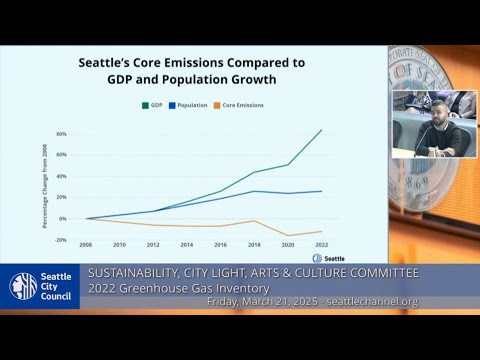
The Office of Sustainability and Environment told the council committee on March 20 that Seattle’s 2022 greenhouse gas inventory showed emissions rose about 4% from the pandemic low but remain about 12% below a 2008 baseline, with transportation making up roughly 58% of core emissions.
The Office of Sustainability and Environment (OSE) briefed the Sustainability, City Light, Arts & Culture Committee on Seattle’s 2022 greenhouse gas inventory on March 20, 2025, presenting trends, sector drivers and planned next steps for a climate action plan update.
Michelle Caulfield, interim director of the Office of Sustainability and Environment, Ani Krishnan, climate data and policy manager, and Liliana Ayala, interim deputy director, reviewed the geographic greenhouse gas inventory used to measure progress on Seattle’s targets. Ani Krishnan summarized the inventory: “In 2022, across these three key sectors, emissions ticked up around 4% after a pandemic-induced dip in 2020,” and added that 2022 emissions are about 12% lower than a 2008 baseline even as the city’s population grew by about 26% over that period.
OSE highlighted the inventory’s structure: a geographic inventory that tracks emissions within city boundaries (about 3 million metric tons of CO2e in the geographic inventory), a consumption‑based inventory (larger in scale), and departmental inventories that measure operations. Krishnan told the committee that transportation accounts for roughly 58% of core emissions, buildings roughly 40%, and waste about 2%.
The committee and OSE discussed drivers behind the 2020–2022 rebound. For transportation, OSE said the primary factor was an increase in vehicle miles traveled as people returned to work and tourism resumed, partially offset by rising electric-vehicle registrations and improved fuel efficiency. For buildings, OSE cited more-extreme weather in 2022 and higher ventilation rates as drivers that increased energy use, while energy-code improvements and slower commercial occupancy tempered growth. For waste, Seattle Public Utilities’ diversion programs reduced emissions overall, with a modest rebound tied to increased self-haul by residents.
Committee members raised questions about data latency and timeliness. Krishnan acknowledged an 18–24 month lag in some data sources and described efforts to develop leading indicators: OSE has piloted a 1Seattle Climate Portal with quarterly utility-based building data by census tract, and the department is exploring higher-frequency transportation datasets to reduce the lag in modeled travel-demand inputs.
Liliana Ayala said Mayor’s Office direction will require OSE to lead an update of the city’s climate action plan; she said the update will examine prior actions, identify gaps and seek public and interdepartmental engagement. Ayala said the inventory shows the city must accelerate reductions: “We need to be moving about 10 times faster than our average annual reduction rate so far to hit that interim target of 2030,” as Krishnan framed the gap: the city must find roughly 46% more reductions from 2022 levels to meet the 2030 goal.
Members of the public who commented during the hybrid public-comment period urged more transparency and faster action. Robin Briggs (Capitol Hill) urged “more transparency in the emissions reporting” and more accountability from elected leaders. Cynthia Irvin (District 4) asked the city to “take the lead in educating and bringing the public along.” Other commenters emphasized timely data and stronger policy measures.
OSE said some recent and pending local, state and regional investments and policies — building emissions performance standards, utility investments, transportation electrification and state Climate Commitment Act funding — are expected to contribute to future reductions, but most of those benefits are not yet reflected in the 2022 inventory. OSE committed to return with details on the climate-action-plan update and to provide more frequent indicators where feasible.