Get Full Government Meeting Transcripts, Videos, & Alerts Forever!
Get email alerts on the Water Transfers topic
No spam. Unsubscribe anytime.
Public hearing on SB 1153 spotlights competing views on tightening review of water-right transfers
Summary
A March 25 public hearing on Senate Bill 1153 addressed a proposal to add focused review of water-right transfer applications to protect in-stream habitat for sensitive species and prevent further water-quality impairment, and to create a tribal opt-in review in selected counties.
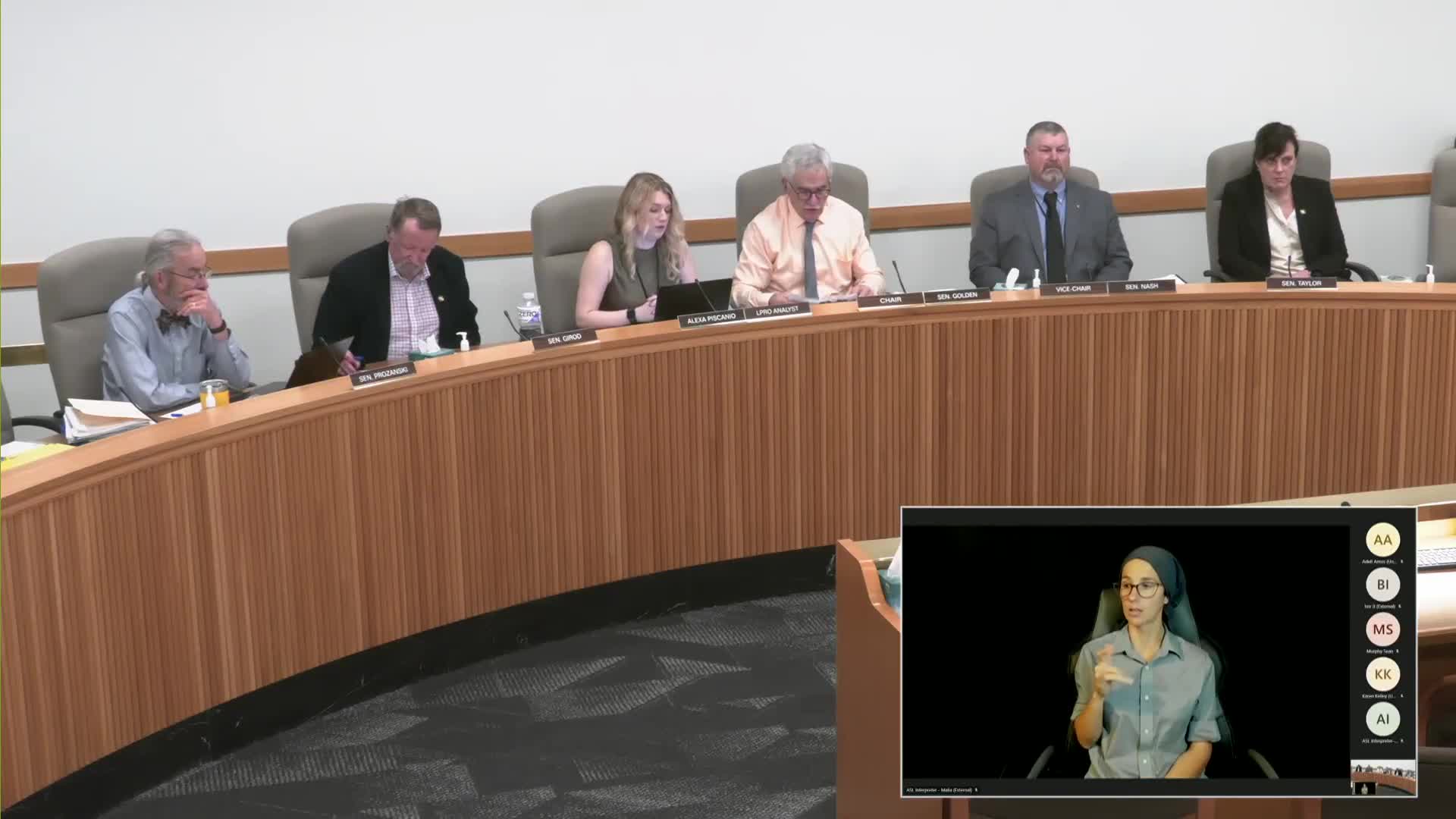
The Senate Committee on Natural Resources and Wildfire held a lengthy public hearing March 25 on Senate Bill 1153, which would add targeted review standards for certain water-right transfer applications and create a time-limited process for federally recognized tribes to opt in to review transfer applications in selected counties.
Under the measure as presented, the Oregon Water Resources Department would review whether a proposed transfer would impact in-stream habitat for "sensitive, threatened, or endangered" species or further degrade water quality compared with baseline conditions. The bill would not apply where an in-stream water right already exists, would not alter existing water rights that are not being changed, and would leave existing permitting requirements intact. The measure also clarifies the department's authority to place conditions on transfers, such as water-use measurement, fish screening, or other mitigation.
Supporters included Robert Bruno, secretary-treasurer and CEO for the Confederated Tribes of Warm Springs, who said the bill "opened essential legislative dialogue" about risks transfers pose to tribal treaty-protected fisheries and urged the committee to advance the measure to Rules. Conservation groups including Wild Salmon Center (testifying for Oregon Water Partnership) and WaterWatch of Oregon also voiced support, saying the bill fills a review gap for roughly 93–97% of Oregon stream miles that lack in-stream water rights and that injury/enlargement standards do not protect public values.
Opponents included the Oregon Water Resources Congress, the Oregon Farm Bureau, municipal water providers (Eugene Water & Electric Board, Beaverton, Joint Water Commission), the Oregon Association of Nurseries, and special-district and utility groups. Their testimony raised several concerns: the bill's language is broadly written and vague, it could duplicate or conflict with existing federal and state permitting processes (for example, Clean Water Act Section 404, Endangered Species Act consultations, DEQ and Army Corps reviews), it could expose routine transfers to contested-case hearings and litigation, and it could delay municipal resilience projects such as aquifer storage and recovery (ASR) wells. Several municipal witnesses and sector representatives urged further negotiation and a carve-out or clear language for municipal water providers.
Legal and historical context aired in testimony: speakers from the Governor's Office and the Water Resources Department recited the prior-appropriation foundation of Oregon water law, the 1955 Oregon Groundwater Act, and the 1987 Instream Water Rights Act; tribal testimony referenced the Treaty of 1855 and the Warm Springs water-rights settlement (1997) and noted unresolved treaty-protected in-stream flow rights in multiple basins. Committee members asked technical questions about scope, the definition of "impact," whether winter-season transfers would be affected, and whether municipal water rights could receive special handling; the Governor's Office said it is open to conversations and has been in talks with municipalities about possible carve-outs. The committee accepted public testimony and closed the hearing; no committee vote was recorded at this meeting.