Get Full Government Meeting Transcripts, Videos, & Alerts Forever!
Get email alerts on the Grant Management System topic
No spam. Unsubscribe anytime.
Oregon DOE to replace aging EGMS with commercial grant-management system; vendor Agate leading phased launch
Summary
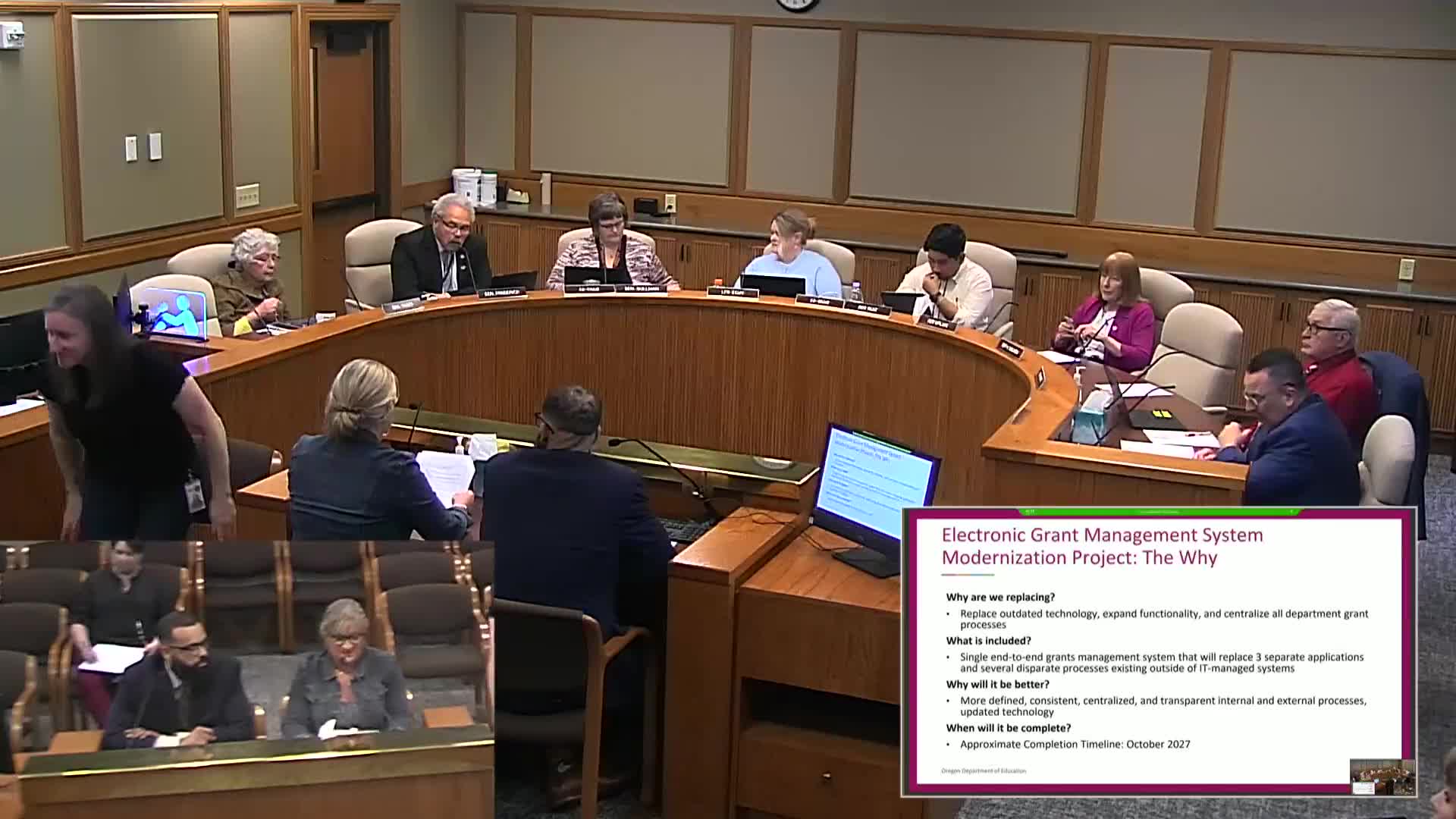
Oregon Department of Education told the Ways and Means — Education committee it will replace its outdated EGMS grant system with a commercial product from vendor Agate, begin a phased rollout this summer, and continue post‑launch enhancements through 2027 while training grantees and integrating child nutrition and budget tools.
The Oregon Department of Education plans to replace its decade‑old electronic grant management system (EGMS) with a commercial solution developed and implemented by vendor Agate, agency officials told the Joint Committee on Ways and Means — Education on March 25.
Agency officials said the replacement is intended to centralize grant intake, application, document management and payments for federal, state and private grants and to eliminate multiple point solutions now used by districts and other recipients.
“Currently, the department uses EGMS…built on an outdated Access database developed back in ’03 that lacks the necessary functionality to efficiently manage the increasing volume of grants,” Amber Forster, ODE chief financial officer, told the committee. “This new system…has the ability to attach backup documentation to submissions,” which ODE staff said will make auditing and reporting easier.
Why it matters: ODE manages hundreds of grants and dozens of subgrants; staff described operational friction from multiple systems, manual Excel workarounds and missing file attachments. The new system is intended to reduce grantee burden, speed payment workflows and centralize records for audit and reporting.
Key details and timeline
- Vendor and scope: ODE selected Agate as the vendor; the contract includes replacement of core EGMS functionality plus integrations with the SIP budget narrative application and the Child Nutrition Programs web application (CNPweb).
- Phases and schedule: Staff described a three‑phase plan. Phase 1 (grant management replacement) is set to go live in summer 2025. Phase 2 (child nutrition / CNPweb) begins development after phase 1 go‑live. Phase 3 (post‑live enhancements such as notifications, improved reporting and application features) is scheduled to start January 2026 and run through August 2027.
- Implementation work: ODE said kickoff meetings occurred in May 2024, weekly core team meetings are ongoing, and the vendor is developing forms, workflows and system integrations with ODE accounting and institutional management systems.
- Training and rollout: The agency has planned a layered training program—live sessions, recorded trainings and step‑by‑step guides—to support diverse grantee needs and to account for school calendars.
- Volume and capacity: ODE staff told the committee the fiscal grants team manages about 155 grants and roughly 45 active subgrants in the system; staff emphasized the need for a “mass upload” tool so large numbers of subgrants can be created without one‑by‑one data entry.
Questions and oversight
Legislators asked about reuse of work done for other agencies and the vendor’s prior state projects. Forster and other staff said Agate previously worked with Michigan and with the Early Learning Division while it was in ODE, and ODE has tried to incorporate lessons learned from those implementations.
“Phase 1 is replacement of the grant management system, which we’re set to go live with this summer,” Forster said. She described ongoing weekly testing and work on integrations with accounting and other internal systems.
Ending
Agency staff said they will continue weekly development work, provide training materials to grantees before the summer transition and return to the committee with requested documentation such as the third‑party assessment used to inform the procurement.