Get Full Government Meeting Transcripts, Videos, & Alerts Forever!
Get email alerts on the Va Claims Reform topic
No spam. Unsubscribe anytime.
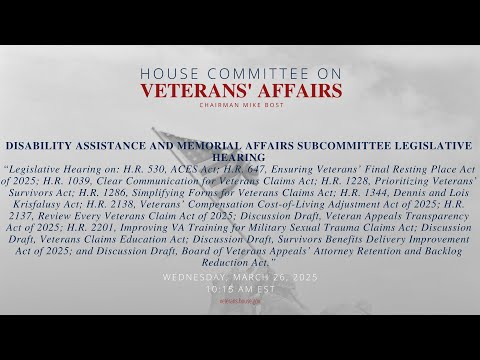
Subcommittee weighs bills to simplify VA claims: missed exams, forms, notice letters and training for military sexual trauma claims
Summary
A House Veterans Affairs subcommittee hearing considered a suite of bipartisan proposals to make VA claims and appeals easier to navigate, including measures to prevent automatic denials when veterans miss scheduled exams, to simplify veteran notice letters and forms, and to expand training and procedural safeguards for military sexual trauma (MST) claims.
A House Veterans Affairs subcommittee hearing considered a suite of bipartisan proposals to make VA claims and appeals easier to navigate, including measures to prevent automatic denials when veterans miss scheduled exams, to simplify veteran notice letters and forms, and to expand training and procedural safeguards for military sexual trauma (MST) claims.
Representative Michael Peters and other sponsors outlined several bills on the docket. The Review Every Veterans Claim Act (HR 2137) would prohibit the VA from denying a veteran's claim solely because the claimant missed a scheduled disability exam; advocates told the committee that veterans sometimes cannot attend exams for many reasons and that automatic denial forces unnecessary rework. The National Organization of Veterans' Advocates (NOVA) testified the proposal “reflects a more veteran‑centric policy” and expects the bill would prompt more comprehensive review of files using existing medical evidence.
Several members also urged VA to improve its notice letters and forms. Representative Tim Barrett told the committee, “These letters should be shorter, clearer, and more easily communicating for the veterans and their survivors,” describing notices he said can be lengthy and filled with jargon. Barrett and other sponsors proposed using an outside federally funded research entity to review and recommend revisions to forms and letters so they are more understandable.
Witnesses raised MST processing as a distinct problem. Representative Young Kim discussed HR 2201, the Improving VA Training for Military Sexual Trauma Claims Act, noting that about 1 in 3 women and 1 in 50 men experience MST as service members. Kim and witnesses said current VA sensitivity training for examiners is outdated and often limited; the bill would require annual training for VA employees and contract examiners involved with MST claims and would require the VA to automatically obtain service personnel records for veterans filing MST‑related disability claims.
VA officials told the panel they generally support the goals of these bills but requested drafting changes. In opening remarks, Kanisha Britton said VA “supports the intent” of the simplifying forms and clear communications bills while asking for flexibility and time to comply with information‑technology and legal requirements. The department also said it supports the Review Every Veterans Claim Act but suggested expanding the language to include pension claims and to ensure comprehensive review of all evidence in a claims file.
Other bills briefly noted in opening comments included the Veterans Compensation Cost of Living Adjustment Act (would tie certain VA benefit increases to Social Security cost‑of‑living adjustments) and the Veterans Claims Education Act (proposals to help veterans avoid unaccredited “claim sharks” by providing clearer information on accredited representation). Advocates including NOVA told the committee they support those proposals and urged the committee to consider technical improvements, such as allowing VA to accept an incorrect form as an intent‑to‑file when the claimant’s intent is clear.
What’s next: VA and witnesses agreed to continue working with the committee to refine bill text, align training and contractor obligations with current practice and to ensure reforms do not create unintended administrative burdens that slow claims processing.