Get Full Government Meeting Transcripts, Videos, & Alerts Forever!
St. Pete Beach planning board debates broad sign-code rewrite, flags mural, hotel-sign and storm-recovery questions
Summary
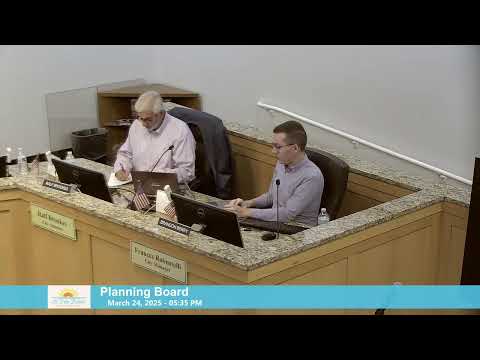
The St. Pete Beach Planning Board on Jan. 27 reviewed a draft update to the city’s sign ordinance (Ordinance 2025‑10), focusing on electronic signs, murals that include words, hotel‑façade signage and how the code should treat signs on buildings damaged by storms.
The St. Pete Beach Planning Board on Jan. 27 reviewed a draft update to the city’s sign ordinance (Ordinance 2025‑10), a consolidation and modernization of Division 26 of the Land Development Code that would change how the city regulates permanent and temporary signs, electronic displays, murals and certain waterfront and resort signage.
Philip DeMaria, a certified planner with Kimley‑Horn, described the draft as intended to “promote high quality signage” and to simplify and consolidate 15 zoning‑district sign rules into a smaller set of standardized charts. DeMaria said the update aims to balance “quality of life and organization” and to ensure the code complies with U.S. Supreme Court precedent such as Reed v. Town of Gilbert.
The board’s review focused on several areas that emerged repeatedly in public and board feedback: standards for electronic/LED displays, how to treat artwork or murals that include words, height and placement limits for signs on large resort hotels, temporary signs and banners (including sandwich boards), and how the ordinance should treat signs on buildings damaged in storms.
DeMaria told the board the draft preserves an existing deadline for electronic signs to conform by Jan. 1, 2027, and carries forward size and siting limits: electronic displays proposed for nonresidential properties along Gulf Boulevard would be limited to no more than 32 square feet of message area and could not exceed 50% of a freestanding sign’s area. The draft also includes technical controls for legibility and nuisance: a brightness cap (no more than 0.3 foot‑candles above ambient measured at 50 feet) and a requirement that messages remain static for at least one minute.
Board members probed the ordinance’s treatment of murals and artwork that include words or place names. Member Terry said she worried a broad “artwork” definition could be used to bypass sign rules: “I…
Already have an account? Log in
Subscribe to keep reading
Unlock the rest of this article — and every article on Citizen Portal.
- Unlimited articles
- AI-powered breakdowns of topics, speakers, decisions, and budgets
- Instant alerts when your location has a new meeting
- Follow topics and more locations
- 1,000 AI Insights / month, plus AI Chat