Get Full Government Meeting Transcripts, Videos, & Alerts Forever!
Get email alerts on the Sign Ordinance topic
No spam. Unsubscribe anytime.
St. Pete Beach planning board debates broad sign-code rewrite, flags mural, hotel-sign and storm-recovery questions
Summary
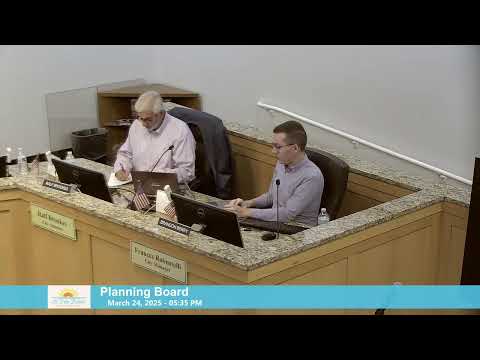
The St. Pete Beach Planning Board on Jan. 27 reviewed a draft update to the city’s sign ordinance (Ordinance 2025‑10), focusing on electronic signs, murals that include words, hotel‑façade signage and how the code should treat signs on buildings damaged by storms.
The St. Pete Beach Planning Board on Jan. 27 reviewed a draft update to the city’s sign ordinance (Ordinance 2025‑10), a consolidation and modernization of Division 26 of the Land Development Code that would change how the city regulates permanent and temporary signs, electronic displays, murals and certain waterfront and resort signage.
Philip DeMaria, a certified planner with Kimley‑Horn, described the draft as intended to “promote high quality signage” and to simplify and consolidate 15 zoning‑district sign rules into a smaller set of standardized charts. DeMaria said the update aims to balance “quality of life and organization” and to ensure the code complies with U.S. Supreme Court precedent such as Reed v. Town of Gilbert.
The board’s review focused on several areas that emerged repeatedly in public and board feedback: standards for electronic/LED displays, how to treat artwork or murals that include words, height and placement limits for signs on large resort hotels, temporary signs and banners (including sandwich boards), and how the ordinance should treat signs on buildings damaged in storms.
DeMaria told the board the draft preserves an existing deadline for electronic signs to conform by Jan. 1, 2027, and carries forward size and siting limits: electronic displays proposed for nonresidential properties along Gulf Boulevard would be limited to no more than 32 square feet of message area and could not exceed 50% of a freestanding sign’s area. The draft also includes technical controls for legibility and nuisance: a brightness cap (no more than 0.3 foot‑candles above ambient measured at 50 feet) and a requirement that messages remain static for at least one minute.
Board members probed the ordinance’s treatment of murals and artwork that include words or place names. Member Terry said she worried a broad “artwork” definition could be used to bypass sign rules: “I don’t wanna see something get passed that anybody can write whatever words they want and call it artwork, and it’s really not artwork,” she said. The City Attorney warned that any test that requires an official to read wording to decide whether a wall graphic is “art” would be content‑based and unconstitutional under Reed: “If you have to read the words to determine whether it’s in compliance or not ... that would be content based, and that would be unconstitutional,” the City Attorney said.
Members discussed a recent example shown in the presentation — a painted wall that reads “Saint Pete Beach.” Some members called it a mural or public art; others said it functions like a billboard and undermines the ordinance’s stated goal to “complement natural surroundings.” The board asked staff to consider artwork‑specific criteria or an art‑review path that does not run afoul of content‑neutrality principles.
Hotel and resort signage drew detailed scrutiny. Board members asked whether rooftop or high‑level façade signage on large hotels (for example, signs visible at the fifth floor on a new Hilton Garden hotel highlighted in the meeting) would be allowed under the draft. Staff confirmed that, as written for several districts, signs “shall not appear above the second floor” or must remain below the roof line in certain zones; members asked staff to clarify whether that restriction should apply across districts or be limited to specified zoning categories. Several members favored keeping prominent signage below the roof line rather than above a second‑story line.
Temporary signage, window signs and sandwich boards also prompted substantive comments. The draft permits limited temporary and window signage but counts permanent window signage toward the property’s maximum attached sign area; it allows one temporary sign on residential properties at up to 3 square feet and larger temporary signs on nonresidential properties (example limits were discussed in the draft). Board members asked for clearer cross‑references and for consistency with the city’s beach and turtle‑lighting rules. Staff said waterfront businesses would retain a narrow allowance for one water‑facing sign.
A major practical concern from multiple board members was how enforcement of abandonment and repair rules would affect businesses recovering from storms. The draft reduces the threshold that triggers mandatory repair or replacement for damaged nonconforming signs (the proposal lowers one repair threshold to 25% of replacement cost for “severe damage” and retains a 50% building‑improvement trigger). Several members asked for explicit exemptions tied to documented storm recovery — for example, waivers when a local state of emergency is declared or when a property holds an active restoration building permit — so businesses working through permits, FEMA or SBA processes would not be forced into immediate sign removals.
Small business impact and timing were recurring themes. Members noted that sign engineering and replacement can be costly and expressed concern about accelerating amortization while small businesses are still recovering. The board asked staff to consider transitional allowances such as secured, fixed banners attached to facades — not loose “wind signs” — during restoration or while permanent permits are pending. Staff said the city already allows limited banner use for grand openings and proposed to return with clearer language for temporary, secured banners tied to either restoration permits or short transitional periods.
The board also asked staff to: tighten references (for example, use “mean high water line” rather than “water’s edge” for waterfront setbacks); clarify how linear street frontage is measured for sign area calculations; confirm that flagpoles and flags that convey commercial messages count against freestanding sign area; add sea‑turtle lighting and wildlife protection language to the ordinance’s purpose; and ensure the Pass‑a‑Grille / historic overlay areas are explicitly referenced so future design standards can be layered in.
Brandon (city planning staff) and the consultant summarized the board’s direction at the end of the discussion and said staff would redraft the ordinance language to reflect the board’s feedback and bring the item back for further review. The meeting also included routine procedural votes earlier in the agenda: the board approved the meeting agenda and approved the minutes from Jan. 27, and the board voted to keep the current officers (Chair Hubbard and Vice Chair Angelides) for the 2025–26 cycle.
The Planning Board asked staff to produce a revised draft that addresses artwork criteria without running into content‑neutrality issues, clarifies height/roof‑line limits by district, tightens storm‑recovery and abandonment language, and adds cross‑references to beach and lighting protections. Staff said they will return with the revisions and continue outreach, including upcoming public workshops on Large Resort and Town Center zoning in April and May.
Votes at a glance - Motion to approve the agenda as submitted — Mover: Member Ray; Outcome: approved (5–0 roll call). - Motion to approve minutes of Jan. 27 as corrected — Mover: Member Ray; Outcome: approved (5–0 roll call). - Motion to maintain current officers (Chair Hubbard, Vice Chair Angelides) for 2025–26 — Mover: Member Ray; Outcome: approved (5–0 roll call).
What’s next Staff will return with a revised version of Ordinance 2025‑10 that incorporates the board’s clarifications on murals/artwork, resort‑district sign heights and storm‑recovery exemptions; the board and staff also noted upcoming public meetings on district zoning in April and May.