Get AI Briefings, Transcripts & Alerts on Local & National Government Meetings — Forever.
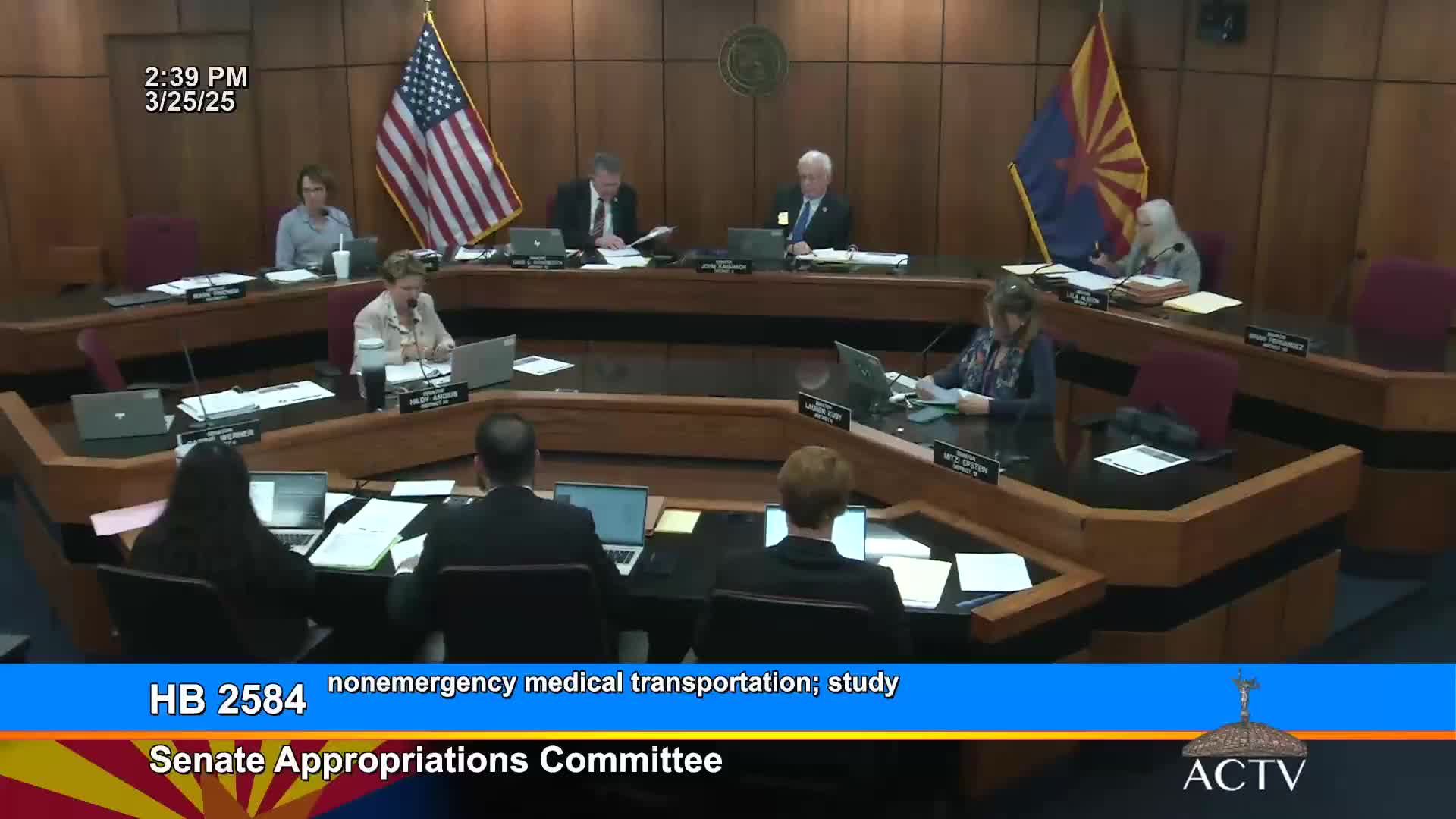
Senate panel backs study of nonemergency medical-transport reimbursement funded by industry
Loading...
Summary
The committee approved House Bill 2584 to let the Arizona Health Care Cost Containment System receive industry funds for an independent study of nonemergency medical transport (NEMT) reimbursement rates; the study would be funded by providers and not the general fund, a point that drew at least one dissenting vote.
The Arizona Senate Appropriations Committee gave House Bill 2584 a due-pass recommendation to authorize the Arizona Health Care Cost Containment System (AHCCCS/ACCESS) to accept funds from nonemergency medical transport (NEMT) providers to contract for an independent reimbursement-rate study.
Sponsor testimony described the study’s purpose: to examine the adequacy of current reimbursement rates for medically necessary nonemergency transportation and to compare provider costs in rural and urban settings. The bill directs that, if sufficient funds are raised from providers, AHCCCS may contract with a consultant to complete the study within one year and submit results to the Joint Legislative Budget Committee (JLBC). The sponsor said there is no general-fund cost; industry actors will provide the money.
Brandy Petrone (testimony identified her as representing MTM/Medical Transport Management via a public affairs firm) told the committee many NEMT categories have not received rate increases in 15 years and said current rates fall well short of national averages. She said the average ambulatory trip is about 7 miles and Arizona’s ambulatory reimbursement of about $15.50 is well below a $36 national average.
Senator Epstein asked whether it was appropriate for the industry that stands to benefit to fund the study; Epstein voted against the bill, saying the funding arrangement risks skewed results. The committee recorded 6 ayes, 2 nays and 2 not voting and gave the bill a due-pass recommendation.
Ending: The committee’s action sends the study authority to the full Senate. If AHCCCS receives industry funds and the study proceeds, agencies and JLBC will receive the consultant’s findings; AHCCCS must include study results in its next capitation-rate filing or explain differences to JLBC.