Get Full Government Meeting Transcripts, Videos, & Alerts Forever!
Get email alerts on the School Discipline topic
No spam. Unsubscribe anytime.
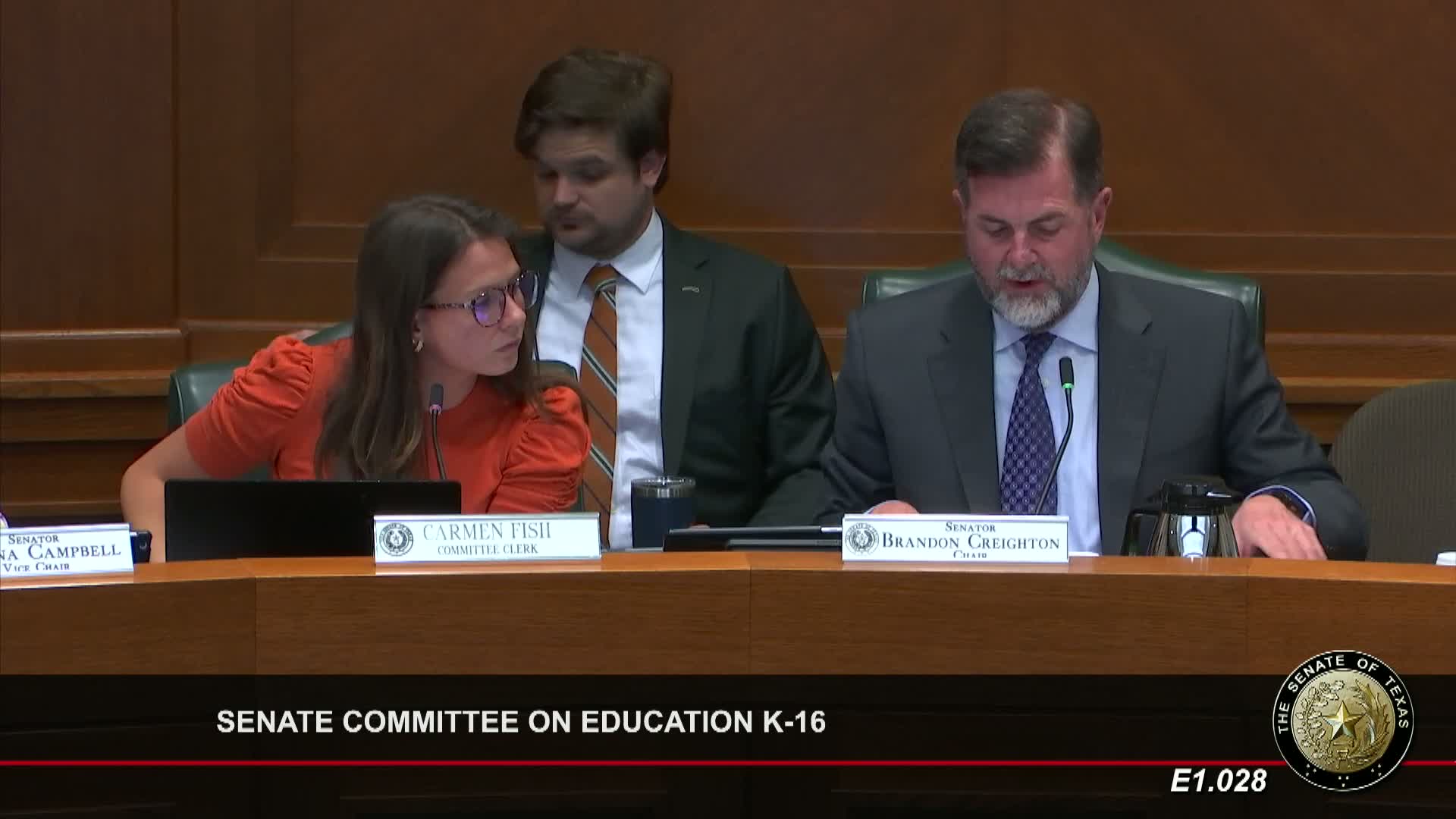
Senate education committee advances broad school-discipline package; substitutes adopted for three bills
Summary
A state Senate Committee on Education hearing Tuesday advanced a package of bills aimed at tightening school-discipline rules and expanding tools available to educators and district leaders.
A state Senate Committee on Education hearing Tuesday advanced a package of bills aimed at tightening school-discipline rules and expanding tools available to educators and district leaders.
The committee laid out a set of related measures — Senate Bills 18-71, 18-72, 18-73, 18-74 and 19-24 — and adopted committee substitutes for three of them (SB 18-71, SB 18-72 and SB 19-24) by unanimous voice or no-objection processes, sponsors and witnesses said. Senator Charles Perry introduced the discipline package and described it as a coordinated set of changes to chapter 37 of the education code and other disciplinary practices.
Why it matters: Sponsors and district officials said the measures aim to restore local authority to remove violent or persistently disruptive students from classrooms, enlarge options for placements and telehealth mental-health services, and protect teachers who follow state discipline law from retaliation. Supporters said the changes respond to increased classroom violence and disruptions that they say are driving teacher attrition and harming student learning.
Perry, the bill sponsor, said the package is intended to “holistically review how we address school discipline in our schools.” He told the committee, “If a kid hits a teacher, you get removed from a class,” and said the measures aim to keep both teachers and other students safe while preserving educational opportunities for students who are removed from a classroom.
What the bills would do (as explained at the hearing): - SB 18-71 (committee substitute adopted): Broad discipline reforms, including restoring or clarifying mandatory placement to juvenile alternative placements for assaultive behavior toward school employees, allowing districts to use virtual disciplinary settings, and specifying teacher protections and return-to-class procedures. The substitute changed some “shall” requirements to “may” for certain disruptive-activity placements. - SB 18-72 (committee substitute adopted): Clarifies that a student who assaults a teacher or school volunteer is to be expelled to a juvenile alternative placement (JJEP) and extends mandatory-expulsion eligibility for certain serious offenses to conduct occurring off campus. The substitute made a drafting fix and otherwise preserved the substantive change. - SB 18-73: Restores prior practice on in-school suspension by removing a TEA-imposed limit that had been read to cap in-school suspensions at three days; the bill would again allow districts to set in-school suspension length without the three-day cap. - SB 18-74: Provides immunity from disciplinary proceedings for teachers who report violations or act in compliance with chapter 37 discipline provisions. - SB 19-24 (committee substitute adopted): Restores authority for local law enforcement and campus police to issue Class C misdemeanor citations for certain school offenses and requires criminal referral when a student poses an imminent threat or assaults a teacher; the substitute clarifies that a district need not make a criminal referral if it has already issued a citation for the offense.
Committee action: Committee substitutes for SB 18-71, SB 18-72 and SB 19-24 were presented and adopted without recorded objection. The transcript records the clerk reading the motions and members indicating no objection; formal roll-call votes were not recorded in the hearing transcript. SB 18-73 and SB 18-74 were laid out and discussed but the hearing record does not show final committee action for those bills during the session.
Testimony and local control concerns: Invited witnesses included attorneys and superintendents who described classroom incidents and urged additional tools and resources. Caitlin Dixon Smith, an attorney with the Texas Classroom Teachers Association, described classroom episodes she experienced as a kindergarten teacher and said the bill gives teachers discretion to remove “unruly, disruptive, and or violent students.” Christopher Moran, superintendent of San Angelo ISD and president-elect of the Texas Association of School Administrators, said he supports some provisions (expanded DAEP/JJEP placement authority, telehealth consortium for mental health) but urged preserving local flexibility and protections for teachers and clearer timelines for return-to-class plans. Kirby Basham, superintendent of Grandview ISD, said rural and urban districts both need options and said the telehealth provisions and removal tools are important to keep classrooms safe.
Key points of debate at the hearing: Committee members repeatedly raised questions about standards and process, including: - How to define “engages in conduct” and what level of evidence administrators must consider before removing a student from class (sponsors said reasonable suspicion and arrests can be indicators; senators pressed for clearer procedural guardrails). - How return-to-class plans would be prepared and whether a single campus behavior coordinator is sufficient on large campuses (witnesses urged flexibility to designate more than one coordinator and use district-of-innovation processes where appropriate). - Concerns about past practices (complaints about children being arrested or publicly cited on campus) and a desire to avoid recreating those negative practices while restoring tools for serious offenses.
What sponsors and witnesses said about safeguards: Several witnesses and senators emphasized they want protocols to limit arrests or public citations in classrooms and want clear, local procedures for when citations or criminal referrals are appropriate. Senator Creighton and other sponsors said they would work with superintendents and other stakeholders to refine language and protocols to avoid unintended consequences.
Next steps: The bills remain under committee consideration; substitutes for three measures were adopted at the hearing and the committee indicated it would continue stakeholder discussions before the measures reach the floor. Several sponsors asked districts to provide staff input and to meet with bill offices for follow-up drafting and operational questions.
Ending note: Senators and witnesses framed the package as an attempt to balance classroom safety, teacher retention and students’ continued access to instruction. Several witnesses asked the committee to couple any statutory changes with clear training, resourcing and local implementation guidance so districts can apply new authorities consistently.