Get Full Government Meeting Transcripts, Videos, & Alerts Forever!
Get email alerts on the Human Smuggling topic
No spam. Unsubscribe anytime.
Prosecutors seek wider tools to fight human smuggling through parks; civil-rights groups urge limits
Summary
Prosecutors told the Committee on Criminal Justice that expanding criminal penalties to cover parks and natural areas would help curb human smuggling and reduce deaths; civil-rights groups warned the language lacks an intent element and could criminalize innocent conduct in public spaces.
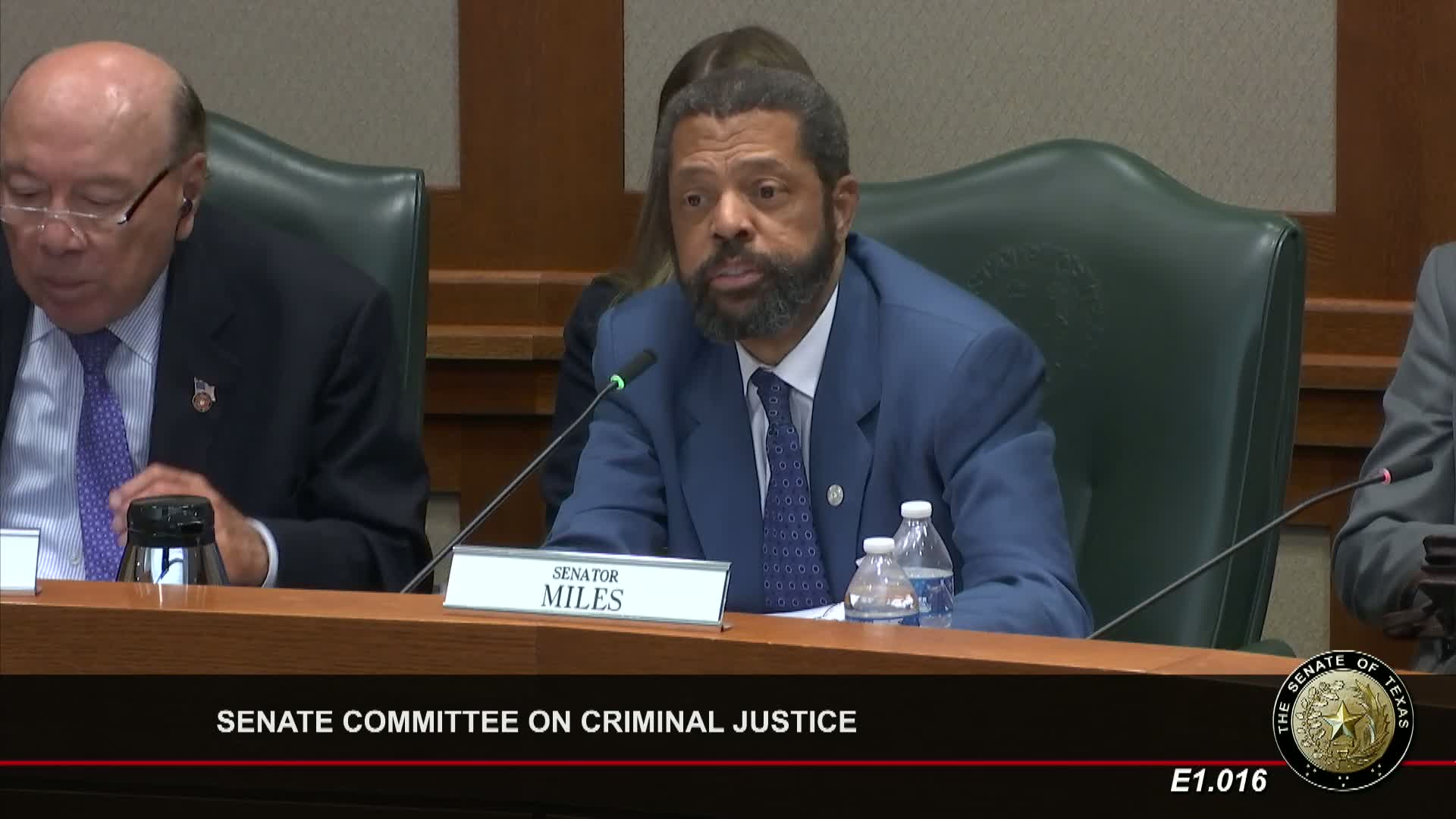
Prosecutors and local law-enforcement officials urged the Senate Committee on Criminal Justice to expand existing anti-smuggling law to include parks, natural areas and cultural-resource sites, saying criminal organizations use those locations to move people across the state and that tougher penalties would protect both migrants and residents.
Fayette County District Attorney John Hubert said large parks and remote public lands have been used by transnational criminal organizations to move people, sometimes leaving them in dangerous conditions. "Every tool y'all give us helps us chip away at the human smuggling issue," Hubert said, recounting past recoveries of people and remains in remote areas.
The committee heard competing testimony from civil-rights groups that said the statute the bill would amend already reaches too broadly and lacks a required criminal-intent element. Nick Hudson of the ACLU of Texas said the statute imposes a mandatory 10-year penalty for "assisting, guiding or directing two or more individuals" onto certain lands, and that the bill’s expansion to parks could sweep in conduct unrelated to smuggling. "Someone could be charged with an offense across the state with a 10-year mandatory minimum sentence for something more akin to a criminal trespass offense," Hudson warned.
Danny Woodward of the Texas Civil Rights Project urged repeal or, at minimum, the addition of an intent requirement so prosecutions would be limited to people who knowingly facilitate smuggling for financial gain or similar criminal purposes.
Prosecutors countered that existing statutory language does require proof that the actor acted intentionally or knowingly and that prosecutorial discretion and jury review operate as checks. Hubert said the statute had demonstrable effects in reducing trespass and the number of bodies found on ranchland after prior amendments raising penalties.
The committee did not vote on the bill during the hearing; later in the session the committee reported the measure to the full Senate with a favorable recommendation and recorded a committee roll-call tally of six ayes and zero nays.
The debate highlighted a split between front-line prosecutors seeking sharper criminal tools to disrupt organized-smuggling operations and civil-rights advocates concerned about overbroad criminal exposure for people in public parks and other open spaces.