Get Full Government Meeting Transcripts, Videos, & Alerts Forever!
Get email alerts on the State Legislation topic
No spam. Unsubscribe anytime.
House minority caucus reviews blue-sheet bills, leaves dozens on consent and pulls several for further review
Summary
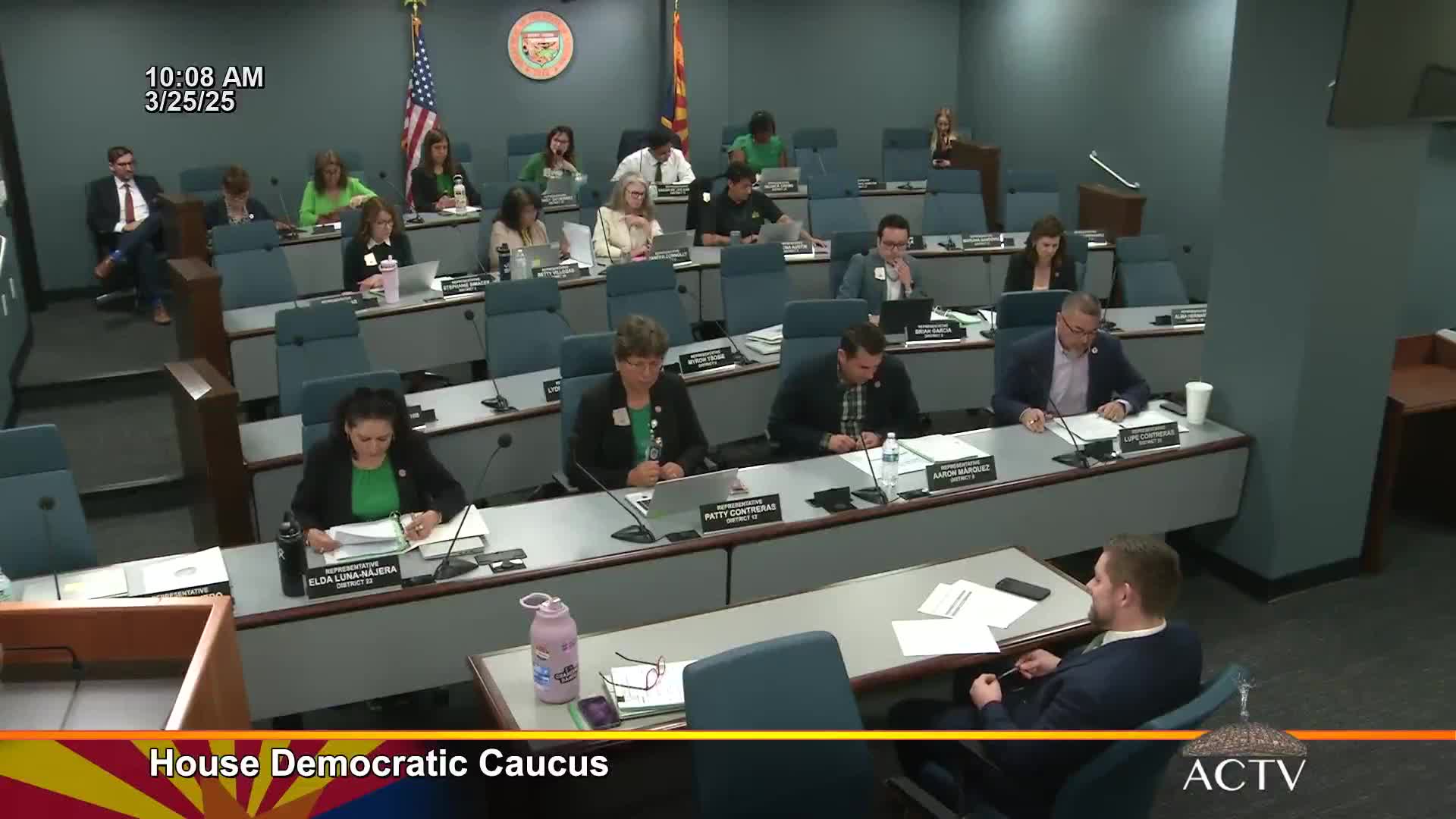
Arizona House Minority Caucus members met in caucus to review a set of "blue sheet" items and a long consent calendar of Senate and House bills scheduled for the floor. Presenters summarized bill changes and numerous items were left on the consent calendar; several were pulled for additional review or comment.
Members of the Arizona House Minority Caucus met in caucus to review bills returning to the House after Senate amendment and a lengthy consent calendar of bills the Senate sent back for final consideration.
Staff and members walked through the three blue-sheet (Senate-amended) House bills on the caucus blue-sheet agenda: HB 2345 (escrow use of loan monies), HB 2484 (school policies on student wireless devices and exceptions for medical needs), and HB 2390 (electronic nomination petition signatures for justice of the peace and constable candidates). Presenters told members the sponsors intend to concur with the Senate changes on those items.
Beyond the blue-sheet items, caucus members heard short summaries of scores of Senate bills and strike-everything amendments placed on the consent calendar or on final passage. Many items drew limited discussion; presenters repeatedly described bills as "on consent." Where members raised concerns, they sought to pull bills from consent for fuller debate on the floor.
Notable substantive points discussed in caucus: - HB 2345 (escrow): presenters said the House-passed bill would require an escrow agent to use monies in an escrow account only to make payments under the loan agreement, and the Senate amendment added a statement of legislative intent. The sponsor reportedly intends to concur.
- HB 2484 (school wireless devices): as passed by the House the bill required districts and charter schools to adopt policies limiting student use of wireless devices; the Senate amendment added medical exemptions, requirements to provide parents/teachers/students copies of policies and notice of changes, and an implementation clause. One member stated she would vote no in caucus, calling the measure an overreach and asserting that such decisions should remain local control.
- HB 2390 (electronic signatures for nomination petitions): presenters said the bill would require the secretary of state to provide a secure, internet-accessible system for qualified electors to sign nomination petitions for justice of the peace candidates and (by Senate amendment) constables; the sponsor reportedly intends to concur.
- SNAP verification (SB 10 71): staff summarized a Senate amendment directing the Department of Economic Security to use Department of Revenue data and EBT purchase histories to identify questionable SNAP eligibility. The presenter cited a fiscal impact summarized in caucus materials of $6,600,000 ongoing and $1,400,000 one-time for DES. Ranking members urged a no vote and suggested pulling the bill from consent.
- Immigration information from county detention centers (SB 16 10): presenters described language requiring county detention centers to transmit certain arrested persons' personal information to ICE daily. Members noted heated debate in committee and several asked to pull the bill from consent for additional review.
- Bills on consent that caucus members specifically pulled or asked to pull included: SCM 1002 (a resolution urging the U.S. president and Congress on transportation policy), SB 14 67 (liquor consumption on watercraft), SB 10 25 (authorization for public funds to invest in virtual currency), SB 13 73 (digital asset strategic reserve fund), and several election-adjacent bills (for example, changes to ballot-paper or voting-center rules). Presenters also noted multiple bills were described as party-line votes in the Senate.
Caucus procedure and next steps Caucus staff walked members through how to read the blue sheets (Senate amendments to House-passed bills) and explained that if the sponsor concurs in the Senate amendment, the House will vote on final passage later the same day on the floor. If the sponsor refuses to concur, the bill can die or proceed to conference committee.
Members were told staff would explain floor effects and that items left on consent in caucus could still be pulled on the floor. Several members said they would seek to pull bills they opposed or to obtain amendments before final House action.
Votes at a glance (caucus status during review) - HB 2345 — escrow/loan monies: sponsor intends to concur; caucus review only. - HB 2484 — school wireless-device policies: Senate amendment adds medical exemptions and notice requirements; at least one caucus member announced a no; caucus did not take a final floor vote in this meeting. - HB 2390 — electronic petition signatures for JPs and constables: sponsor intends to concur; caucus review only. - SB 10 71 — SNAP verification/data matches: on third-read consent; fiscal note cited at $6.6M ongoing and $1.4M one-time; ranking members urged a no and recommended pulling from consent. - SB 16 10 — county detention centers and ICE data: on consent calendar; members requested to pull for further review after heated committee debate. - SCM 1002 — resolution urging federal action on Vision Zero/safe-systems: pulled from consent by Representative P. Contreras for further consideration. - SB 10 25 — public monies/virtual currency investments (authorizes up to 10%): on consent; members asked to pull and requested more detail on types of virtual currency. - SB 13 73 — digital assets strategic reserve fund: on consent; members asked to pull to reconcile with other digital-asset bills and AG/committee input. - SB 14 67 — liquor consumption on watercraft (Series 5 licenses): requested pulled from consent by Representative Sandoval. - Multiple other bills on health licensing, pharmacy authority, behavioral health facility reporting, education and credentialing, water policy and groundwater certificates, and court and victim rights were reviewed in brief; many remained on the consent calendar absent a caucus request to pull them.
What caucus members asked for or flagged Members repeatedly asked for clarifications on implementation timelines, fiscal impacts, and whether a bill was mandatory or permissive for local entities. Specific clarifications during caucus included whether school-board authority would be preempted by HB 2484's standards (members arguing for local control), whether pharmacists authorized to testing/treat (SB 12 14) would be required to carry liability coverage, and whether property-tax-related changes would leave seniors protected (members sought assessor office confirmation and possible amendments).
The caucus adjourned after brief announcements and scheduling; staff reminded members that bills on the blue-sheet and consent calendars would appear on the floor later the same day and that members could still pull items for debate at that time.
Ending note Caucus materials and staff summaries were relied on in caucus for fiscal numbers and bill text changes; several members left items on the consent calendar while asking staff to prepare further detail for possible floor pulls or amendments.