Get Full Government Meeting Transcripts, Videos, & Alerts Forever!
Get email alerts on the Surety Management Highfield Commons topic
No spam. Unsubscribe anytime.
Planning board reviews surety spreadsheet and ongoing Highfield Commons compliance issues
Summary
Staff updated the planning board on monthly surety and inspection fee spreadsheets, the process for handling expired or unnecessary sureties, and the complex, multi-phase status of the Highfield Commons planned unit development (PUD).
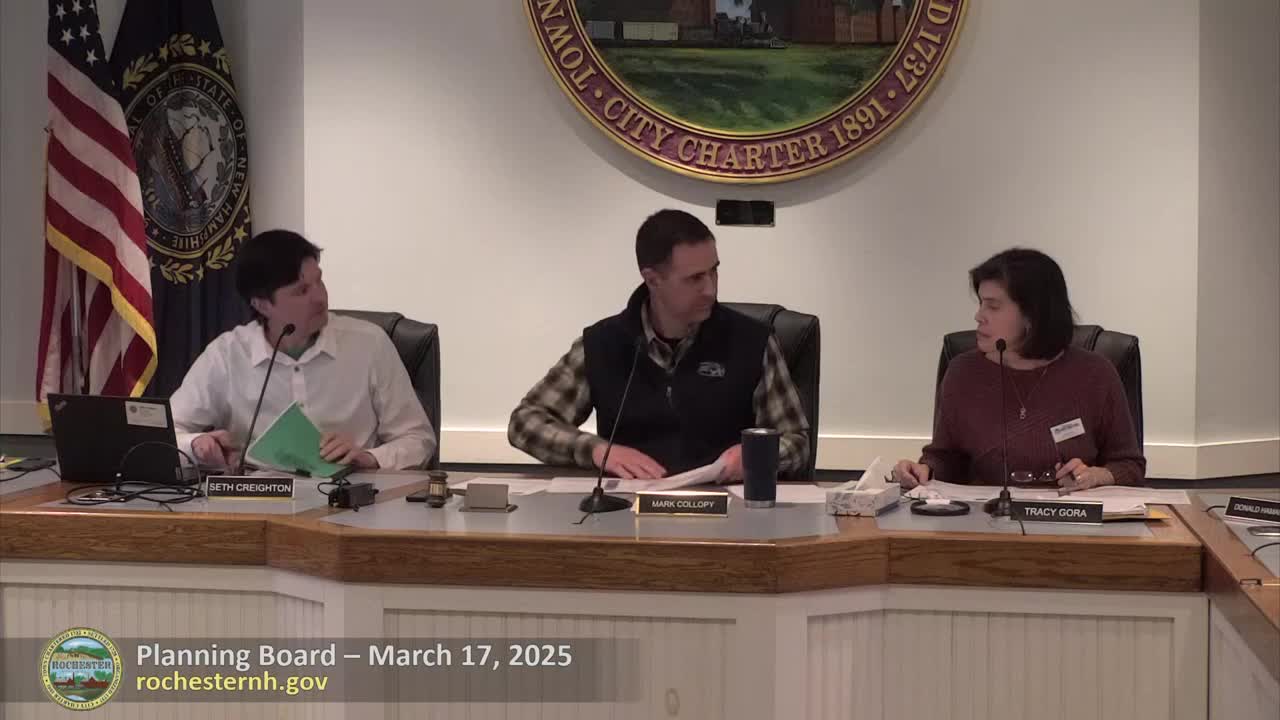
Planning Department staff updated the Rochester Planning Board on March 17 about the city’s monthly surety spreadsheet and the department’s ongoing effort to reconcile expired, unnecessary or missing surety instruments for active and legacy projects.
Staff explained the city holds surety — typically a letter of credit, bond or cash — to guarantee completion or stabilization of public infrastructure such as roads, drainage and landscaping when developers do not finish required work. The regulations call for annual surety review, staff said, and costs and project status may change over the life of a development. “Surety is to be reviewed once a year,” staff said, adding that costs fluctuate and the city works with public works, legal and finance staff to determine appropriate surety amounts.
Board members asked whether expired surety instruments present a risk to the city. Planning Department staff said that when a surety expires and the project remains active, staff contact the developer to reissue a bond or letter of credit; when developers cannot be reached or LLCs dissolve, staff seek legal advice and coordinate with finance and the issuing bank. Staff noted some entries on the spreadsheet date back 15 years.
Highfield Commons (sometimes discussed as Highfields), a multi-phase planned unit development, drew specific questions. Planning Department staff described a complex history of phased approvals, multiple developers and overlapping infrastructure that ties phases together (shared access and services). The current property owner, who purchased the development within the past year, has been in frequent contact with staff and is attempting to bring phases back into compliance, staff said. The owner has proposed posting one large surety to cover the whole development, and staff said they are evaluating whether that approach is permissible because approvals and suretys were granted per phase.
Staff warned that permits cannot be issued for phases that lack required surety. The city retains the right, in a public-safety emergency, to step in and perform work and then place a lien on the property if the owner does not remedy a threat or failure, staff said, but acknowledged that outcome would be undesirable and legally and administratively complex.
No formal action was required or taken by the planning board on the surety spreadsheet that night; staff said they will continue outreach to applicants and developers to resolve expired instruments, release sureties where appropriate and update cost estimates for at-risk projects.