Get Full Government Meeting Transcripts, Videos, & Alerts Forever!
Get email alerts on the Capital Improvements Plan topic
No spam. Unsubscribe anytime.
Rochester planning board backs proposed 2026 capital improvements plan for manager review
Summary
The Rochester Planning Board reviewed the proposed 2026 Capital Improvements Plan, discussed priorities including water and sewer mandates, IT security, sidewalks and library HVAC, and voted to forward a recommendation to the city manager for budget consideration.
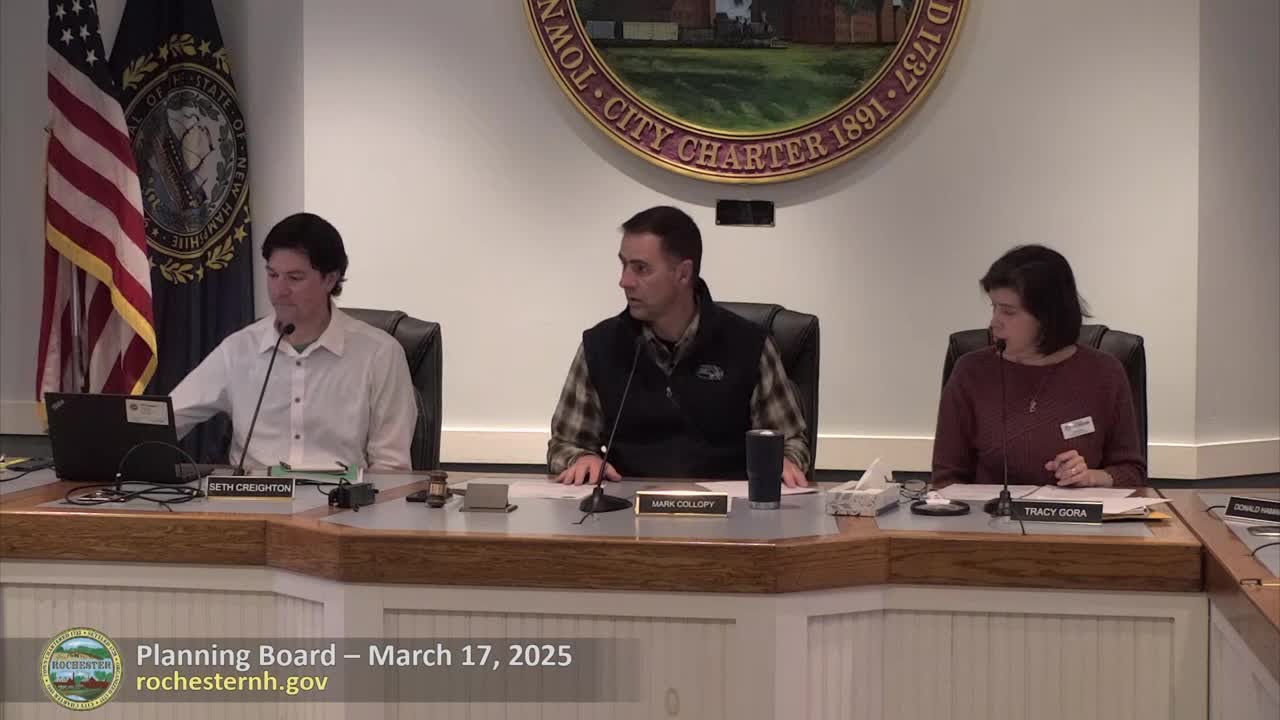
The Rochester Planning Board on March 17 reviewed the proposed 2026 Capital Improvements Plan and voted to forward the plan, with the board's comments, to the city manager for inclusion in the upcoming budget process. The motion was made by Peter Bruckner and seconded by Councilor Don Hammond; members vocalized “aye” and the motion carried.
The board’s review summarized a new scoring process used this year by the Capital Improvements Program (CIP) committee, which classified projects into four priority tiers: A (essential), B (necessary), C (desirable) and D (not a CIP project). Planning Department staff told the board the new process condensed a previously time-consuming matrix of nine criteria into a single-day scoring event, producing a ranked “capital improvements book” of roughly 100 pages with project descriptions, rough cost estimates and CIP grades.
The nut of the discussion centered on projects the CIP committee rated highest. Planning Department staff and committee members said mandated water and sewer work and certain environmental compliance items were essentially automatic A priorities because state and federal requirements apply. Councilor Don Hammond noted that “for the MS4 stuff and, sewage treatment plant and things that we have to do whether we like it or not,” those items receive top priority. Other recurring priorities raised by board members included IT infrastructure and security upgrades, pedestrian and sidewalk improvements and a library HVAC replacement.
Board members pressed for clarity on cost estimates and the scoring output. Peter Bruckner, Planning Board member, suggested a concise table listing totals for all A projects, all B projects, etc., to help city council decision-making: “It would be very useful to have that kind of a tabulation.” James Hayden asked how pavement rehabilitation estimates are derived; Public Works staff said the city conducted a pavement condition assessment in 2021 and maintains about 149 miles of paved roads, using a laser assessment program to prioritize keeping better roads in good condition rather than rebuilding every failing road.
Several board members said IT security remains a high priority after past infrastructure failures. Allison Burridge, Planning Board member, called attention to the library HVAC replacement, noting the library’s role as a cooling and warming center for low-income residents and people without housing.
Planning Department staff outlined the next steps: the planning board may propose a different rank but generally provides an advisory recommendation; the city manager will then work with the finance department and department heads to propose a budget; and finally the city council will adopt, amend or reject items during budget hearings. Planning Department staff advised that mandatory items will appear in the manager’s recommended budget and other projects will appear either in the manager’s book or in a separate “Issues and Options” list for council consideration.
Votes at a glance: the board also approved the minutes of the March 3, 2025 meeting earlier in the session. For the CIP motion, the board recorded a motion by Peter Bruckner, second by Councilor Don Hammond; members voted in favor and the motion carried. The meeting record does not show a named roll-call tally for either vote.
Board members agreed the revised CIP scoring session — a single-day review of department submissions — worked better than the prior multi-night process and will now inform the manager’s budget decisions.