Get Full Government Meeting Transcripts, Videos, & Alerts Forever!
Get email alerts on the Aviation Training topic
No spam. Unsubscribe anytime.
Veterans and volunteers urge expansion of youth aviation, drone training at Detroit City Airport
Summary
During the Detroit City Council public-comment period, veterans and airport tenants described existing aviation training and announced drone classes and a Tuskegee Airmen kiosk funded by tenants; speakers also raised stormwater drainage and infrastructure concerns at the airport.
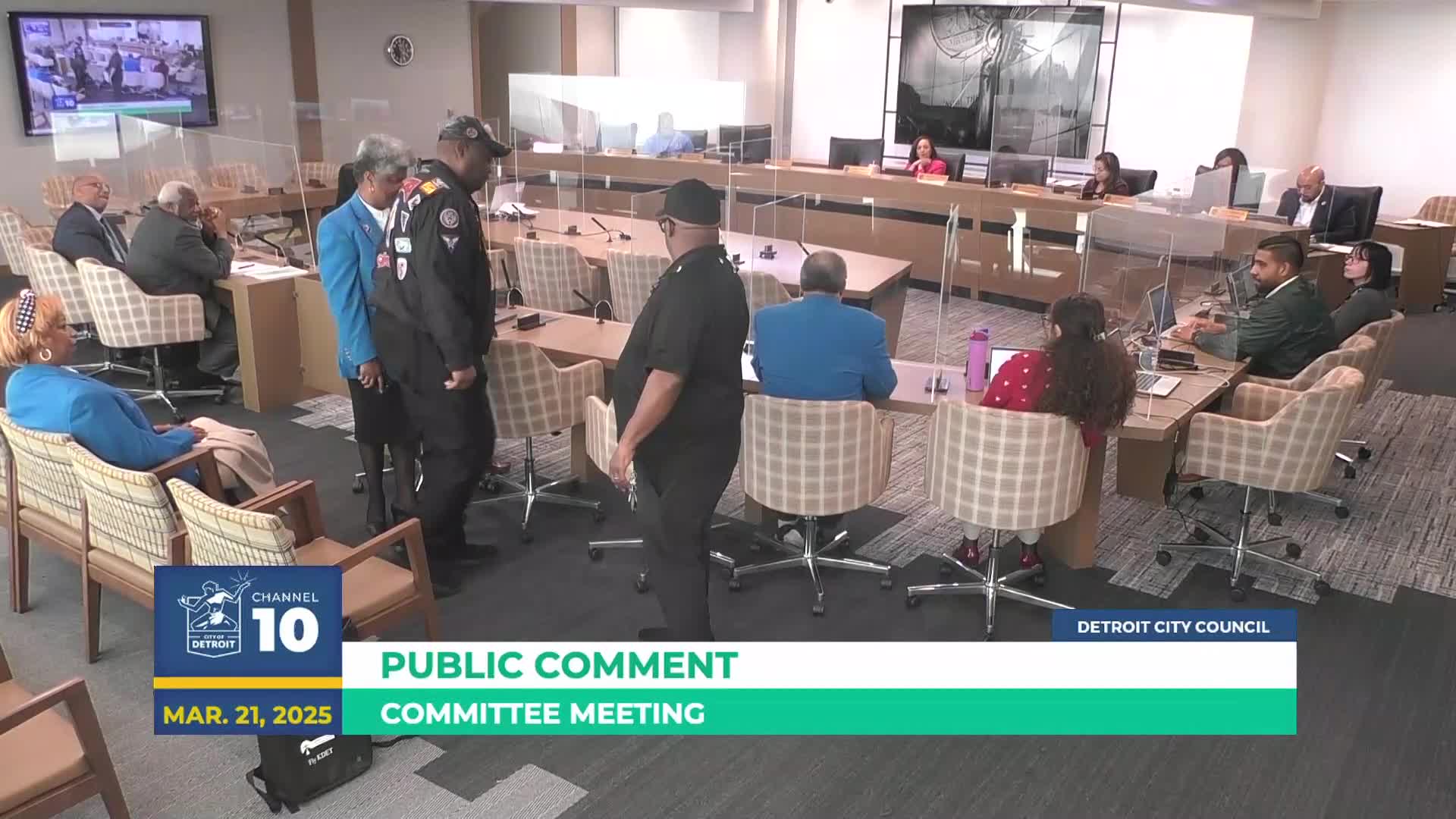
Veterans and volunteers urged Detroit leaders during the council’s public-comment period to support youth aviation pathways at Detroit City Airport, describing ongoing Civil Air Patrol work, upcoming drone-training classes and a privately funded Tuskegee Airmen kiosk on airport grounds.
The airport-based groups described hands-on programs they say give young people experience that can lead to military and civilian aviation careers. Tony Stevenson, a member of the Davis Aerospace Technical Advisory Group, a captain in the Civil Air Patrol and president of the Detroit chapter of the Tuskegee Airmen, said, "That gives young people from the age of 13 to actually as old as I am to work, in conjunction and get aviation experience that can be turned around and used for the military."
Nut graf: Speakers said the airport serves as a long-running community asset and training hub, and they asked the city to recognize and support workforce and outreach efforts while also addressing infrastructure issues that affect airport operations.
Retired Master Sergeant Alfonso King, U.S. Air Force, who identified himself as a Civil Air Patrol member and a qualified drone instructor, said the group is "trying to get this program going so we can get these kids off the street." King and other speakers described drone instruction for youth and adults, and said the classes are open to both females and males.
Speakers provided program details during public comment. According to comments recorded in the meeting, a drone class will begin on the coming Monday at 7 p.m., and an additional adult-focused drone program will start on Saturdays in May. Stevenson said participants can earn remote pilot credentials that could be used in real estate, photography or law enforcement work and noted that some instructors hold U.S. and Canadian drone licenses.
Airport advocate Beverly Kendall Walker, who said she was appointed to the Detroit City Airport by Mayor Coleman A. Young around 1990, highlighted the airport’s long presence in the East Side community and pushed for broader awareness of non-pilot aviation jobs. "The airport that has never closed in its existence since 1927," Walker said, and she described tenant-led efforts to build a small monument and informational kiosk for the Tuskegee Airmen.
Walker told the council the kiosk and related displays have been funded by tenants without government assistance: "That project is coming out of our pocket pockets just like BPA and all the other tenants." She and other speakers called for better marketing and outreach for the airport’s programs.
Speakers also raised infrastructure concerns tied to new development, saying stormwater runoff and drainage fees at the airport are a growing problem and that additional green infrastructure would help manage costs.
A caller who identified himself as an Air Force veteran, Ronald Foster, urged the city to consider expanding aircraft access as a training tool, including ultralight aircraft, and suggested the city study whether owning aircraft would improve municipal operations. Foster also asked for more oversight of a separate city program referenced as "GSW," saying it had large expenditures and should be accountable to the city.
Ending: Speakers asked city officials to connect directly with program leaders to explore support options, and several volunteers offered to follow up offline to discuss funding and logistics for training and outreach programs.