Get Full Government Meeting Transcripts, Videos, & Alerts Forever!
Get email alerts on the Infrastructure Assessments topic
No spam. Unsubscribe anytime.
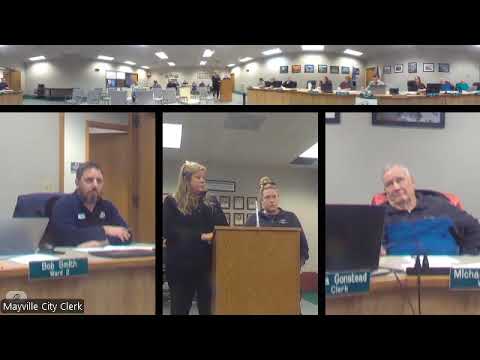
Public Works committee debates changing special‑assessment rules for sidewalks and alleys, tables ordinance for more work
Summary
The Public Works Committee spent extensive time reviewing proposed changes to Chapter 13 of the municipal code that would alter who pays for new and replacement sidewalks and alley improvements; the committee tabled the ordinance to clarify repair vs. replacement standards and how projects trigger city payments.
Committee members and public works staff debated March 24 whether and when property owners should pay for sidewalks, curb/aprons and alley work under an amendment to Chapter 13 of the City of Mayville municipal code.
Staff described the proposal as a procedural change to special assessments. Under the draft language discussed in committee: new sidewalks installed as part of a project would be paid by adjacent property owners; replacement sidewalks in project areas would be paid by the city; and corner lots and driveway aprons would be addressed in the code text. Members asked staff to clarify whether replacements meant "any time a section is replaced" or only when replacement occurs as part of a larger public project.
Public comments and council members raised practical issues: when is an owner responsible for repairs caused by tree roots or heaving, and would routine maintenance remain the homeowner's responsibility? Staff explained current practice: inspectors use a measured standard (grind vs. replace thresholds) and offer property owners options—city crews, contractor, or homeowner completion—followed by an inspection and potential enforcement if work is not completed.
Committee members also pressed for consistent treatment of curb and gutter language and to add an alley specification section to Chapter 368 (the code section that governs construction standards). Members cited complicated neighborhoods such as a multi‑phase rural subdivision and cited past disputes (for example, Bunker Alley was resolved by a one‑time city contribution).
After extended discussion the committee voted to table the amendment and requested staff refine the draft language (including curb/gutter wording and a separate alley‑specifications section) before returning to the committee and later to council.
Why it matters: changing special‑assessment rules alters who pays for sidewalks, alleys and curbs across neighborhoods and can shift costs between property owners and the city. Committee members emphasized fairness, process clarity and avoiding ad hoc decisions that create precedent.
What happens next: staff will revise the ordinance language to explicitly state when the city pays replacement costs (for example, as part of an identified street project), add curb/gutter verbiage, and draft alley construction standards for council and attorney review; the revised ordinance will return to committee for further consideration.