Get Full Government Meeting Transcripts, Videos, & Alerts Forever!
Get email alerts on the Digital Equity topic
No spam. Unsubscribe anytime.
Bill would shift digital‑equity leadership to Office of Equity; advocates urge coordination with broadband buildout
Summary
House Bill 1503 would transfer primary responsibility for digital equity outreach and planning to the governor’s Office of Equity, require a statutory digital equity plan and regular updates, and direct coordination between the Office of Equity and the State Broadband Office; supporters say the change improves outreach to underserved communities.
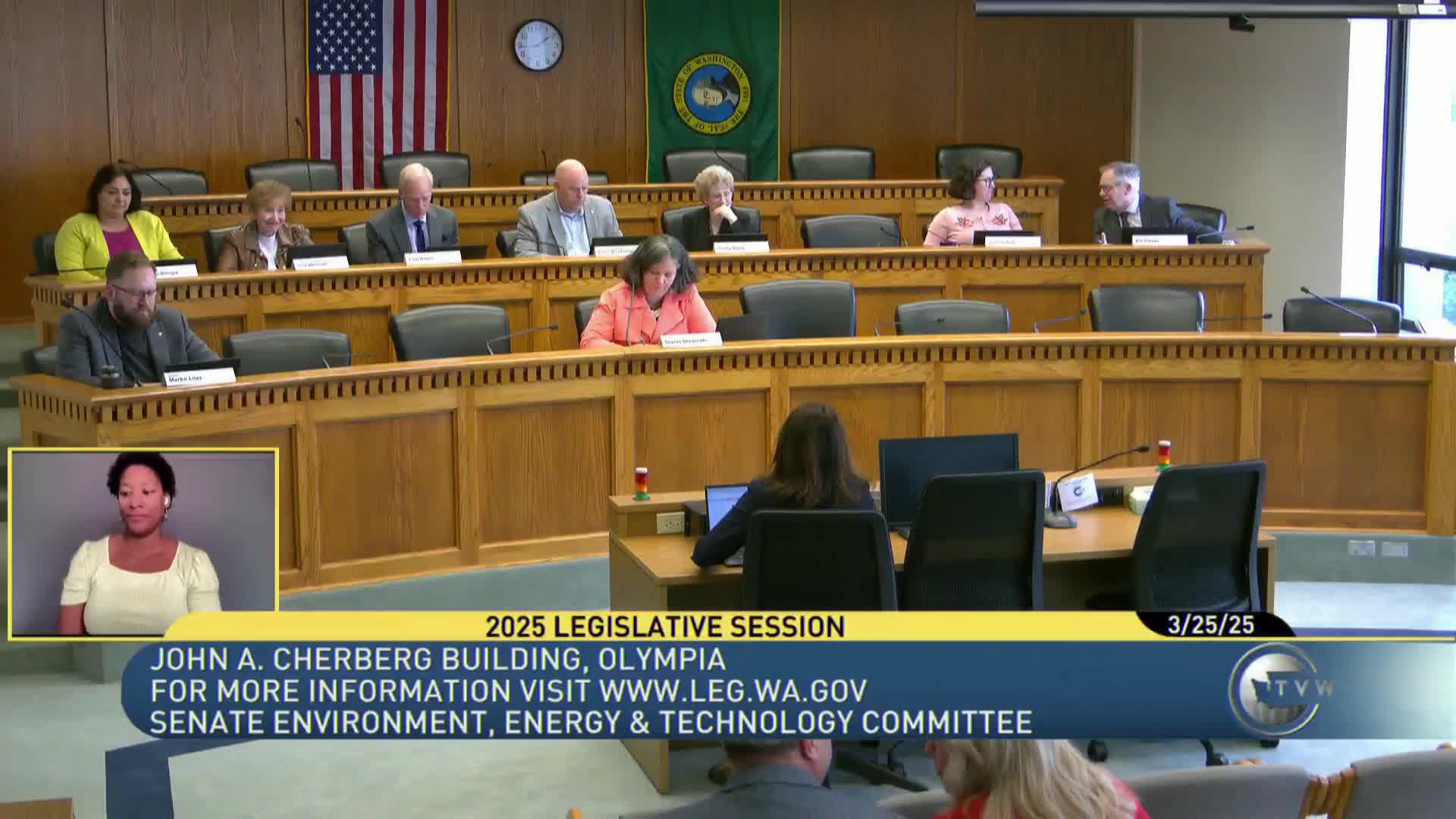
The Senate Environment, Energy & Technology Committee heard House Bill 1503, a proposal to shift responsibilities for digital equity from the Department of Commerce and the Washington State Broadband Office to the governor’s Office of Equity and to codify a statewide digital equity plan and related duties.
Committee staff summarized the measure: digital equity — defined in statute as the condition in which individuals and communities have the information technology capacity needed for full participation in society, democracy and the economy — would become an explicit purpose of the State Broadband Office. The Office of Equity would take the lead on outreach, development and oversight of a statutory digital equity plan, and would receive data from the State Broadband Office on broadband adoption and programs. The bill requires the Office of Equity to support the Digital Equity Forum and to update the plan every four years; it also calls for reviewing and updating state minimum speed goals by 2028 with input from tribes, utilities and other stakeholders.
Sponsors and agency staff said the measure is intended to keep infrastructure planning and BEAD/BEED-style implementation work with the Broadband Office while strengthening the Office of Equity’s role on outreach, adoption and user-side programs.
Representative Mia Gregersen, sponsor of the legislation, described the measure as a carefully planned, agency-driven bill and said it is “about as close to trailer bill and agency request legislation as you’ll get.” She told senators the change is meant to let the Broadband Office focus on infrastructure while the Office of Equity focuses on outreach, anchor institutions and adoption. Committee staff and Commerce staff confirmed the bill does not itself reset the state speed goals; instead it requires an additional consultative step when speed goals are reviewed.
Committee members asked how the change would affect coordination with federal infrastructure funding (BEED/BEAD) and whether the bill would slow or speed deployment. Commerce staff said the bill does not change BEED processes; the State Broadband Office is in the middle of round-two BEED applications and the bill is intended to help address the next stage — adoption and use after infrastructure is in place. Patrick Stickney of the Office of Equity described existing interagency agreements under which the Office of Equity has led staff support for the Digital Equity Forum and outreach to hard-to-reach communities.
Supporters included community nonprofits, regional coalitions, workforce and education groups, and the governor’s office. Testimony stressed the need to couple infrastructure with adoption supports — training, devices and trusted local navigators — so that newly-built broadband is used and affordable. Examples included programs for students, seniors, veterans, and people reentering from incarceration.
Key provisions - Transfers primary responsibility for digital equity outreach and the statutory digital equity plan to the Office of Equity. - Requires the Office of Equity to receive data from the State Broadband Office and provide staff support for the Digital Equity Forum. - Requires a statutory digital equity plan that evaluates existing state initiatives and is updated and transmitted to the Legislature every four years. - Calls for input on state broadband speed goals by 2028 from the Digital Equity Forum, tribes, utilities and relevant agencies.
Questions and concerns during the hearing centered on coordination with BEED/BEAD infrastructure funding and ensuring the Broadband Office retains a central role in infrastructure planning; staff and sponsors said the bill is intended to improve coordination rather than displace the Broadband Office. Several community and equity-focused groups urged passage.
Ending: Committee did not vote on the bill in this hearing; sponsors and agencies said they will continue collaborating on implementation details and coordination with federal broadband funding efforts.