Get Full Government Meeting Transcripts, Videos, & Alerts Forever!
Get email alerts on the Agriculture Fuel Exemption topic
No spam. Unsubscribe anytime.
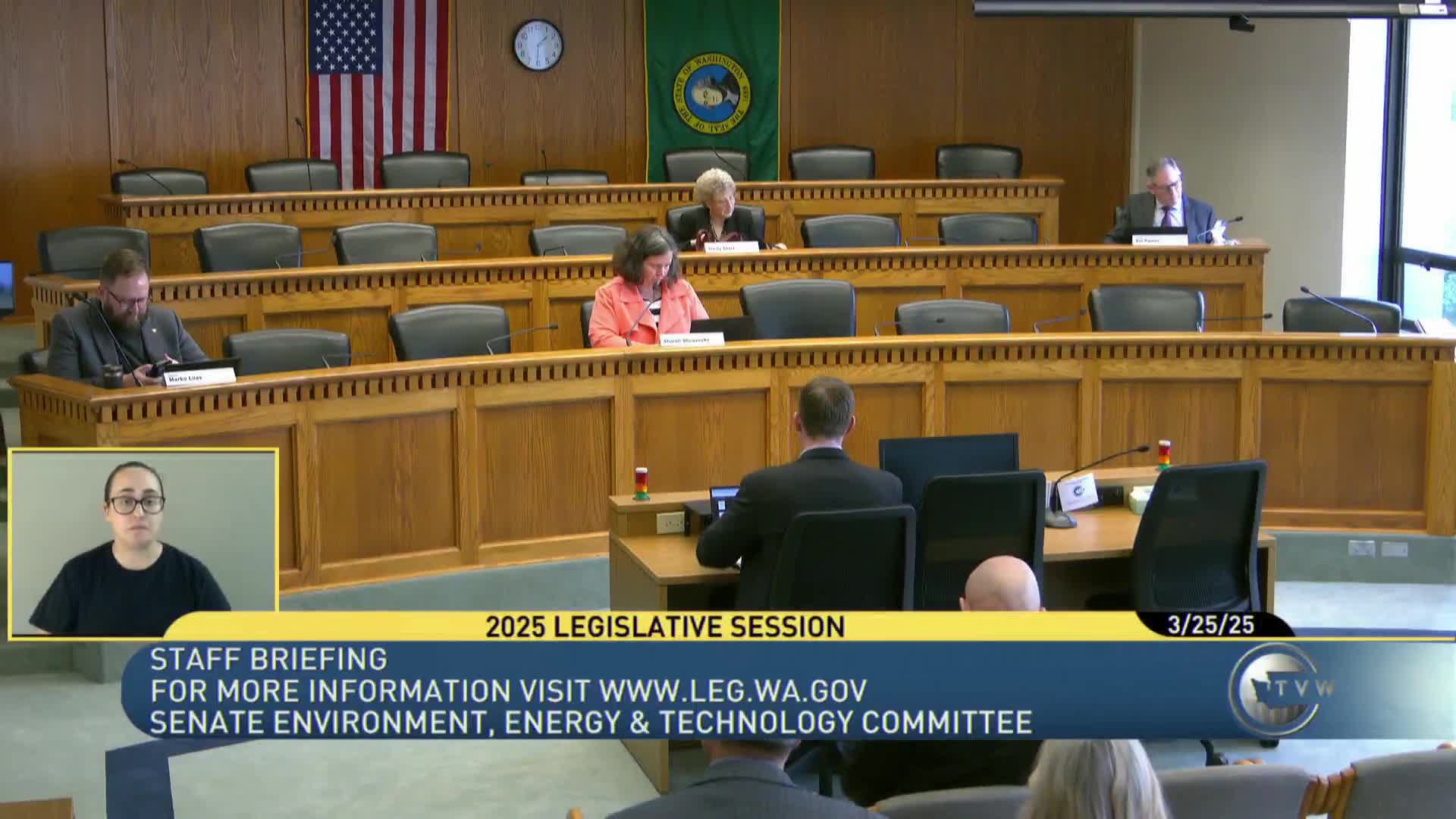
Committee hears bill to improve farmer access to Climate Commitment Act fuel exemption
Summary
The Senate Environment, Energy & Technology Committee heard testimony on House Bill 19-12, which lawmakers and agencies say will improve farmers’ ability to buy fuels exempted under the Climate Commitment Act by creating a public directory of sellers, directing Commerce to offer incentives to retailers (subject to appropriation), and extending a transport exemption to 2029.
The Senate Environment, Energy & Technology Committee heard testimony on House Bill 19-12, a measure intended to make the agricultural-fuel exemption in the Climate Commitment Act more usable for farmers and other agricultural users.
Staff told the committee the bill would require retail fuel sellers to be able to voluntarily notify the Department of Ecology about locations, contact information and fuel types where exempt agricultural fuels are available; Ecology must post a directory and user guide by Oct. 1, 2025. The bill also directs, subject to appropriation, the Department of Commerce to offer financial incentives to retail fuel sellers to remove barriers to offering exempt fuels at point-of-sale — for example by helping retailers implement a card- or membership-based payment option. It extends a temporary five-year on‑road transport exemption for fuels used to move agricultural products on public highways by two years, to 2029, and contains intent language to continue the Department of Licensing remittance program.
Why it matters: producers and trade groups told the committee that while larger farms and cooperatives can generally access exempt fuels through distributor card-lock or bulk sales, small or geographically isolated operations sometimes cannot. Supporters said a public directory and Commerce incentives would lower the transaction costs that prevent retailers from offering exempt fuels at the pump.
Representative Tom Dent, the bill sponsor, said the legislation aims to keep a promise to agriculture. “This bill even though it’s not perfect ... it will help every egg producer in the state if they so choose to use the provisions inside this bill,” Rep. Dent said.
Stakeholders gave mixed but largely supportive testimony. Clifford Traceman of Washington Conservation Action said stakeholders worked to fix access issues and urged passage. Diana Carlin of the Washington Oil Marketers Association said most farmers can access exempt fuel through distributors and card-locks, but agreed better education and an online directory would help. “I have not found any of my distributor members that are charging a membership to do this,” Carlin said in response to concerns about hidden fees. Representatives of commodity groups — including the Washington Potato and Onion Association, the Washington State Dairy Federation, Washington Association of Wheat Growers and others — described both progress and remaining gaps for some small operations in accessing exemptions.
Agency witnesses said they are continuing implementation work. Kate Bruns, climate and energy policy advisor to the governor, said the governor’s office, Ecology, Commerce and Licensing have been refining language and implementation plans, and are continuing to work on the definition of “special fuels.” Joel Creswell, program manager, Department of Ecology, said Ecology supports the bill as a low-cost way to improve access: “By creating an online directory of retail fuel sellers that have an exempt fuel for sale, agricultural users will be able to more easily purchase exempt fuel, reducing the need for more burdensome administrative solutions.”
Points of continuing work and clarifications raised in the hearing - The bill directs Ecology to publish a directory and guidance by Oct. 1, 2025, using voluntary reports from retail sellers. The Commerce incentive program is subject to appropriation and still under design. - Stakeholders and some producers urged clearer legislative language on whether certain fuels — notably natural gas and other “special fuels” used on farms — are covered by the statutory exemption; sponsors said an amendment to clarify definitions is expected. - A fiscal note update was requested but not yet available at the time of the hearing.
No final committee action was taken on HB 19-12 in this meeting; proponents and agencies said they will continue to refine implementation details on special‑fuels definitions and Commerce’s incentive program.
Ending: Supporters urged the committee to move the bill forward after stakeholders resolve definitional issues and the agencies finalize implementation plans; Commerce said it will continue working on incentives to reduce point-of-sale barriers if funding is provided.