Get Full Government Meeting Transcripts, Videos, & Alerts Forever!
Get email alerts on the Revenue Measures topic
No spam. Unsubscribe anytime.
Senate resources bill would raise gas tax, index fees and add new levies; stakeholders split over equity and program impacts
Summary
Senate staff described SB 5,801 revenue measures including a 6¢ fuel tax increase with a 2% annual indexing schedule, higher EV fees and a package of new and revised vehicle‑ and event‑related levies.
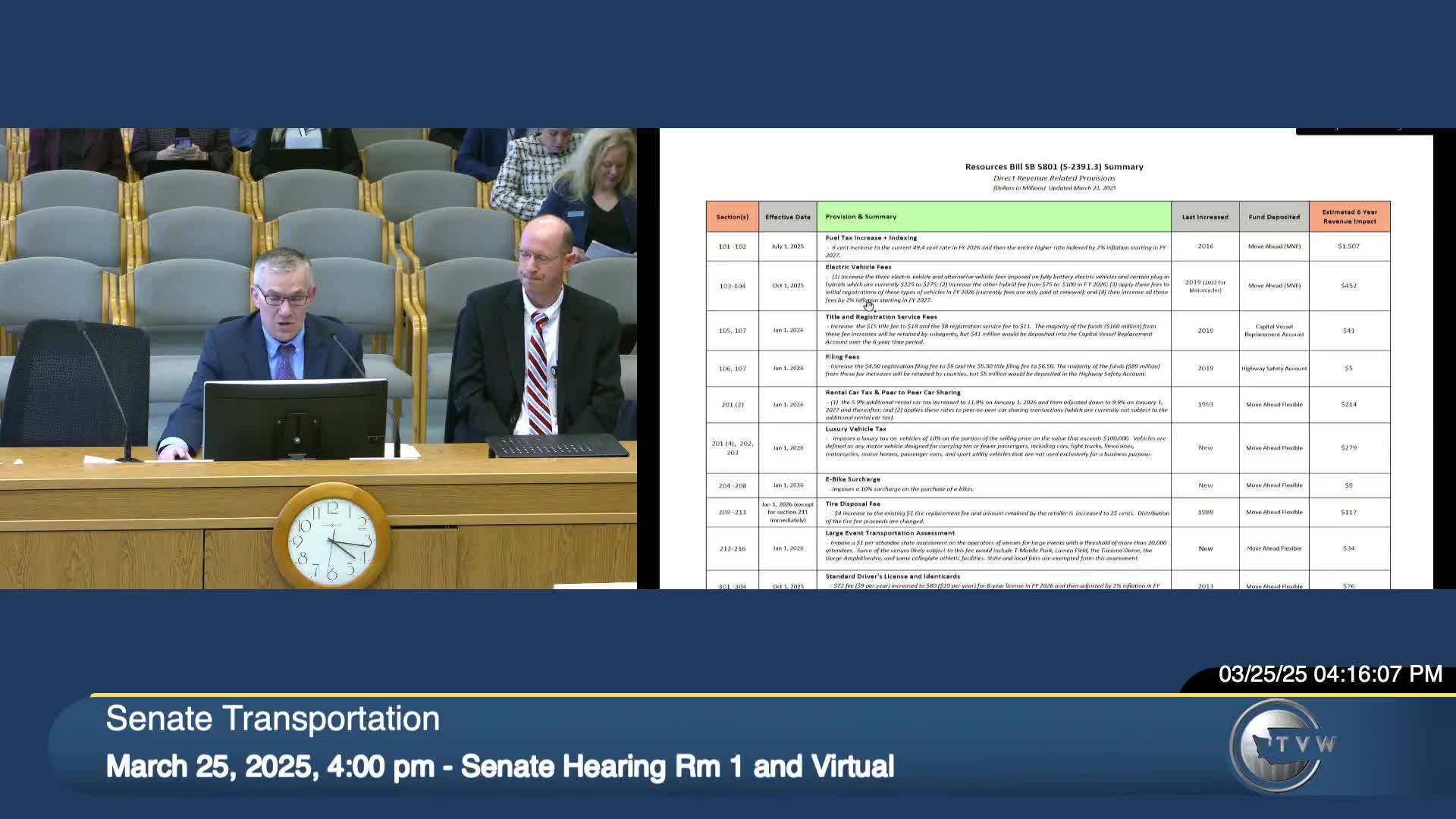
Committee staff walked senators through the revenue provisions of Senate Bill 5,801 and detailed estimated receipts for each item over a six‑year window.
Brian Moore summarized the largest revenue items on the bill chart: "Beginning 07/01/2025, there would be a 6¢ increase in the current 49.4¢ state fuel tax rate. In the second year ... that total rate ... would be increased by inflation applied to the entire rate." Moore said that fuel‑tax indexing and the initial increase account for about $1.5 billion of the package's six‑year revenues. He also described electric‑vehicle registration increases and indexing (estimated at $452 million), higher title/registration service and filing fees (some of which are retained by subagents and counties), rental‑car tax changes that would apply to peer‑to‑peer car sharing (estimated $214 million), a 10% luxury vehicle tax on amounts above $100,000 (about $279 million), an e‑bike surcharge (about $9 million), and other smaller assessments such as tire disposal fee changes and a large‑event facility assessment.
Moore said the proposal assumes a 4% annual increase in ferry fares above baseline in the model and includes a $125 penalty for first work‑zone violations under the speed camera pilot. He noted the proposal is a six‑year revenue projection and that many provisions have staggered effective dates.
During public testimony, stakeholders were split. Labor and construction groups, county and city officials, and many transportation advocates voiced support for raising revenue to restore preservation, maintenance and safety work and to avoid deeper project delays. "Preservation projects are often the most cost effective in the long run," Heather Kurtenbach of the State Building Trades said.
Conversely, business groups and some advocacy organizations opposed particular provisions. Tim Eyman testified the package imposes too many taxes and called the overall set of increases "shocking." The Western States Petroleum Association urged caution on indexing, saying indexing weakens legislative accountability and noting that cumulative charges and Climate Commitment Act costs already raise per‑gallon fuel costs. The Seattle Mariners and other event interests opposed a proposed $1 large‑event assessment, calling it an additional tax on attendees and vendors at venues already subject to admissions and parking taxes.
Other objections focused on the distributional or programmatic consequences of specific provisions: environmental groups and EV advocates objected to reductions in funding for the zero‑emission medium and heavy‑duty vehicle incentive program while companies building truck charging infrastructure and vehicle manufacturers urged restoring that funding to support fleet transitions. Peer‑to‑peer platform Turo opposed taxing its transactions and urged closing an existing rental‑industry sales‑tax loophole first; major rental car companies argued parity is needed because some peer‑to‑peer firms now purchase fleets.
Staff and stakeholders flagged next steps: staff noted effective dates embedded in each bill section and reminded the committee that amendment requests must be submitted by the committee deadline ahead of executive action.