Get Full Government Meeting Transcripts, Videos, & Alerts Forever!
Get email alerts on the Transportation Budget Package topic
No spam. Unsubscribe anytime.
Senate Transportation staff outline $10.2 billion six‑year plan; $7 billion in bond authorization proposed
Summary
Committee staff briefed senators on a linked package of transportation bills that together propose about $10.2 billion in new revenues over six years, $1.9 billion in 2025–27 spending in the proposition shown, and $7 billion in potential bond authority for highway projects.
A Senate Transportation Committee staff briefing on March 25 laid out four linked bills that together would reshape transportation funding and borrowing for the next six years.
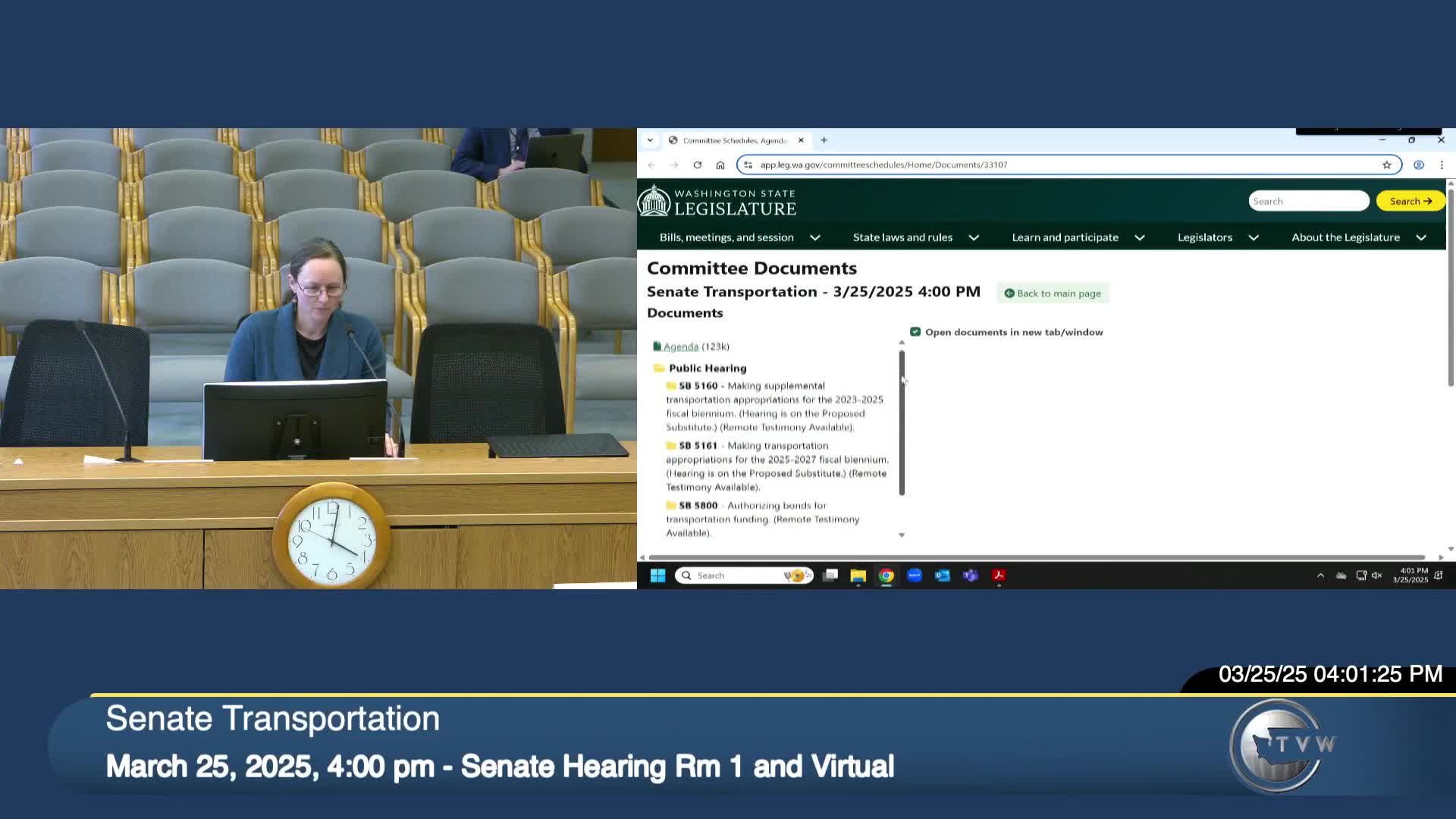
Haley Gamble, budget coordinator for the committee, told senators the package includes a new‑revenue spending bill (Senate Bill 5,160), the regular biennial transportation appropriations bill (Senate Bill 5,161), a bond authorization bill (Senate Bill 5,800), and a resources and policy bill (Senate Bill 5,801). "You're looking at about $10,200,000,000 over the 6 year time period," Gamble said, summarizing the revenue and spending matrices provided to the committee.
Gamble said traditional transportation revenues (fuel and related vehicle revenues) account for roughly $3 billion of the six‑year total, bond proceeds comprise a $7 billion authorization of which about $3.7 billion is shown spent in the current proposal, and a portion of an existing sales tax transfer (0.3% starting in FY27) would shift into a multimodal account and is currently estimated to add about $800 million per year in later years. "So you're looking at $3,200,000,000 coming in from that source in this 6 year plan," Gamble said.
Staff detailed the biennial spending profile for the 2025–27 period and the six‑year plan. Gamble said the package restores operating and capital items trimmed in current‑law budgets and adds preservation and maintenance dollars, listing $2 billion for preservation across six years plus $375 million for maintenance and $700 million over six years for eligible safety projects. She also pointed senators to program‑level spreadsheets and a list of projects funded by the new revenue proposal.
Committee staff said the bond bill (SB 5,800) would authorize $7 billion in highway bonding backed by gas tax and vehicle fees, and would increase the State Route 520 toll‑backed bond authorization from $1.95 billion to $2.45 billion. "No bonds would be offered for sale without prior legislative appropriation of the proceeds of those bonds," Gamble said.
On the resources bill (SB 5,801), committee staff Brian Moore described a series of specific revenue provisions detailed in the bill: a six‑cent increase to the state fuel tax on July 1, 2025 with a 2% annual inflation indexing; increases and indexing of electric vehicle registration fees; increases to title, registration service and filing fees (with portions retained by county subagents and others); adjustments to rental car tax and application of that tax to peer‑to‑peer car‑sharing; and a new luxury vehicle tax for vehicles priced above $100,000. Moore and Kelly Simpson, committee staff, also walked senators through hundreds of policy and program provisions in the resources bill, including toll policy changes, permit streamlining, new and altered grant programs, and other statutory amendments.
Senators asked clarifying questions about bond timing and the fixed 2% indexing rate for several increases. Senator Christian asked whether the bonds "are dumped all at once or spread out over years," and staff replied the bonds would be issued according to a spending plan and not issued all at once. Senator King asked staff to confirm effective dates; staff pointed the committee to the effective‑date language already included in the bill chart.
Committee business at the start of the hearing included a motion to waive the five‑day notice rule required under Senate Rule 45 in order to hear the bills that day. The motion was carried by voice vote.
What’s next: staff reminded senators of the amendment deadlines and posting requirements for the committee's scheduled executive session on the bills. Committee staff said Senate rules require amendment requests to be filed with staff by noon the day before executive action and posted that evening in the electronic bill book.
No formal committee action on the three substantive bills took place at the hearing; the session was a staff briefing and public hearing on the bills and budget documents.