Get Full Government Meeting Transcripts, Videos, & Alerts Forever!
Get email alerts on the Police Training Language Access topic
No spam. Unsubscribe anytime.
Council member adds annual DPD training to closing resolution after public calls for language access and accountability
Summary
Public commenters urged Detroit City Council to fund language services, clarify immigration protocols and strengthen police training; Councilmember Gabriela Santiago Romero successfully moved to add a requirement for annual Detroit Police Department training into the meeting's closing resolution by unanimous consent.
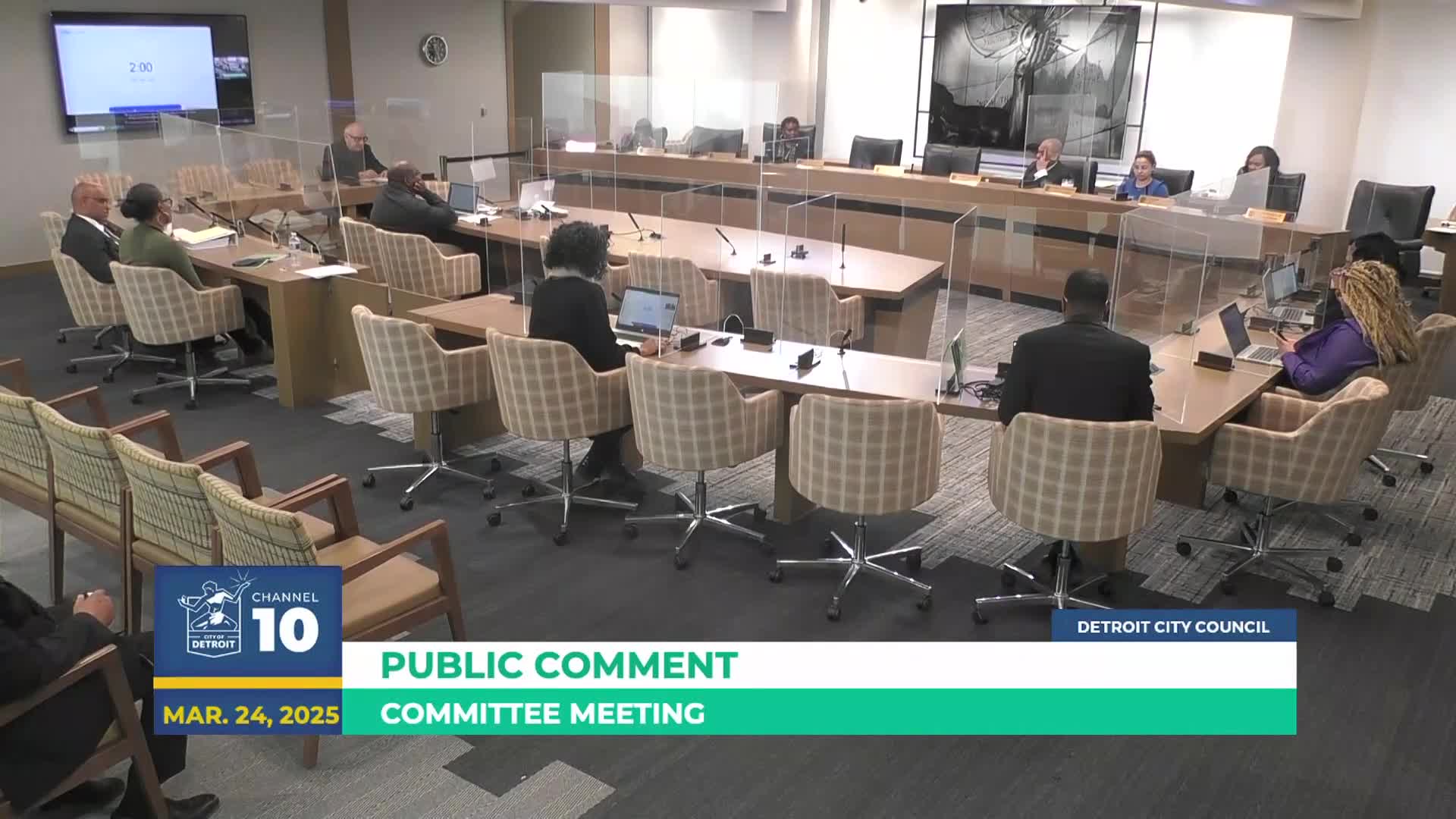
Detroit 'Public comment at a Detroit City Council budget hearing on an unspecified date focused on the Detroit Police Department's use of language services, immigration-related interactions and internal training; Councilmember Gabriela Santiago Romero moved to add annual DPD training requirements to the meeting's closing resolution, and the change was adopted by unanimous consent.
Why it matters: Commenters and council members said language access and officer training affect immigrants' willingness to report crimes and overall community trust in policing. The council added language requiring annual training at the start of each year to the closing resolution; Council staff will provide the final wording.
Several residents, immigrant-rights advocates and community members urged the council to ensure the DPD has both resources and clear policies so officers do not rely on federal immigration authorities for interpretation and so all officers receive up-to-date training. William M. Davis, a Detroit resident, said the city should create incentives for more officers to live in Detroit and suggested a DPD ombudsman or inspector general to help citizens navigate complaints. "They should have their own inspector general ombudsman to help citizens navigate what's going on there," Davis said.
Karen Cardenas, who identified herself as part of a statewide Latino-focused organization, urged council to allocate budget funding to maintain interpretation services. "I'm urging council to ensure that DPD has sufficient resources to continue to provide language services," Cardenas said, adding that callers report DPD sometimes uses federal immigration or border authorities for interpretation, which she said increases the risk of detention.
Christine Sove, co-chair of the Detroit Immigration Task Force and a staff member at the Michigan Immigrant Rights Center, asked the council to fund department-wide training on the city's ordinance guaranteeing unbiased service, language-access policies and visa protocols for crime victims. "DPD needs to have its own robust language services to ensure all residents have meaningful access to city services per title 6 of the civil rights law," Sove said.
Julia Givens, representing "Freedom plus Teacher" (as stated on the record), echoed the call for training and said some officers believe immigration enforcement by local police is required; she disputed that belief. "First, currently, there is no federal or state mandate for local law enforcement to conduct federal immigration enforcement," Givens said, and later referenced the Tenth Amendment in arguing that the federal government cannot compel localities to enforce federal immigration programs.
Not all public commenters sought more DPD funding. Member Gabriela Santiago Romero told the council, "DPD does not need any more money. They are fully funded. They need to commit to training." Romero moved to add language to the closing resolution requiring annual training for DPD at the start of each year covering U- and T-visa protocols, unbiased-provision training and language-access usage. The motion was made on the record and, with no objections, the language will be sent to the closing resolution and recorded as adopted by unanimous consent; no roll-call vote was taken.
Other commenters praised recent DPD community engagement. Ronald Foster said the chief and precinct commanders have been visible and accessible and urged that officers with "egregious" conduct be placed on Brady lists so they cannot affect other communities.
The council chair asked staff to include the proposed training language in the closing resolution; the hearing was adjourned without a roll-call vote on that specific language.
What remains unresolved: The transcript records calls for funding and training but does not specify any budget line-item changes, dollar amounts, or a formal ordinance. Council staff will draft the closing-resolution language and circulate it; the final text and any implementation schedule were not specified on the record.
Ending: The budget hearing concluded after the council accepted Romero's addition to the closing resolution by unanimous consent and closed public comment.