Get Full Government Meeting Transcripts, Videos, & Alerts Forever!
Get email alerts on the Education State Of Schools topic
No spam. Unsubscribe anytime.
Pasco School District holds State of the Schools reviews for three elementary schools
Summary
Assistant Superintendent Goebel led table-style State of the Schools reviews this afternoon where teams from Longfellow, McClintock STEM and James McGee elementary schools presented school-improvement snapshots, student-demographic data and instructional adjustments, including bilingual programming and assessment practices.
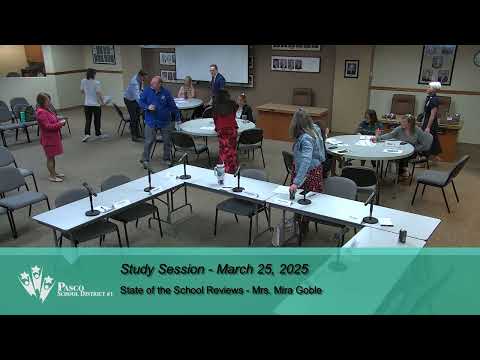
PASCO, Wash. — This afternoon the Pasco School District held State of the Schools reviews in a study-session format, with Assistant Superintendent Goebel introducing short, table-based presentations from Longfellow Elementary School, McClintock STEM Elementary School and James McGee Elementary School.
"The purpose of this is really the school teams to share their school improvement efforts," Assistant Superintendent Goebel said, asking school teams to present for roughly 15 minutes with five minutes for board questions.
The district provided one-page data summaries for each school and asked board members to rotate between three tables so each could hear from every school team. Board President Brown and Superintendent Whitney were present for the session.
Longfellow Elementary reported about 315 students; the team said roughly 90.6% of students are Hispanic/Latino, approximately 67% are English learners, about 92% qualify as low income and nearly 20% are students with disabilities. Presenters described targeted supports intended to reduce the number of students performing at emergency levels in early grades and coaching supports for teachers.
McClintock STEM said its enrollment is about 625 students, with 64% Hispanic/Latino, 27% English learners, 64% low income and 15% students with disabilities. McClintock presenters discussed curriculum and coaching efforts and referenced the district-provided one-page data overviews used during the table presentations.
James McGee reported about 459 students, with 62% Hispanic/Latino, 23% English learners, 38% low income and about 17% students with disabilities. James McGee presenters described bilingual classroom structures and assessment timing.
School teams discussed bilingual instruction models in which students receive both Spanish and English instruction. Presenters described two-way classroom placements in which English-speaking students and Spanish-speaking students learn together, and said classrooms typically test in Spanish first. One presenter summarized daily scheduling as including distinct English-language-arts blocks and Spanish instruction blocks.
Teams said a portion of students missed foundational skills in kindergarten through second grade and that coaches and teachers are providing focused instruction to address those gaps. Presenters also referenced social-emotional learning surveys and said the data pages at each table provided demographic context that the Office of Superintendent of Public Instruction (OSPI) uses to identify disparities.
No formal board votes or motions were recorded during the review session; the format was explicitly described as a snapshot for board members to "stay curious and ask questions" rather than to evaluate or make recommendations, according to Assistant Superintendent Goebel.
Board President Brown closed the session by thanking the three school teams and announcing the study session’s end and the upcoming regular board meeting: "We'd like to thank Longfellow, McClintock, and James and, McGee for coming to the State of the School Reviews this evening. This ends our study session. Please join us for our regular board meeting at 06:30PM."