Get Full Government Meeting Transcripts, Videos, & Alerts Forever!
Get email alerts on the State Budget Overview topic
No spam. Unsubscribe anytime.
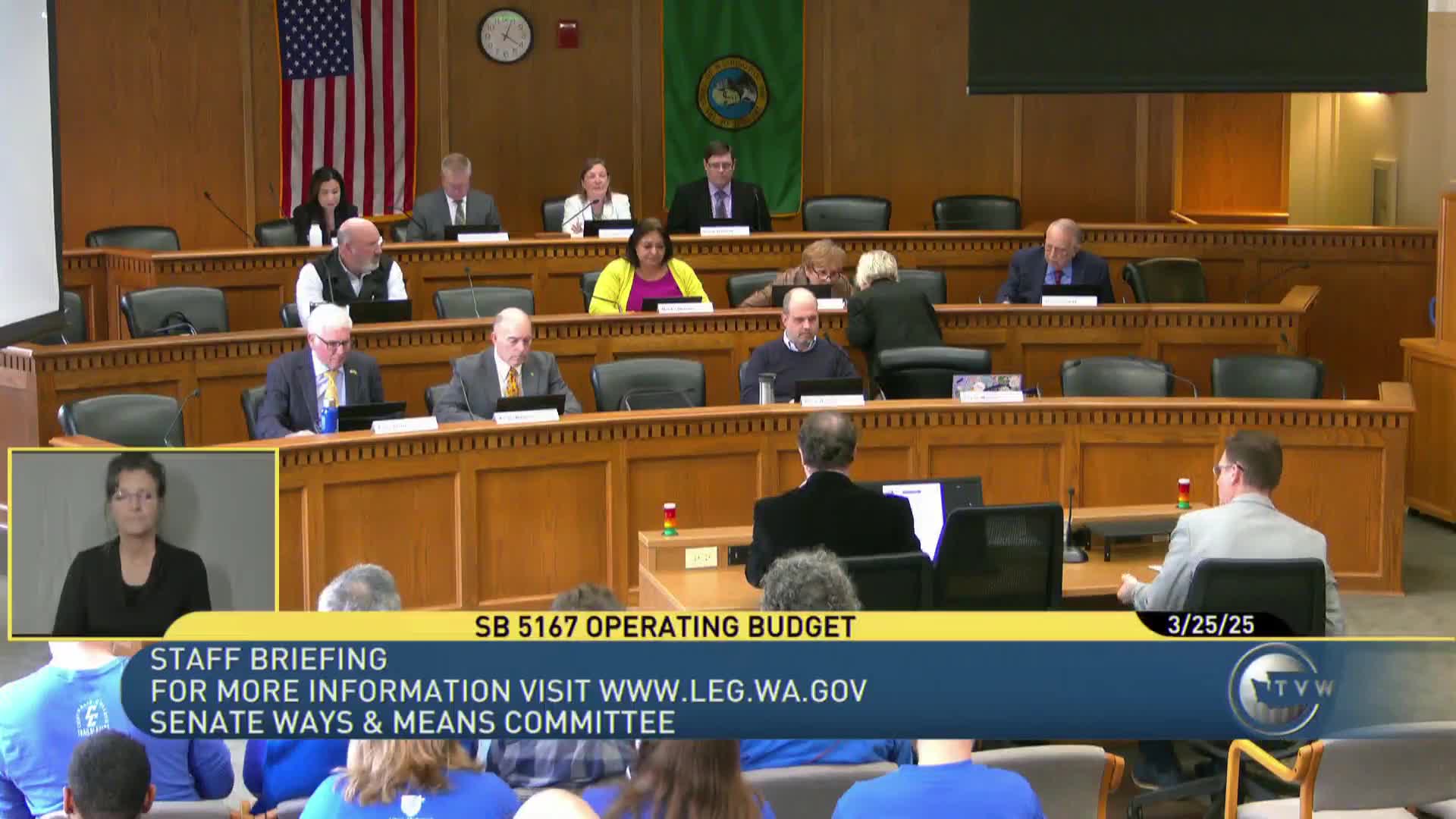
Senate Ways & Means holds hearing on SB 5,167 state operating budget; staff outlines outlook, revenue proposals
Summary
Committee staff summarized the chair's operating budget proposal for SB 5,167, highlighting concentrated maintenance costs, major policy adds in K'12 and capital, proposed revenue changes and numerous fund transfers that together modestly improve the near general fund balance.
The Senate Ways & Means Committee convened a public hearing March 25 on Senate Bill 5,167, the state operating budget proposal, and heard a staff overview of the chair's plan from James Kettle, Operating Budget Coordinator for the committee.
Kettle told the committee the overview document available on the Electronic Budget Book and fiscal.wa.gov shows the revenue forecast, maintenance-level cost drivers, policy-level adds and savings, and the budget outlook over the next several fiscal years. "This is the budget overview document," he said as he introduced the materials visible to the committee.
The nut graf: the chair proposal concentrates most maintenance-level costs in a small number of agencies and assumes substantial policy additions primarily in K'12 (including collective bargaining costs) and a proposed capital budget. Revenue measures in the proposal include new taxes and reforms intended to raise new progressive revenue; transfers between accounts are larger than usual and the net of transfers in the package is roughly $200 million positive for the general fund in the near term.
Most maintenance-level spending, Kettle said, is concentrated: roughly 90 percent of maintenance-level costs are in five agencies. He summarized the budget presentation as three parts: resources (including the March revenue forecast and revenue proposals), spending (maintenance level plus policy choices), and balances (near general fund operating balance and the budget stabilization account). He flagged that at the chair's direction an additional 4.5 percent growth factor commonly used in forecasts was turned off in the proposal.
On timing and balances, the chair proposal shows a near general fund operating balance of about $66 million in FY26 and $75 million in FY27, growing across the forecast horizon into the billions of dollars by FY29, after assumed transfers. Kettle also pointed lawmakers to a number of agency- and program-level documents on the EBB for detail on policy choices and savings assumptions.
The hearing proceeded to public testimony from statewide elected officials and dozens of organizations and individuals representing K'12 education, higher education, early learning, human services, health care, natural resources and tourism. Many speakers thanked the Senate for prioritizing progressive revenue while urging restoration or protection of particular programs or funding lines. Several participants asked the committee to preserve specific programs or to match House funding levels during negotiations.
Looking ahead, committee staff urged members to consult the agency detail documents to trace savings and policy assumptions and to direct substantive follow-up questions to the named budget analysts.
Ending: The committee did not take votes at the hearing; members were reminded that amendments are due to staff by noon the following day and the public hearing record remains open as the budget moves to negotiations.