Get Full Government Meeting Transcripts, Videos, & Alerts Forever!
Get email alerts on the Evictions And Court Operations topic
No spam. Unsubscribe anytime.
Detroit judge reports drop in evictions, warns of rising danger to court officers
Summary
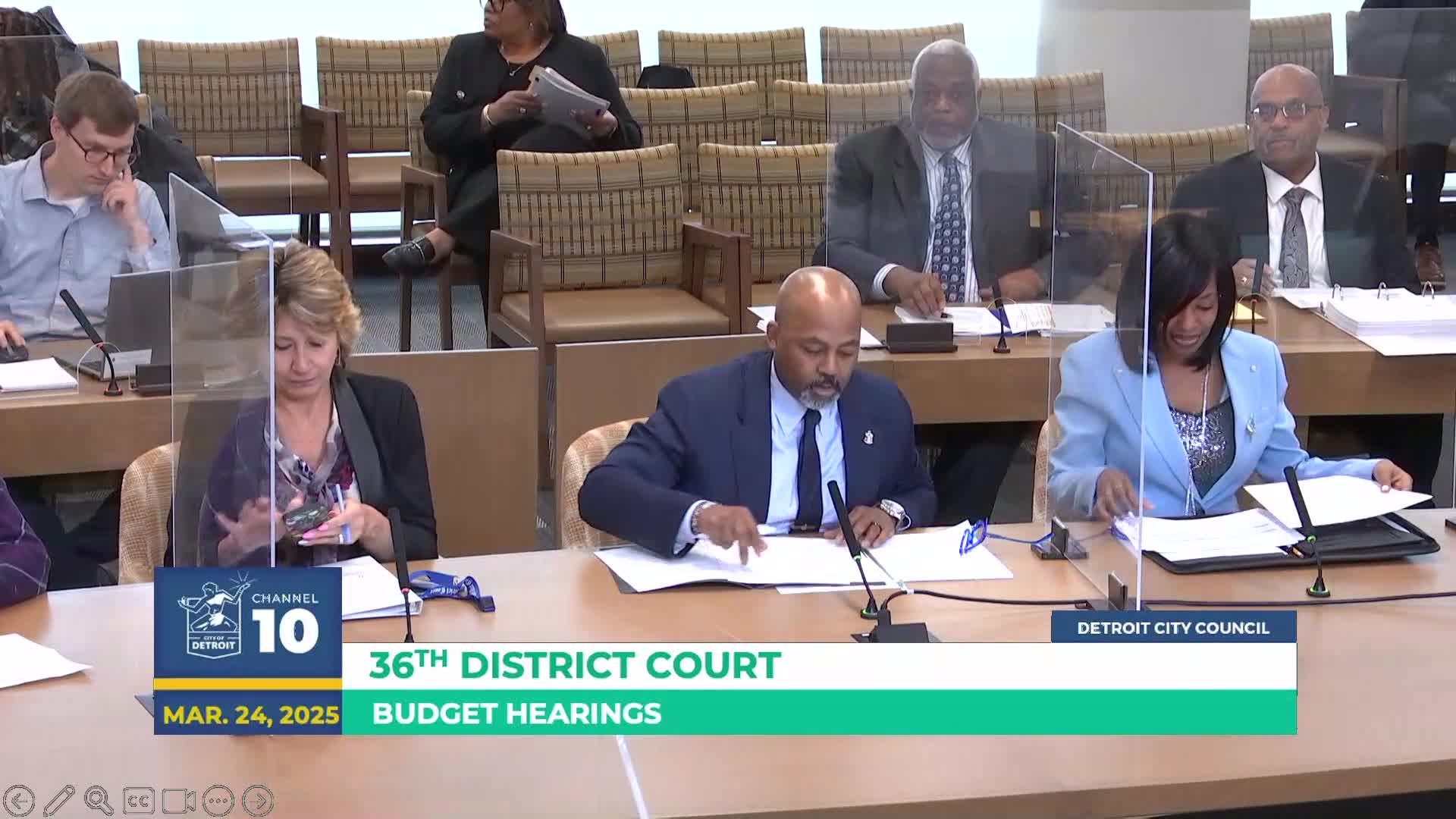
Chief Judge Bill McConico of the 30th District Court told the Detroit City Council that eviction filings in Detroit have fallen sharply since 2019 and that increased legal representation under the city's Right to Counsel ordinance is driving more agreements and fewer evictions.
Chief Judge Bill McConico of the 30th District Court told the Detroit City Council that eviction filings in Detroit have fallen sharply since 2019 and that increased legal representation under the city's Right to Counsel ordinance is driving more agreements and fewer evictions.
McConico said, "we are having 10,000 less eviction cases, per year than we did pre pandemic," and reported that legally represented defendants rose from under 2% in 2019 to "over 35%" last year, a shift he said is producing more consent judgments and fewer completed evictions.
The drop in filings coincides with other changes McConico described as central to the court's recent work: stepped-up community outreach and specialty-court programming, new grants, and a set of capital repairs to the court building funded through a council appropriation. "We received $550,000" and "$646,007.61" in Department of Justice grants for drug, veterans and related specialty programs, McConico said, and listed additional state court administrator awards for drug court, mental health court, veterans court, a clean slate program, a virtual-backlog initiative and a legal self-help center.
McConico also raised safety concerns for court officers executing evictions. He recounted a fatal incident last year in which a former tenant attacked a police officer with a box cutter and a court officer fired; he said the Wayne County Prosecutor's Office concluded the shooting was "in self defense" and filed no charges. He described a Feb. 18 incident in which an armed gunman fired multiple rounds at a court-officer crew; one crew member was hit, the scene became a barricade incident and a nearby school was locked down. McConico said another court officer was shot in a separate episode last summer.
Because of those incidents, McConico said the court has adopted a new policy: "When there is a mental health crisis occurring, the court officer is just to stand down and leave and just turn it over to Detroit police and wait for their mental health specialist to take over the scene." He said the change has been in effect since the fatal shooting and that Detroit Police Department presence at eviction actions has increased as a result.
McConico also updated council members on the court building capital repairs funded in the current budget appropriation, which he said totaled about $3 million. He said work has started with vendor Lardner to install a new prisoner elevator (an installation McConico characterized as an "18 to 24 month process" with installation costs estimated at a little over $700,000) and to restore a nonworking escalator (estimated around $400,000 if a new install is needed). He said other projects'1 ADA improvements to detention areas, fire/life-safety restoration, new public-elevator parts and detention security panel replacements'1 are underway or complete.
On specialty courts and services, McConico said the court has expanded internships and outreach, continues to operate drug, veterans and mental health courts, and was designated as a national mentor specialty court. He warned, however, that some federal grant streams are paused in Washington and the court may need local funding if those grants do not resume: "If we lose our funding for our specialty courts, we may have to come back to ask to fund our drug and veterans and mental health court," he said.
Council members expressed support and asked follow-up questions about de-escalation, tenant protections and enforcement. On cash-bail reform, McConico said he testified in Lansing for legislation introduced by Representative Stephanie Young but the measure died in the last lame-duck session; Council members then asked to add a formal council endorsement to the meeting's closing resolution. "Hearing no objection, we will add that to the closing resolution," the Council President said during the meeting.
McConico described the court's approach to tenant-protection claims tied to unsafe housing: judges require more documentation than some other courts (he noted judges sometimes require deeds on filings) and can order landlords to place tenants in temporary housing and return to court with proof of repairs. He stressed that the court cannot itself enforce city code or maintain a public list of noncompliant landlords; those enforcement functions rest with city departments such as Buildings and Safety and the law department. He encouraged coordination between the court and city agencies to improve information sharing.
Council members and McConico also discussed mental-health supports for judges and staff. McConico said judges have access to resources through the state court administrator's office and the state bar and that the court has brought grief counseling and other supports to staff after traumatic events. Court staff said an employee-assistance program, on-site workshops and manager training are in place.
Finally, McConico warned of a pending Lansing discussion that could change how courts are funded statewide; he said the court would seek council and mayoral support if a legislative plan sought to reallocate local court funds to other jurisdictions.
The presentation concluded after about an hour and a quarter of remarks and questions; council members thanked McConico and his staff and said they would follow up on funding and interagency coordination.