Get Full Government Meeting Transcripts, Videos, & Alerts Forever!
Get email alerts on the Land Use And Development topic
No spam. Unsubscribe anytime.
Marlborough council hears public concerns over proposed Washville car wash at 223 East Main
Summary
A public hearing on March 10 drew residents and nearby business owners to question traffic, noise, stormwater and market saturation for a proposed Washville Car Wash at the former Bank of America site. The council referred the special‑permit application to Urban Affairs and site‑plan review and requested a draft permit from the applicant.
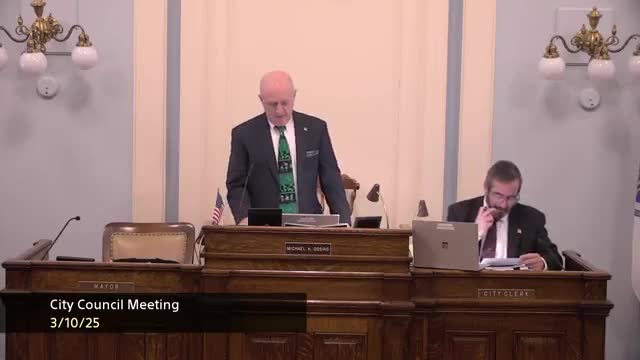
Council President Ossing opened a public hearing March 10 on a special‑permit application from GR Development LLC, doing business as Washville Car Wash, to redevelop the vacant former Bank of America at 223 East Main Street into an express car wash.
Attorney Brian Falk, representing the applicant, told the council the company seeks a special permit to “construct and operate [a] car wash” on the property currently zoned Business District. Jim Waterman, executive vice president of Washville Car Wash, described the company as “a Connecticut‑based family‑owned enterprise” operating 23 facilities in New England and said the firm intends local hiring and community outreach.
The proposal calls for a full demolition and replacement of the existing building with a roughly 4,200‑square‑foot car wash, 15 parking spaces, three inbound queuing lanes and on‑site water reclamation. Engineer Luke DiStefano said the project would increase impervious surface by about 3,000 square feet but include a stormwater management system designed to meet Marlborough and Massachusetts standards. Traffic consultant Robert (Bob) Michaud said similar facilities generate roughly 30–60 customer transactions per hour on average and that the project would add about 20 vehicle trips per typical hour compared with the former bank use; he also said the site offers more on‑site queuing than other area car washes and that fire apparatus swept‑path requirements are accommodated.
Neighbors and nearby business owners spoke at length in the hearing. Elvira Watson of Curtis Avenue asked how the development would affect residents directly behind the site and whether vehicle emissions and noise would worsen. Leah Owen, property manager for 41 Curtis Ave., raised existing flooding and drainage problems on Curtis Avenue and asked how the new stormwater system would address that. Longstanding local operators, including Matthew Paesner of Scrub It Up Auto Wash and Nick Gioloussis (27 Curtis Ave.), told the council they were concerned about market saturation and safety near the hill and signalized section of Route 20 that borders the site. Paesner urged a peer review of traffic data.
Applicant representatives provided technical details: Washville says typical operations reclaim about 74% of water used; the company said staffing would be three to seven employees on site, operating hours would be 7:30 a.m.–7 p.m. Monday–Saturday and 8 a.m.–5 p.m. Sunday, and the tunnel can host up to eight vehicles with a designed maximum throughput capability higher than typical demand (the operator cited a design capacity of about 130 vehicles per hour while projecting an operational average of 30–60 per hour). Michaud and the applicant noted MassDOT jurisdiction over Route 20 and said the existing no‑left‑turn restriction on the easterly exit would be retained and that MassDOT permitting will be required for any curb‑cut changes.
Council members pressed on specific operational risks and mitigation. Councilor Paciello asked whether vacuum spaces count toward the 15 required parking spaces; Attorney Falk said the building commissioner had signed off that the shown spaces meet zoning requirements. Councilors asked for more recent traffic counts, a noise mitigation plan and details about stormwater runoff and winter de‑icing procedures; Washville said it uses noise‑mitigated dryers at other locations, keeps a salt log and has an exit drain and operational routines to reduce runoff onto Route 20.
The council did not vote on the special permit on March 10. Members asked the applicant to provide a draft special‑permit document for distribution to the site‑plan review committee and to the Urban Affairs Committee; the council indicated the matter will proceed to Urban Affairs and detailed site‑plan review, and that MassDOT review and any required permitting will be pursued.
Why it matters: The proposal would replace a long‑vacant commercial parcel on a busy, signalized stretch of Route 20. Neighbors cited noise, drainage, pedestrian safety and competitive effects on existing small car‑wash operators; the city and MassDOT will need to address those concerns during site‑plan review and permitting.