Get Full Government Meeting Transcripts, Videos, & Alerts Forever!
Get email alerts on the Indigent Defense topic
No spam. Unsubscribe anytime.
Detroit council hears law department briefing on indigent defense caseloads, uncertainty over reverse-conviction exposure
Summary
At a law department budget hearing, corporation counsel outlined caseloads, funding and limits on predicting costs tied to reverse-conviction claims; council moved to discuss indigent defense in executive session.
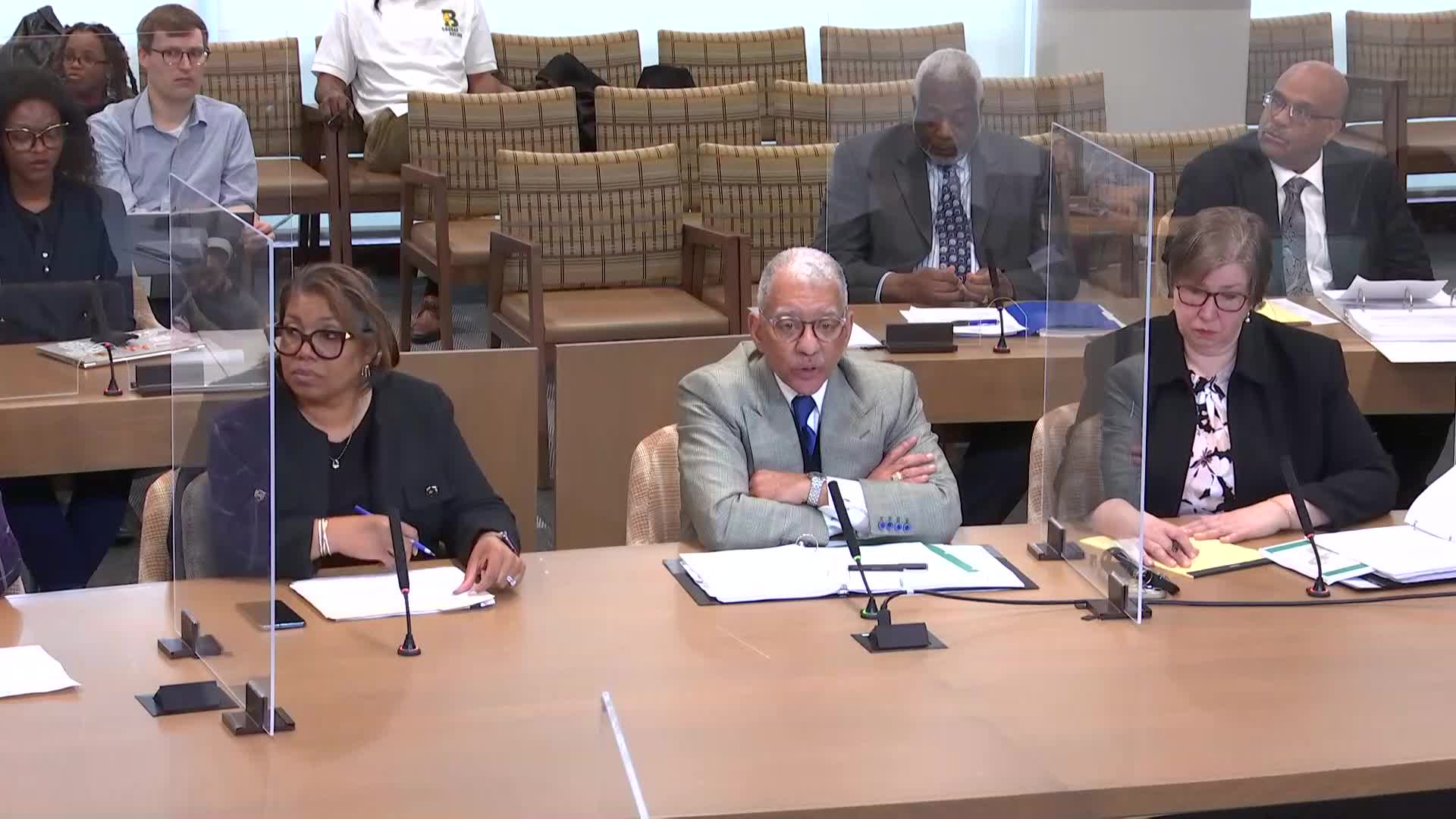
Conrad Mallett, corporation counsel for the city of Detroit, told the City Council during a budget hearing that the city’s indigent defense programs handle large volumes of work and that total program costs and future reverse-conviction exposure are difficult to predict.
Mallett said the city’s Michigan Indigent Defense Commission (MIDC)–funded program reports high activity: the law department described 56,062 arraignments and other large case counts handled in the program and said total attorney hours for one reporting period were about 68,000 spread among roughly 80 attorneys. He told the council the overall indigent defense program costs are about $5.5 million a year, of which about $5.0 million is grant-funded and the city’s share is roughly $1.1 million.
“On average, the overall cost is around 5 and a half million dollars per year. That’s for the entirety of the program,” Mallett said during the hearing.
Why it matters: council members pressed for clarity because any rising caseload or new legal claims could increase the city’s budget exposure. Mallett said the city cannot reliably predict how many reverse-conviction claims might be filed or what the ultimate cost would be because those cases depend on decisions by plaintiffs’ counsel and the Wayne County conviction-integrity processes.
Mallett reviewed the law department’s broader litigation workload to put indigent defense in context. He said attorneys assigned to courts such as 36th District handle hundreds of thousands of misdemeanor matters; litigation and appeals volumes remain substantial across divisions.
Council member Colmille Young II asked specifically whether the city can estimate additional reverse-conviction cases or the budget impact. Mallett replied that the department cannot predict the number of such cases and that indemnification decisions are handled as cases evolve. He said the department is negotiating with plaintiffs’ counsel in several matters and that the legal team continues to defend cases vigorously.
The council took at least one formal procedural action on the topic. Council member Colmille Young II moved to place indigent defense counsel discussion into executive session; there were no objections and the body announced the action would be taken.
What the city reported: program statistics and funding levels were provided by the law department during the presentation; Mallett described the MIDC rules that cap hours by case type and outlined the city’s mix of grant and local funding. He said limits recently imposed by the state change how attorneys’ hours are tracked and funded.
Ending: Council members requested additional written details on cases, hours and costs. Mallett and law department staff said they would provide further materials to the committee and that the executive-session discussion would follow the public hearing.