Get Full Government Meeting Transcripts, Videos, & Alerts Forever!
Get email alerts on the Fire Department Operations topic
No spam. Unsubscribe anytime.
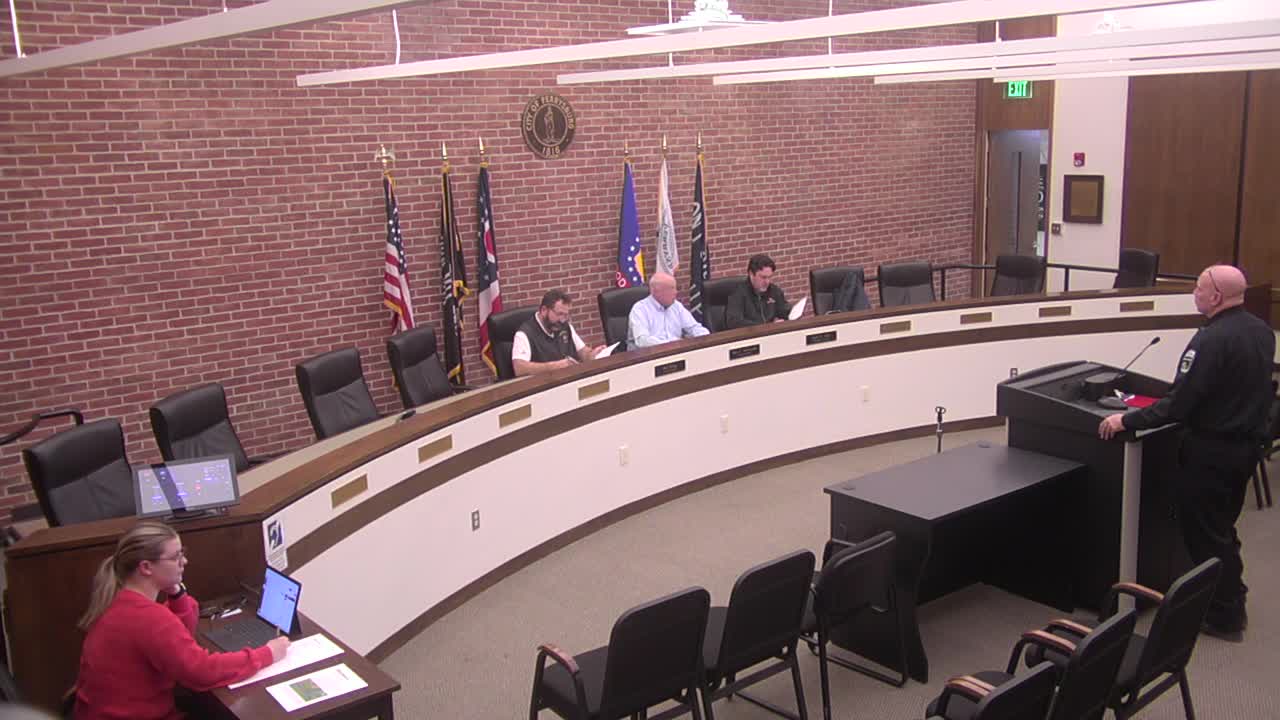
Perrysburg Fire Division reports rise in calls and plans to add in-vehicle data terminals
Summary
The city's Fire Division told the safety committee it handled 3,584 incidents last year, saw a nearly 13% increase in runs and plans to equip fire apparatus with mobile data terminals to get up-to-date incident information while responding.
Perrysburg's Fire Division reported to the safety committee that incidents rose to 3,584 last year, a 12.75% increase from the previous year, and said it will add mobile data terminals (MDTs/MDCs) to its fire apparatus to improve in-field access to real-time information.
The update, delivered by Chief Bryce, said the department's average response time citywide is 7 minutes, 18 seconds, and that travel-time mapping from the city's two stations shows about 89% of the city lies within four minutes' travel time. The Chief characterized the incident increase as roughly 405 additional runs over the prior year and said the department will continue to track trends quarterly.
Chief Bryce told the committee the department is moving ahead with MDT and MDC hardware even though a countywide computer-aided dispatch (CAD) system rollout has been delayed. "The original plan was to wait until the county's CAD system came online. But as that goal post keeps moving ... I felt it necessary for us to take this initiative and do this with our current CAD system," he said. He added the hardware being purchased will be compatible with the county system when it is implemented, so the city will not need to replace it later.
Why it matters: MDTs give crews live updates from dispatch and incident reporters and provide routing/navigation information. In Perrysburg's case, committee members were told the current third-party mapping service does not always reflect updates a dispatcher receives while crews are en route.
The department highlighted additional operational details in its annual report. Notable items included: station-level call volumes (Station 38: 1,853 calls; Station 39: roughly 1,430 calls; multi-station responses: 290), 5,500 man-hours of training in 2024 (versus about 3,000 the year before), and 2,894 EMS incidents that produced 2,007 transports. Chief Bryce said most patients are transported to Mercy Perrysburg unless a specialty trauma or pediatric facility is required or Mercy is on bypass.
The report also described changes to response patterns. The division has been adjusting its dispatching to avoid tying ambulances to low-acuity calls; for some call types ("lift assists" and certain medical alarms), the department now sends a reduced or tiered response so ambulances remain available for higher-acuity calls. "We're really taking a close look at the data ... to make sure we're not sending the same level of response when the emergencies are different," Chief Bryce said.
The committee heard about equipment and grant activity: a Firehouse Subs Public Safety Foundation grant replaced multi-gas meters and a Bureau of Workers' Compensation grant paid for upgraded protective hoods. The division also pointed to a cross-staffing policy at Station 38 that places a reserve medic in service when the station's engine crew is available, creating a third medic unit while reducing wear on a front-line engine.
Committee members asked several operational questions about peak-period clustering of calls and train crossing delays; Chief Bryce said train crossings have rarely caused delays longer than one minute and that such delays are logged by dispatch. He also described the map the GIS department produced, noting that travel times vary by time of day and traffic conditions and that quarterly embedding of actual run data into the map will help the division analyze trends.
The committee did not record a separate formal vote on the annual report or the MDT procurement during this segment. The Chief invited committee members to follow up with specific data requests.
Ending: The department framed the MDT project as an operations-driven acquisition intended to improve situational awareness and routing while preserving future compatibility with a county CAD system when it is implemented. Committee members expressed appreciation for the data and flagged ongoing attention to staffing and response-model changes.