Get Full Government Meeting Transcripts, Videos, & Alerts Forever!
Get email alerts on the Virtual Currency Kiosks topic
No spam. Unsubscribe anytime.
Committee holds public hearing on bill to regulate virtual-currency kiosks, including $1,000 daily limit and fee cap
Summary
The Consumer Protection & Business Committee held a public hearing March 25 on Senate Bill 5,280, a proposal to add licensing, location reporting, transaction limits and disclosure requirements for virtual-currency kiosks operating under the Uniform Money Services Act.
The Consumer Protection & Business Committee held a public hearing March 25 on Senate Bill 5,280, a proposal to add licensing, location reporting, transaction limits and disclosure requirements for virtual-currency kiosks operating under the Uniform Money Services Act.
The bill would define a ‘‘virtual currency kiosk’’ as ‘‘an electronic terminal that facilitates the exchange of virtual currency for money or other virtual currency,’’ require kiosk operators to report branch locations and authorized delegates to the statewide licensing system at least 30 days before business begins, and bar a kiosk from accepting, dispensing or transmitting more than $1,000 per day to or from a customer. It also would cap aggregate fees per transaction at the greater of $5 or 5% of the U.S. dollar equivalent, require pre-transaction disclosures about the licensee and fraud risk, and require a detailed receipt that includes the customer’s name, transaction amount, fees, exchange rate and any price difference from prevailing market rates.
Why it matters: Department of Financial Institutions staff and local law enforcement told the committee the kiosks have been used in fraud schemes that particularly affect older adults and low-income neighborhoods. Supporters said the bill’s transaction limit and disclosure rules would create guardrails intended to reduce rapid-loss fraud and ease recovery efforts; industry witnesses said the fee cap and low daily limit would be unworkable and could push operators out of the state.
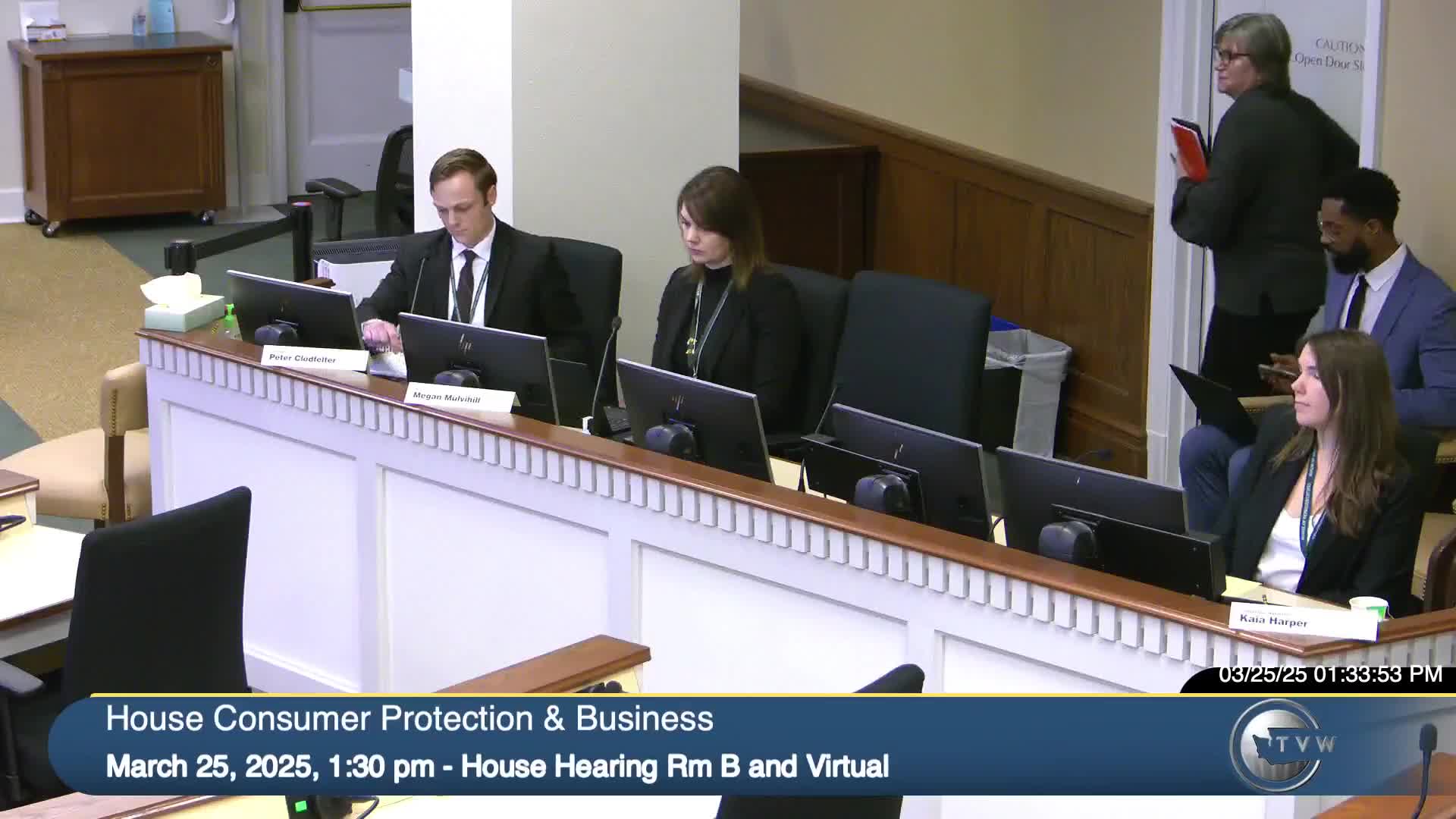
Committee staff Peter Clodfelter summarized the bill’s provisions, saying the kiosks are already regulated as money transmitters but that the bill would ‘‘add certain requirements for virtual currency kiosk operators’’ including reporting, a daily transaction limit and new disclosure and receipt obligations. Clodfelter also explained the bill excludes mobile phones and similar consumer devices from the kiosk definition.
Drew Bowden of the Department of Financial Institutions told the committee the bill came after the Spokane Police Department alerted the agency to a string of frauds. Bowden said regulators found ‘‘increasing fraud’’ connected to kiosks and noted Federal Trade Commission data showing reported fraud increased roughly tenfold between 2020 and 2023. He said the department reviewed other states’ laws and cited California and Vermont as recent comparators.
Spokane Police Detective Timothy Schwaring said his office now handles ‘‘several a day’’ involving kiosk fraud, including cases in which victims have deposited life savings. ‘‘I’ve had 3 suicides associated with cases of people that have lost their entire life savings due to these scams,’’ Schwaring said, and he described kiosks also being used to move proceeds in narcotics cases.
City of Spokane Council President Pro Tem Paul Dillon said the Spokane City Council had unanimously supported local regulations in December and urged the Legislature to pass the state bill, noting kiosks are concentrated in some low-income census tracts.
Consumer advocates including Kathleen McCall, Advocacy Director at AARP Washington, urged the committee to support the bill’s limits and disclosure requirements. McCall cited an FBI 2023 cryptocurrency report referenced in testimony that ranked Washington among the states with high complaint counts and dollar losses.
Industry witnesses voiced objections. Ari (Airy) Yu of the Washington Technology Industry Association said a 3% fee cap in a prior draft (committee staff and witnesses discussed a 5% or $5 cap in this hearing) would amount to a de facto ban and that the proposed $1,000 per-day limit could undercut federal suspicious-activity reporting thresholds and reduce data available to law enforcement. Ethan McClelland of Bitcoin Depot and Kevin Lawley of CoinFlip said kiosks already operate under federal anti–money-laundering rules and argued the bill’s fee cap and transactional ceiling would make business unworkable; they stressed their companies’ investments in compliance, blockchain analytics and law-enforcement cooperation.
The public hearing record included differing views on possible compromise language such as lower limits for first-time users and higher limits for established customers, and on whether a percentage or flat-dollar fee cap better balances consumer protection and operator viability.
No committee vote was held on SB 5,280 during this meeting; the chair closed the public hearing and the committee moved to the next agenda item.
Sources and next steps: The Department of Financial Institutions and multiple municipal and industry witnesses provided testimony during the hearing. The committee will consider amendments and potential next steps at a future meeting; the transcript does not record any committee action on SB 5,280 at this session.