Get Full Government Meeting Transcripts, Videos, & Alerts Forever!
Get email alerts on the Community College Programs topic
No spam. Unsubscribe anytime.
South Puget Sound Community College credits I‑BEST and new‑arrival funding for growth; refugee student describes pathway to cybersecurity
Summary
South Puget Sound Community College officials told the committee that state new‑arrival funds and I‑BEST expanded local English and transition programs; a Ukrainian student described using ESL and I‑BEST classes to enter a cybersecurity program.
OLYMPIA — South Puget Sound Community College (SPSCC) told the House Postsecondary Education & Workforce Committee on March 25 that state new‑arrival funds and the I‑BEST model have allowed the college to add sections, adopt new curriculum and expand supports for refugee and immigrant students.
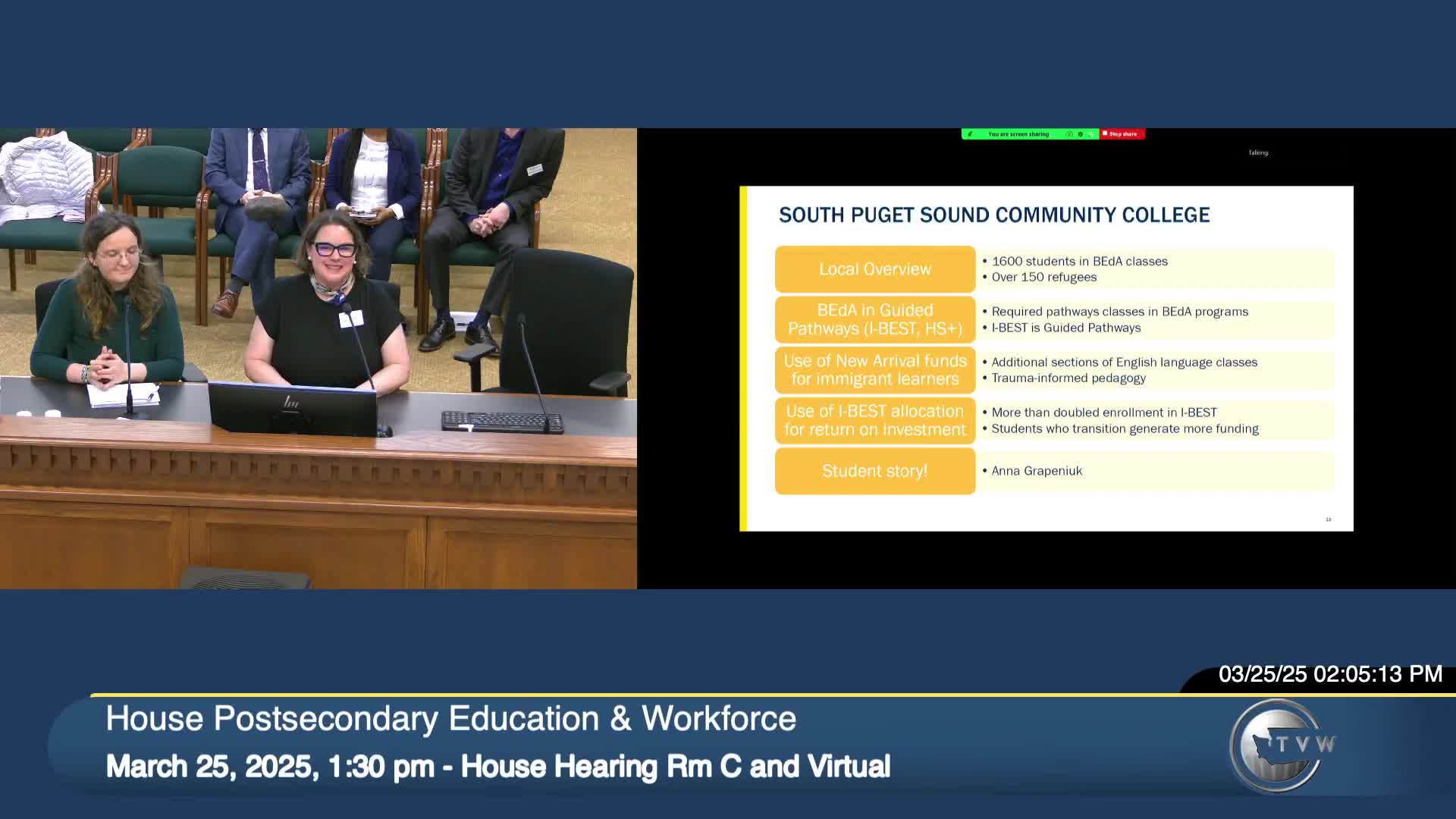
Jennifer Barber, dean of Transition Studies at SPSCC, said the college serves about 1,600 students in its English as a second language (ESL) classes and has taken in more than 150 refugees in the past two years. “The new arrival funds have been tremendously helpful,” Barber said. “They’ve allowed us to add additional sections to our English language program, adopt new curriculum, offer faculty additional training, as well as adopting and understanding better trauma‑informed pedagogy.”
Why it matters: SPSCC staff told lawmakers that increased state support has let the college expand ESL access in a region with growing demand and that the I‑BEST model — which pairs basic‑skills instructors with technical faculty and provides wraparound supports — produces high retention and transition rates into college programs.
Local outcomes and student pathways Barber said SPSCC has doubled I‑BEST enrollment over the last six years and reported a 76% retention rate in I‑BEST cohorts. She added that students who transition into college‑level programs do not immediately generate tuition revenue for the college’s ABE classes but can lead to additional funding as students meet milestones in credit programs.
A student who identified herself as Zannan Gropiniuk, a recent arrival from Ukraine, described her pathway from ESL classes through I‑BEST into cybersecurity coursework. Gropiniuk said pathway classes, repeated exposure and supportive instructors motivated her to continue: “Don’t hesitate … continue to set up from the beginning your life and to continue learning,” she told the committee.
Languages and local access Barber said the college’s primary ESL languages are Spanish, Korean, Vietnamese and Mandarin, and that the college also serves Ukrainian, Afghan and Central and South American students. Lawmakers raised concerns about uneven distribution of classes in high‑demand parts of the state and asked SPSCC and SBCTC to describe system strategies to shift capacity to the most affected communities.
What was asked of the committee Barber asked legislators to visit local adult basic education and ESL classes to see course scheduling and supports in practice, and to consider system‑level approaches for instructor pipelines and classroom capacity. Committee members indicated interest in continuing engagement and in receiving more information about how colleges cover costs for non‑tuition‑generating classes.
Ending note SPSCC officials said they would follow up with the committee on detailed funding and staffing models and welcomed lawmakers to visit campuses.