Get Full Government Meeting Transcripts, Videos, & Alerts Forever!
Get email alerts on the Adult Basic Education topic
No spam. Unsubscribe anytime.
State board details adult basic education strategy, highlights I‑BEST and High School Plus, seeks legislative support
Summary
State Board for Community and Technical Colleges staff told the House Postsecondary Education & Workforce Committee that adult basic education and I‑BEST help address a projected workforce shortfall; presenters outlined program models, funding sources, performance targets and two pending bills to expand student access to college supports.
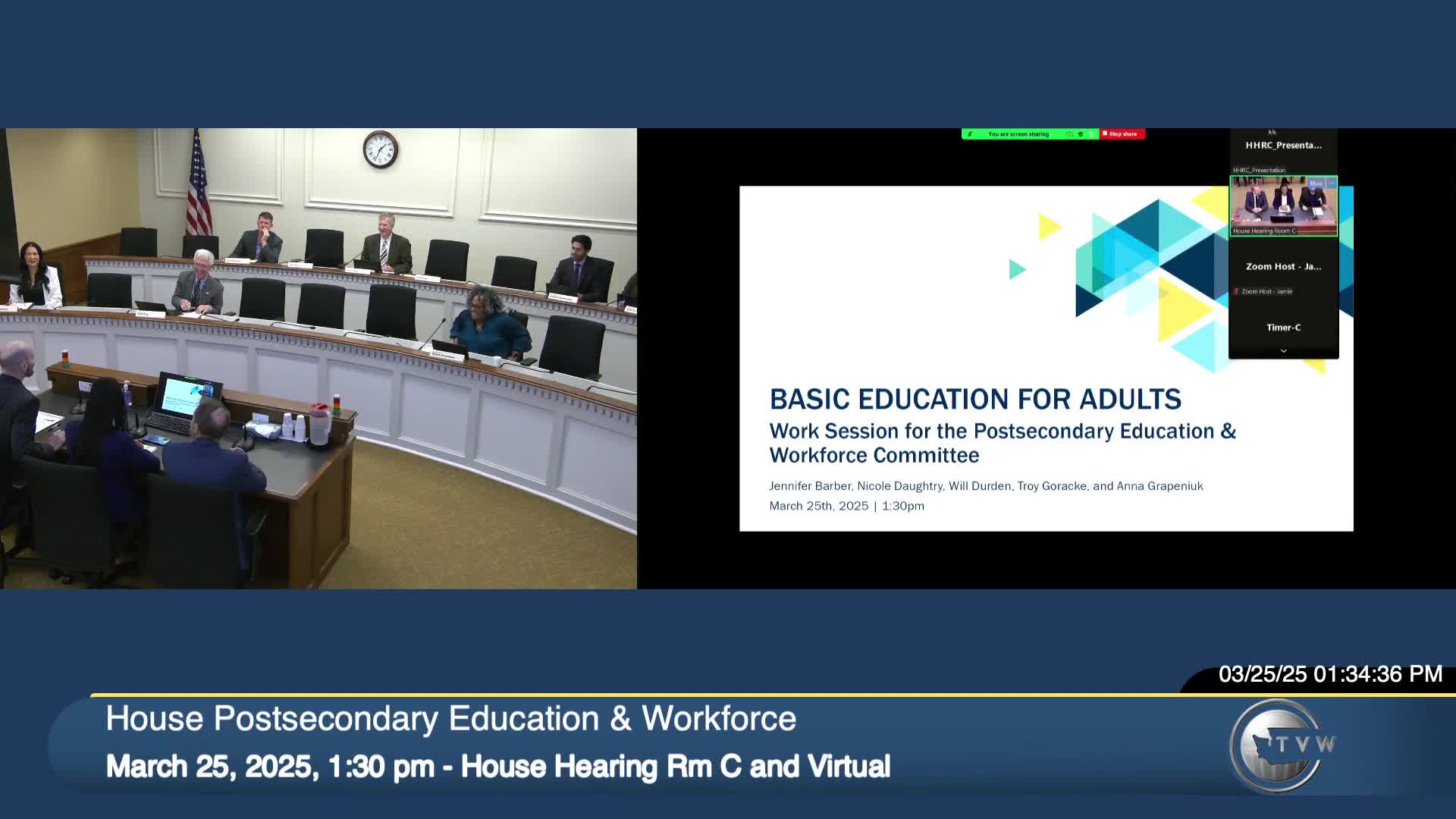
OLYMPIA — Staff from the Washington State Board for Community and Technical Colleges told the House Postsecondary Education & Workforce Committee on March 25 that adult basic education (ABE) programs, including the nationally replicated I‑BEST model and the state’s High School Plus diploma program, are a key part of the state’s strategy to close a projected workforce credential shortfall.
Will Durden, director of Basic Education for Adults at the State Board for Community and Technical Colleges (SBCTC), said the programs serve working‑age adults seeking high school completion, English language acquisition and pathways into postsecondary training and employment. “People also go back to school to feel their minds working and to learn new things, to help their kids, to feel competent, to remedy a poor education, to redefine who they are, and to start over,” Durden said.
Durden and SBCTC policy associates outlined program models, funding, outcomes and legislative priorities. The presenters said Washington faces a 12.8% job growth projection over the next decade and an estimated shortfall of nearly 600,000 credentialed workers; roughly 500,000 state adults have less than a high school diploma or equivalent.
Why it matters: SBCTC staff told lawmakers that ABE addresses both education equity and workforce needs by helping adults gain diplomas or credentials, improve English proficiency and enter or re‑enter postsecondary programs or employment. The committee heard that these programs are not tuition‑generating and depend on a mix of federal, state and local subsidies.
Program models and outcomes SBCTC described two Washington‑specific models: High School Plus, in which community colleges issue a Washington State high school diploma after competency and prior‑learning assessment, and I‑BEST, the integrated basic education and skills training model that pairs at least two instructors and includes navigational supports for barriers such as childcare and transportation.
Nicole Daughtry, policy associate at SBCTC, said I‑BEST combines contextualized, industry‑specific training with team teaching and wraparound services so students can “walk away with an industry‑recognized credential or certificate and go right into the workforce” after one to three quarters in many programs.
SBCTC reported serving about 37,000 individuals in its last full program year and said colleges award more High School Plus diplomas than GEDs. The board also shared federal Workforce Innovation and Opportunity Act performance indicators (credential attainment, employment and earnings). Durden explained that employment targets — for example, the 30.1% employment target for second and fourth quarters after exit shown on a slide — are negotiated every two years with the U.S. Department of Education and adjusted based on past performance.
Funding and administration Presenters said federal seed funding for ABE was approximately $13.7 million in the most recent fiscal year, with additional state investments of about $3.2 million annually for new‑arrival students (including Afghan and Ukrainian refugees) and roughly $750,000 to support the I‑BEST program. Colleges also heavily subsidize programs with local funds because ABE and many ESL classes are not eligible for standard financial aid; SBCTC staff said colleges commonly charge $25 per quarter for ABE classes (sometimes waived) while covering the remainder from local and state sources.
The board noted that correctional facility high school completion is run through an interagency agreement with the Department of Corrections, with the SBCTC acting as the contracted provider for those services.
Legislative items Troy Geraci, policy associate at SBCTC, thanked the committee for its support of House Bills 1554 and 1556. He said HB 1554 would make students who obtain a high‑school equivalency credential eligible for the College Bound Scholarship, placing them “on the same footing as everyone else with a secondary credential.” HB 1556 would allow colleges to waive fees and tuition for students taking college‑level courses while completing high‑school credentials. Geraci said Senate companion bills were scheduled for executive session in the committee the following day.
Clarifying points from lawmakers Committee members asked for clarifications on several topics. Rep. Drew (Chair Paul) and others questioned how employment targets are set; Durden said the Department of Education proposes targets and SBCTC negotiates them based on past performance and a formula the department uses. Rep. Thomas asked whether students who enter further education rather than employment are captured in employment metrics; SBCTC staff said some students who continue full‑time postsecondary study may not show as employed in the short‑term employment measures. Lawmakers also raised concerns about wait lists for English classes in high‑demand areas, and Durden and colleagues pointed to two capacity issues: a teacher shortage in some regions and limited classroom space.
Staff and committee members advised SBCTC to provide more detail on system‑level strategies for reallocating classes and building educator pipelines, and asked for follow‑up information about connections between correctional education and apprenticeship or workforce board pipelines.
What was not decided No formal motions or votes were recorded on March 25. SBCTC requested continued legislative support for the two bills and offered to return with additional information as requested by committee members.
Ending note SBCTC presenters asked the committee for continued engagement on the bills and for help understanding system‑level responses to teacher shortages and capacity constraints in high‑demand regions.