Get Full Government Meeting Transcripts, Videos, & Alerts Forever!
Get email alerts on the Operating Budget topic
No spam. Unsubscribe anytime.
House Appropriations Committee holds wide-ranging public hearing on proposed substitute HB 1198 operating budget
Summary
State budget staff briefed the committee on the proposed substitute House Bill 1198 and dozens of agencies, local officials and advocates urged restorations or changes on matters ranging from court technology and special education to homelessness, long‑term care and tourism funding.
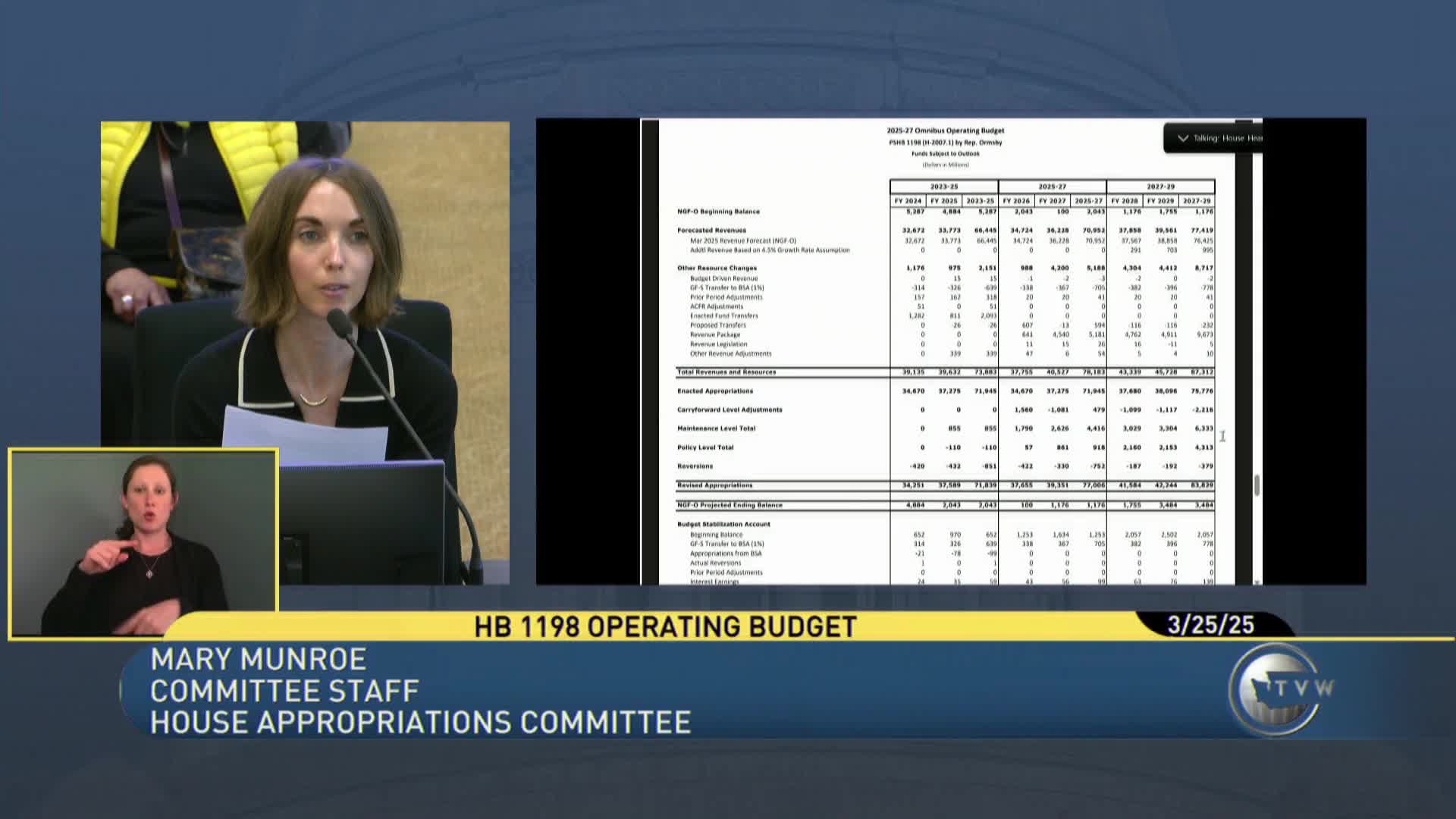
The House Appropriations Committee held a public hearing on the proposed substitute House Bill 1198, the operating‑budget proposal that lays out spending and savings across the 2025‑27 biennium. Mary Monroe, staff to the committee and the budget coordinator who opened the briefing, told members the package assumes the March 25 revenue forecast and that the bill leaves a near‑general fund outlook (NGFO) ending balance of about $1.2 billion at the end of the 2025‑27 biennium.
Why it matters: The briefing and more than 300 people who signed up to testify highlighted how the proposal’s cuts and restorations would affect courts, schools, behavioral‑health programs, homelessness services, long‑term care providers and local economic development. Witnesses repeatedly asked the committee to restore or adjust funding in targeted areas and flagged operational and implementation risks if changes are adopted as drafted.
Budget briefing and outlook: “The bill before you today is proposed substitute House Bill 11 98,” Mary Monroe said, adding the NGFO outlook rolls forward the March revenue forecast and reversion assumptions carried in the governor’s Book 2 proposal. She summarized the policy‑level net increase of roughly $5.1 billion in NGFO spending across a five‑year outlook and detailed projected reserve levels and reversion assumptions included in the package. Monroe and committee staff pointed members to the written PSHB 1198 summary for line‑by‑line items and to fiscal.wa.gov for full documents.
Requests from the judicial branch: Chief Justice Deborah Stevens, representing the judicial branch and the Administrative Office of the Courts, thanked the committee for funding a limited‑jurisdiction case management system but urged the House to restore money to move statewide court IT to the cloud. “The absence of that funding would be nothing short of devastating,” she said, adding that court education funding has been flat for 15 years and that training for newly onboarded judges and staff is essential to consistent statewide implementation of new laws.
K‑12 and special education: Multiple witnesses representing education organizations and school districts urged deeper investment in K‑12 to avoid cuts to services. Tyler Munsch, speaking for the Office of the Superintendent of Public Instruction, said OSPI is “in opposition to the proposed operating budget” because it continues to underfund special education and materials, supplies and operating costs (MSOC), which he said risks services that students are legally entitled to and could force districts toward layoffs. School boards, superintendents and the Washington Education Association echoed that request and asked the committee to consider the Senate’s higher funding levels.
Ninth‑grade success and early learning: District leaders and representatives of the Ninth Grade Success Initiative described measurable gains from the program and asked the committee to restore its funding. Advocates for early learning and child care also asked the House to preserve existing ECAP and early ECAP investments, warning that cuts to these programs would reduce access for the most vulnerable children.
Homelessness, encampment response and local shelter requests: Local officials and homelessness providers urged the committee to preserve or restore several homelessness programs. King County and community organizations thanked the House for some funding but warned that reductions to consolidated homeless grants and other streams put hundreds of projects at risk. Tacoma’s mayor asked the Legislature to restore a $12 million request to keep more than 300 emergency and temporary shelter beds open beyond June 30. Several witnesses urged that the Right‑of‑Way Encampment Resolution (ROE/ERP) program maintain prior funding levels; providers said the program’s outreach‑to‑housing model has high acceptance rates and long‑term housing outcomes.
Long‑term care and Medicaid reimbursement: Nursing‑home and assisted‑living operators, trade associations and union representatives warned that the House proposal freezes Medicaid reimbursement rates based on 2022 costs and postpones a planned rate rebase to fiscal 2028. They said rising labor and supply costs make a multi‑year freeze unsustainable and risk facility closures, reduced access, longer hospital stays and higher downstream public costs. Several administrators warned the pause in rebasing and increases in license fees would force limits on Medicaid admissions and staffing.
Adult family homes and assisted‑living advocates highlighted carveouts and bridge funding that help high‑Medicaid facilities but urged the committee to adopt the Senate approach to base‑rate increases and bridge funding that would avoid narrowing access for low‑income seniors.
Higher education and fund‑split concerns: Public universities and community and technical colleges raised concerns about reductions in institutional support and changes to the state/student fund split that would increase pressure on tuition and institutional budgets. Multiple university representatives urged the Legislature not to reverse progress on the fund‑split policy that had been moving state support toward agreed targets.
Legal aid, eviction defense and immigrant legal services: Civil‑legal aid providers asked the committee to restore or continue funding for eviction‑defense appointed counsel, kinship legal aid (LARC), immigrant legal aid (including the Legal Aid for Low Income Immigrants grama) and the WAMAS program for migrant and asylum seeker services. Office of Civil Legal Aid staff warned that not funding vendor rate adjustments would, in effect, cut legal services capacity at a time of high need.
Behavioral health, children’s mental health and diversion programs: Providers and advocates called for sustained or increased funding for youth behavioral health, crisis services and prevention programs. Several testimony teams asked the House to match Senate funding for children’s crisis services, the Partnership Access Line and other behavioral‑health items to reach children in crisis and expand early intervention.
Other agency and local concerns: Testimony covered a wide range of other programs: the Office of Independent Investigations warned about cuts that would halt hiring and expansion; public defenders asked for vendor‑rate parity for contract attorneys; local governments and public works advocates urged the Legislature not to divert large sums from the Public Works Trust Fund; tourism organizations asked the House to restore a $6 million annual increase that would return the biennial appropriation to $9 million and fund destination marketing and regional grant programs; and veterans, workforce and business groups asked for restored or continued programmatic funding in their areas.
Committee housekeeping and next steps: Committee leadership closed with two near‑term deadlines for members: the committee announced an amendment deadline at 10 a.m. the following day and a release deadline for caucus packets at noon the next day. The committee did not take votes during the hearing; the session consisted of a staff briefing followed by public testimony and technical questions.
What was not decided: No final votes or policy enactments occurred at the hearing. Many speakers asked the House to adopt Senate funding levels or specific amendments; those requests will be considered in the next stages of conference and negotiations.
Looking ahead: The hearing collected dozens of written letters and hundreds of minutes of oral testimony that committee staff said they will sample for technical follow‑ups. Many witnesses promised to submit amendment language or technical clarifications directly to staff as negotiations proceed.