Get Full Government Meeting Transcripts, Videos, & Alerts Forever!
Get email alerts on the Transportation Budget topic
No spam. Unsubscribe anytime.
House panel reviews proposed substitute for transportation budget, notes project delays and $1.2 billion reserves
Summary
Committee staff described a $15 billion transportation spending plan for 2025–27 anchored on new revenue assumptions and a $1.2 billion six‑year reserve; the substitute delays or reduces some projects and grant programs and preserves others, prompting local officials to urge restoration of specific projects.
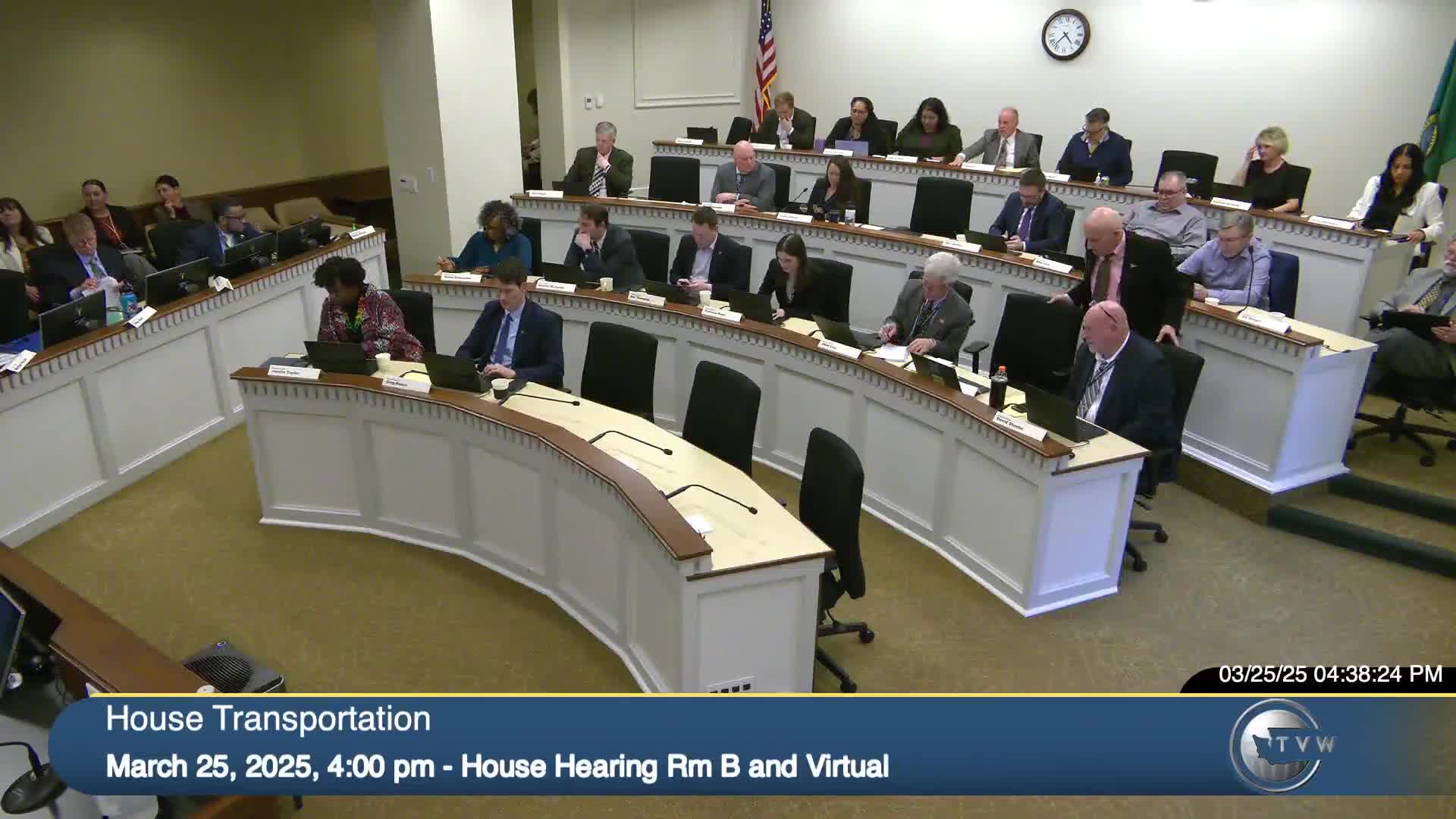
House staff presented the proposed substitute for House Bill 1227 on March 25, outlining appropriations and programmatic priorities for the 2025–27 biennium and related supplemental adjustments.
“New biennial budget proposal here for the two years includes a total of $15,000,000,000 in appropriations to transportation agencies,” Amy Skay, fiscal staff, told the committee. She said about $9 billion is for the capital program, $6 billion for operating programs and $1.8 billion for debt service and issuance costs. Skay said the capital list largely continues prior projects but that the package includes program reductions and schedule shifts to balance available resources.
Skay said the chair’s budget relies on new revenue that would be generated by the substitute for House Bill 2043, and that the overall six‑year plan retains $1.2 billion in reserves. She described reductions of about $1.3 billion in state funding for state projects and about $488 million in state funding for local projects compared with earlier plans, with many projects moved past the six‑year horizon to maintain fiscal balance.
The substitute increases funding for fish‑passage barrier removal ($220 million proposed for the biennium), funds state ferry electrification and hybrid‑vessel construction continuing from prior plans, and keeps preservation and maintenance at near current levels with a modest increase in ferry preservation. It includes climate‑related investments drawn from Climate Commitment Act resources: a sales‑tax exemption for zero‑emission transit buses (estimated $15 million), $32 million for zero‑emission school bus grants, $25 million to increase vouchers for medium and heavy‑duty zero‑emission vehicles, and $10 million for the zero‑emission vehicle infrastructure program (ZVIP).
Staff noted reductions to the regional mobility grant program and to transportation demand management (TDM) and vanpool grants. Skay also described driver safety and Washington State Patrol workforce investments and said collective-bargaining compensation increases for transportation employees were included (roughly $145 million over the biennium, including $68 million for State Patrol and $34 million for the ferry system).
Local officials and stakeholders used the hearing to press the committee to restore or preserve funding for specific projects that the proposed substitute delays. Testimony highlighted projects the staff listed as deferred or reduced, including:
- I‑5 Nisqually Delta project (expressed as an urgent project for Joint Base Lewis‑McChord connectivity and national‑security concerns by the South Sound Military & Communities Partnership and the Nisqually Indian Tribe).
- US‑12 rail separation / grade‑separation project in Aberdeen and Grays Harbor (multiple local officials, port and business leaders warned that a terminal expansion will double rail traffic and that the separation is needed to avoid long blockages and safety risks).
- Poplar Way (Lynnwood) bridge project (city officials asked the committee to retain $10 million in the 2025–27 biennium or risk losing matching federal funds).
- Bothell Way NE multimodal improvements (testimony said moving $5 million out of the biennium could jeopardize more than $37 million in federal grants and local schedule commitments).
- Mountains to Sound Greenway trail funding (Bellevue requested sequencing the $6.6 million appropriation into the 2025–27 biennium to avoid losing federal matching funds).
Speakers also pressed for preservation of the regional mobility grants, commute trip reduction (CTR) program and vanpool/ride‑share grants; transit, TDM and employer‑based commute programs said deep cuts would harm congestion mitigation and employer‑supported transit passes.
Port and seaport stakeholders generally supported the package’s commitments to Puget Sound Gateway and related freight investments, but the Northwest Seaport Alliance and allied groups asked for additional port‑electrification grant funding and flagged a separate supply‑chain competitiveness program that did not appear in the house proposal.
Why it matters: staff said the substitute balances accounts over a six‑year horizon while leaving a reserve to manage uncertainty; local governments and project sponsors argued that timing shifts for several projects would increase costs, jeopardize federal grants, and create safety and economic risks. The committee proceeded to public testimony on the budget after staff remarks; no committee vote on the substitute was taken at the hearing.