Get Full Government Meeting Transcripts, Videos, & Alerts Forever!
Get email alerts on the Transportation Resources Revenue topic
No spam. Unsubscribe anytime.
Committee hears details of proposed transportation revenue package in House Bill 2043
Summary
Staff outlined a proposed substitute for House Bill 2043 that raises fuel taxes, expands motor-vehicle sales taxes and fees, and creates a highway-use fee and other charges to generate new transportation revenue; public testimony offered both support and opposition, particularly on indexing and road-usage concepts.
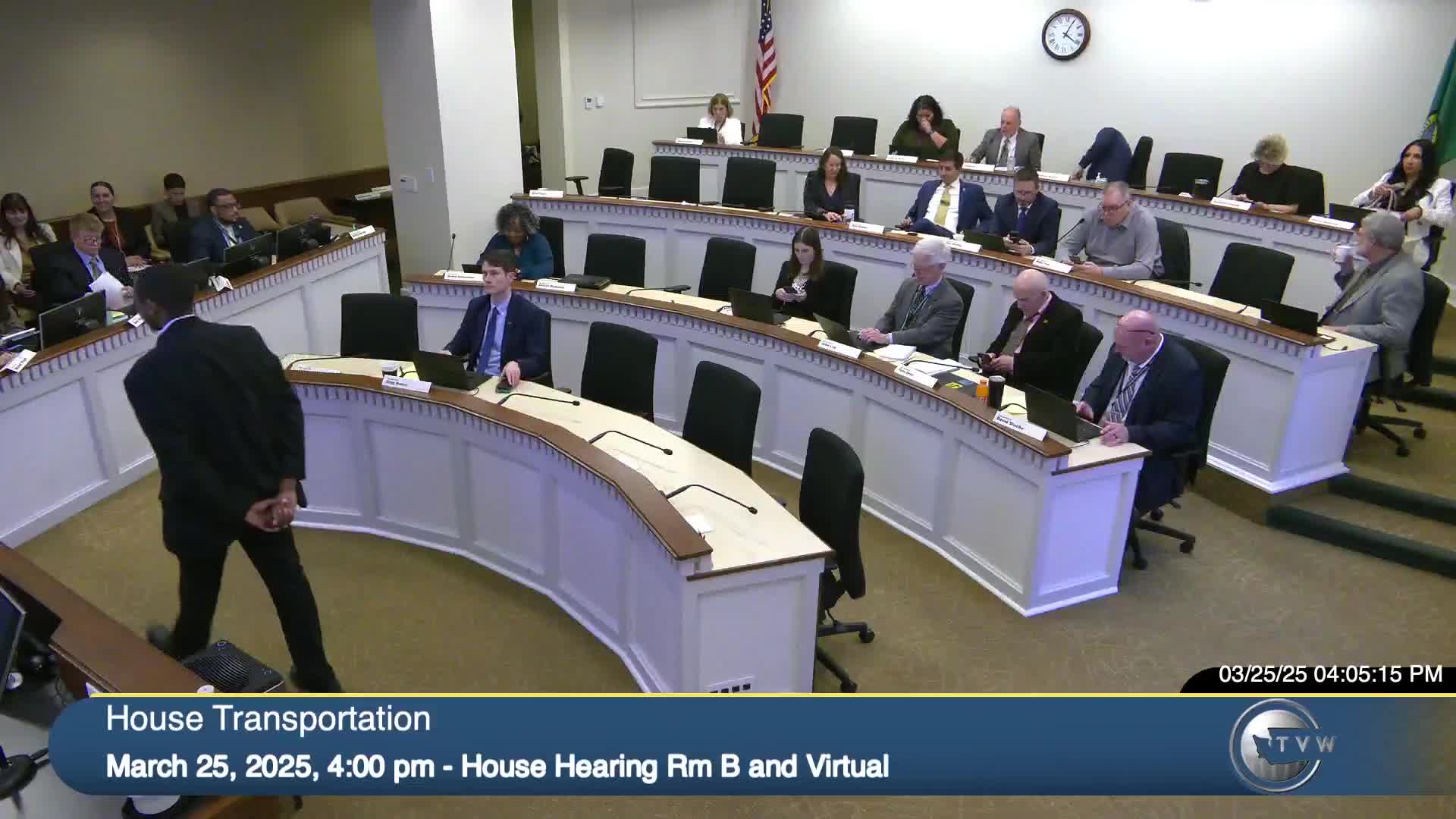
House staff told the House Transportation Committee on March 25 that a proposed substitute for House Bill 2043 would add multiple new revenue sources to support the state's transportation spending plans.
“House bill 2043 concerns transportation resources,” said Jennifer Harris, staff to the committee. Harris said the transportation budget for the 2025–27 biennium is $14,500,000,000 and that recent revenue and cost changes have created a multibillion-dollar shortfall the bill is intended to address.
Michael Hirsch, committee staff, briefed members on the substitute’s provisions. He said the bill would raise the state motor fuel tax by 9¢ per gallon beginning July 1, 2025, and increase the special-fuel (diesel) differential by an additional 3¢ on July 1, 2025, with another 3¢ on July 1, 2027. Hirsch said those fuel-rate increases are projected to raise about $1.8 billion statewide over six years and the diesel differential roughly $155 million over six years.
The substitute also raises motor-vehicle sales and use taxes. Hirsch said an additional 0.3% retail sales tax on vehicle sales would be expanded to 1% beginning Jan. 1, 2026, with proceeds deposited in the multimodal transportation account. The proposal would add graduated 1% taxes on the portion of noncommercial vehicle sales exceeding $50,000 and $100,000, and it would not allow trade-in deductions for that assessment.
Hirsch described increases to vehicle-related fees, including raised weight-based registration fees for trucks and passenger vehicles, additional fees tied to heavier passenger vehicles, and indexing of many fees to inflation beginning in mid-2026. He summarized projected six‑year revenue impacts that staff provided: $453 million from increased truck weight fees, $228 million from increased passenger vehicle weight fees, $1.1 billion from motor-vehicle sales/use tax changes, $121 million from an added $4 tire‑replacement fee per tire, $45 million from higher title and registration service and filing fees, and roughly $384 million from the new highway‑use fee together with electric-vehicle fee changes. Hirsch also estimated modest revenues from proposed ferry surcharges and credit-card transaction surcharges on ferry fares.
On electric vehicles, Hirsch said the bill replaces the existing hybrid vehicle fee with a highway‑use fee assessed at registration for motor vehicles under 10,000 pounds and with fuel economy above 25 mpg (excluding battery electric and plug‑in hybrid vehicles). He said ZVIP and ZAP programs and WSU Extension energy assistance programs would not expire July 1, 2025, and clarified that the ZVIP program would not be restricted to the electric vehicle charging infrastructure account alone.
Public testimony reflected a range of views. Greg Hannon, who identified opposition to indexing, told the committee indexing “breaks the link between budgeting and revenues” and said his group’s objection was specifically to automatic indexing rather than to periodic legislative increases. Dakota Manley and Anthony Mixer of the Washington State Young Republicans opposed what they described as language that could permit a road‑usage charge, citing privacy, administrative, and equity concerns. By contrast, Transportation Choices Coalition and other transit and environmental advocates generally supported graduated sales‑tax elements and a highway‑use fee as ways to shore up revenue as vehicles become more fuel efficient.
Committee staff also provided preliminary administrative estimates. Sandy Meyer said the Department of Licensing listed roughly $225,000 in one‑time IT programming costs related to the fuel tax and vehicle-fee changes and that implementing the highway‑use fee could require two additional full‑time employees and about $500,000 per fiscal year, including a vendor contract for mileage data.
No formal action or vote on the substitute was recorded during the hearing; the committee opened public testimony following the staff presentations.
Why it matters: committee staff and several testifiers tied the proposed revenue package to an immediate need to prevent program cuts and to preserve ongoing transportation projects. Supporters said the mix of fees is intended to maintain purchasing power as inflation and fuel‑efficiency trends reduce traditional gas‑tax revenue; opponents warned that indexing and automated increases reduce legislative accountability and could disproportionately affect some drivers.
The committee heard the bill’s technical details and public perspectives and then moved on to the separate budget proposal that relies in part on new revenue from HB 2043.