Get Full Government Meeting Transcripts, Videos, & Alerts Forever!
Get email alerts on the Subdivision Controversy topic
No spam. Unsubscribe anytime.
Neighbors sharply oppose Whispering Woods subdivision; concerns about water pressure, emergency access and wetlands dominate hearing
Summary
A proposed 19‑lot subdivision called Whispering Woods drew sharply critical public comment Tuesday in Manchester, where neighbors warned that low water pressure, single‑point access for emergency vehicles, tight roadway geometry and wetland impacts make the plan unsafe as presented.
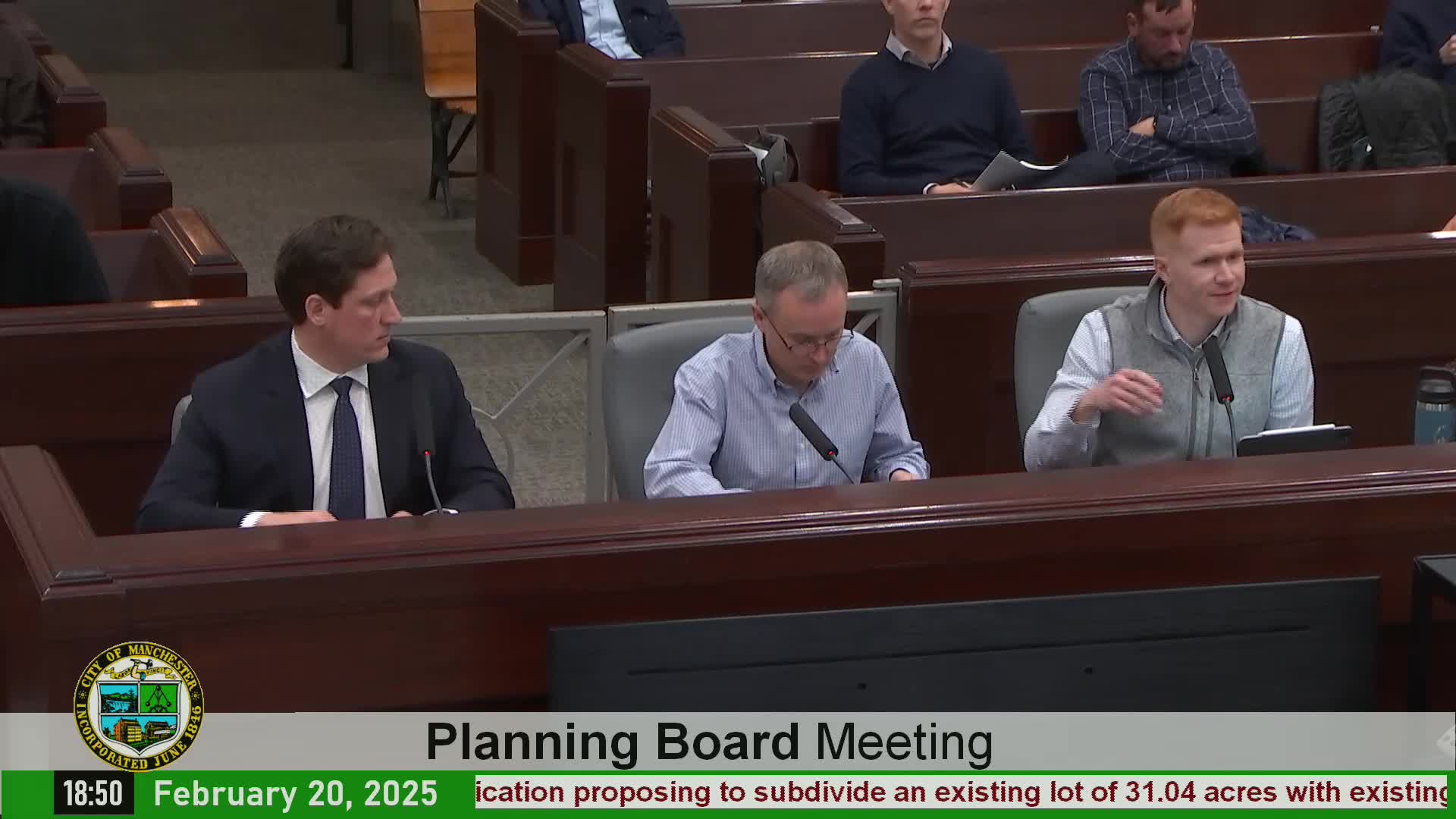
A proposed 19‑lot single‑family subdivision called Whispering Woods, located off South Ridge Drive and accessed from a 50‑foot right-of-way, drew sustained public opposition at Tuesday’s Manchester Planning Board public hearing.
Brent Cole of Granite Engineering presented the plan for a 31‑acre parent parcel to be subdivided into 19 buildable lots served by a 28‑foot-wide municipal loop road and municipal water, private sewer, underground utilities and a closed drainage system. The project would cross two wetland corridors; the applicant said it has submitted a wetland crossing and Alteration of Terrain application to state agencies, that the Conservation Commission had given a favorable recommendation and that traffic counters showed only a modest number of new peak‑hour trips from the project.
Residents who live on South Ridge Drive, Bryant Road, Forest Hill Way and adjacent streets spoke in numbers during public comment. Recurring themes:
- Water pressure and fire response: Multiple speakers said water pressure is low at the top of Bryant Road and that Manchester Fire Department had difficulty fighting a house fire in 2014 because of inadequate pressure. Neighbors warned that adding 19 houses would stress existing pumping and make firefighting and other emergency responses slower or less effective. Several asked whether Manchester Water Works would require upgrades and whether the developer would fund mitigations.
- Single access and emergency egress: South Ridge Drive and Bryant Road are effectively single‑access streets; longtime residents and former planning board members said the lack of a second egress and the development’s long no‑outlet approach create a risk for rescue and evacuation. Some asked whether the developer had explored connecting to Lucas Road or providing emergency access; the applicant said there is no frontage or willing seller on Lucas Road and no feasible alternate access.
- Roadway geometry and snow removal: Neighbors said the stub right-of-way between 73 and 99 South Ridge Drive is narrow, with tight curves and limited room for construction vehicles, plows and large emergency vehicles to turn. Multiple speakers asked whether street trees or buffers could be preserved, and whether the City would be able to maintain the additional road segment during winter.
- Wetlands and environmental concerns: Commenters and an attorney representing a group of abutters cited the subdivision regulations’ requirement that lots be suitable for building and public safety. They urged consideration of downstream hydrology, Cohas Brook water quality (noting E. coli impairment), and cross‑town impacts. Attorney Laura Gandy asked that the town of Londonderry be notified because downstream flows affect Little/Big Cohas Brook, which has protections in Londonderry’s ordinance.
Applicant response and staff notes: The applicant said the design follows Manchester standards for roadway width, curbing and drainage, that they have technical answers for wetland crossings (48‑inch culverts with stream simulation), had met early with DPW and Fire and that the Conservation Commission issued a favorable recommendation. Granite Engineering said the project mirrors the size and form of South Ridge Drive, approved in 2002, and does not require variances or waivers.
Board and staff follow-up: Planning staff noted several outstanding technical items (sewer connection permits, AOT filings and DPW engineering comments) and said the Project will require DES and EPD approvals for stormwater and wetlands. The hearing remained open; the board asked for further details about water‑system capacity, emergency access possibilities, and the proposed wetland crossings. Chairman Bryce Kawout asked Manchester Water Works to review reported low-pressure claims and provide data to the board.
Why it matters: Residents framed the proposal as a community‑scale change for a quiet neighborhood, citing safety, infrastructure and environmental impacts. The subdivision would add nearly two dozen homes on a site that neighbors and the attorney for abutters said has complex wetlands and limited existing access. The board left the hearing open pending technical responses and additional staff review.
Sources: Public hearing testimony and applicant presentation, Manchester Planning Board transcript, Feb. 20, 2025.