Get Full Government Meeting Transcripts, Videos, & Alerts Forever!
Get email alerts on the Municipal Budget topic
No spam. Unsubscribe anytime.
Chelsea presents draft FY26 budget, seeks public input
Summary
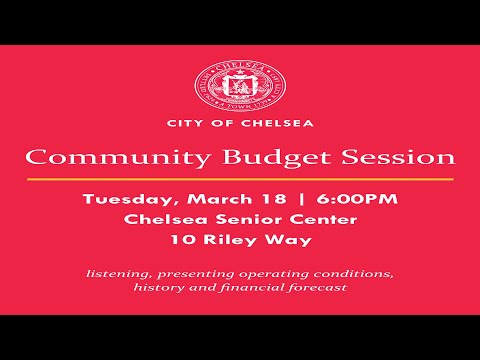
Deputy City Manager for Finance Michael Mason Jr. presented a draft fiscal 2026 budget at a community session in Chelsea, describing projected revenue sources, proposed spending increases for schools and public safety, planned staffing changes, and next steps for public review.
Deputy City Manager for Finance Michael Mason Jr. presented a draft fiscal 2026 budget at a community budget session in Chelsea, outlining projected revenue, proposed increases for schools and public safety, planned staffing changes and efficiency cuts, and a timeline for community feedback and City Council review.
Mason told attendees the city is sharing the draft earlier than in past years to gather public input before the City Council considers a final budget; he emphasized the numbers are preliminary and subject to change as state aid and other items are finalized. The draft reflects the city’s stated priorities of supporting education, strengthening public safety, sustaining core city services and advancing neighborhood and infrastructure improvements.
Mason walked the audience through the development timeline: the capital improvement plan (CIP) work began in August; departmental operating requests were submitted in mid-January; the school committee must adopt a budget by April 2, and the City Council will hold budget meetings May 12–14 with a budget hearing and vote expected in June and formal adoption in July. Mason said the city accelerated internal deadlines this year to allow earlier community sessions.
On revenue, Mason said state aid and local taxes are the major funding sources. He said state “chapter 70” education funding and other state receipts make up roughly 50–55% of Chelsea’s revenue, with taxes (including property, motor vehicle excise, meals and hotel taxes) representing a bit more than 35%. Mason said the city is conservatively projecting tax receipts and that state aid figures may change as the governor’s budget and state allocations move through the process.
Mason described notable cost pressures in the draft: an increase in debt service of about $1.7 million year-over-year, planned additional spending for public safety (he cited roughly a $2.1 million increase), and a projected health insurance cost rise of about 16 percent. To limit shock to employees, Mason said the city plans to budget a 10 percent increase and draw on the city’s self-insurance trust fund to cover part of the rise.
Education represents the largest portion of spending in the draft. Mason said the Student Opportunity Act (changes to the state education funding formula) has increased chapter 70 funding but also raised the city’s required contribution to education. He noted Chelsea’s assessment for the regional Northeast Vocational School will grow because of new construction; Chelsea is the second-largest sending community with more than 250 students enrolled, and the district’s debt service is being allocated across sending towns.
Mason said the city received American Rescue Plan Act (ARPA) funds and has used ARPA for capital, housing, public health and business development projects. He reported the city received about $20.3 million in ARPA funds and stated the city has obligated approximately $25.4 million to projects, leaving about $14.9 million still available for future obligations; Mason framed remaining ARPA-funded activities as subject to ongoing review and comparison with existing programs before being continued in the general fund.
On expense management, Mason described about $17.49 million in upward cost pressures that required offsetting reductions and efficiencies. The draft trims the salary reserve compared with the prior year and identifies about $238,000 in savings from the elimination or non‑funding of approximately 3.5 positions (Mason cited an example vacancy in emergency dispatch and a clerk position in the assessor’s office). Some positions were reallocated to create or upgrade roles: Mason said the human resources office will add a full-time HR assistant and convert an HR manager role to assistant director to improve succession and redundancy; the Department of Public Works will bring vehicle maintenance in house by adding a mechanic supervisor and a mechanic. Mason said a community health worker previously funded by ARPA has been moved into the general fund.
Mason described public safety staffing changes: the police department moved to a 4×4 schedule, prompting an additional hire to cover shifts and reduce overtime; the fire department had aimed to reach 110 firefighters but budget constraints reduced a planned increase from four hires to two in the current draft. He said the city is exploring restructuring a lease balloon payment (a one-time payment he said is about $1.1 million) to relieve short-term pressure.
Mason invited public questions and feedback and said the administration plans another public budget presentation in April along with release of the fiscal 2026 budget book and a new online portal for transparency. He said community comments will be passed to the city manager’s office as staff refine the draft for council review.
Next steps: the administration will continue internal reviews, release the budget book and an online portal, hold City Council budget meetings May 12–14, and expect a budget hearing and council vote in June with formal adoption in July.