Get Full Government Meeting Transcripts, Videos, & Alerts Forever!
Get email alerts on the Opioid Abatement Funding topic
No spam. Unsubscribe anytime.
Manchester committee approves $201,000 from opioid abatement fund for Hope for New Hampshire Recovery program
Summary
The Manchester Special Committee on Alcohol and Other Drugs advanced a motion to allocate $201,000 from the city's opioid abatement fund to Hope for New Hampshire Recovery to support the Hope Connections program, including peer support and case management positions; the motion was approved by voice vote and will be forwarded to the full board.
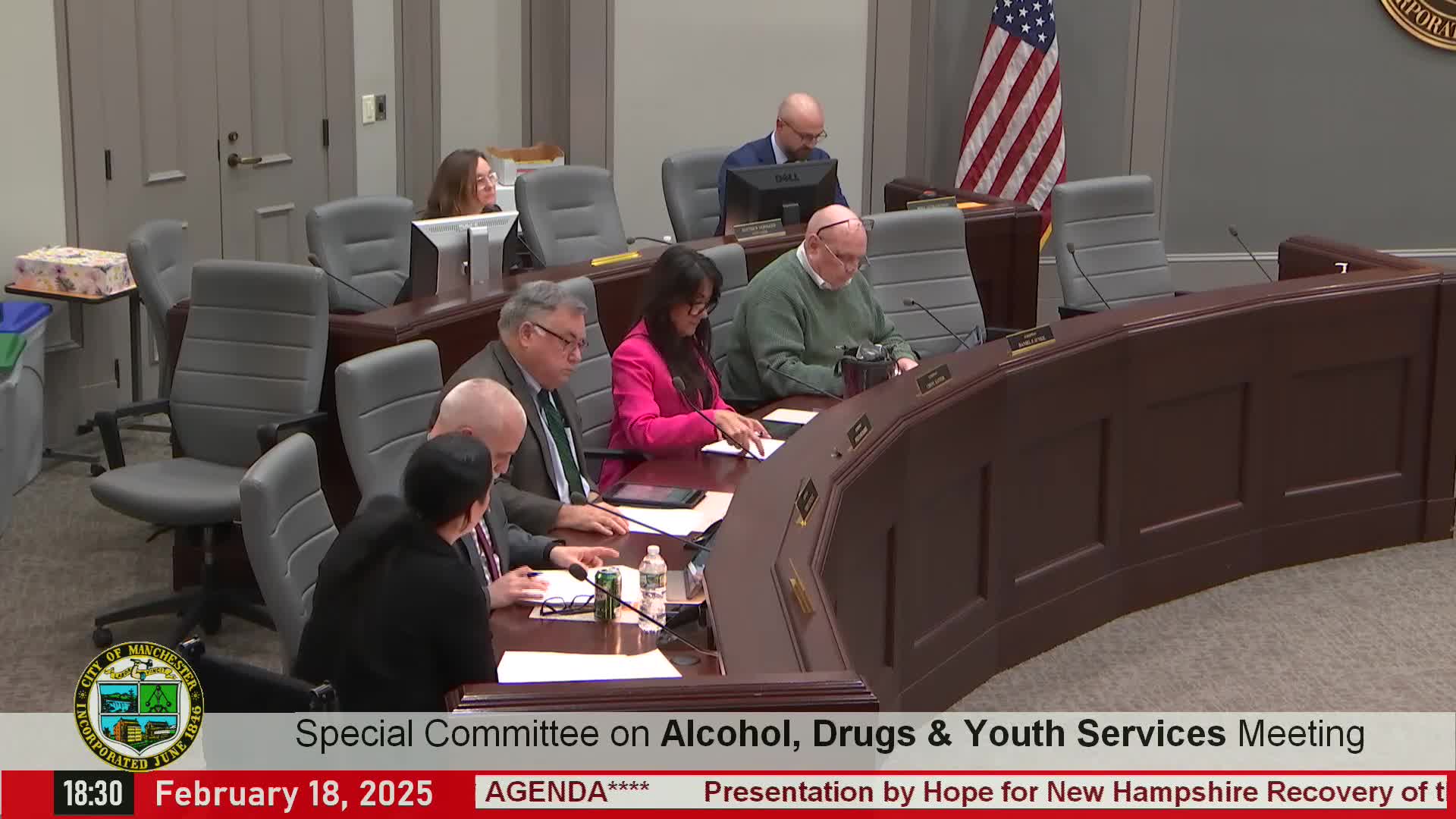
The Manchester Special Committee on Alcohol and Other Drugs voted to allocate $201,000 from the city's opioid abatement fund to Hope for New Hampshire Recovery for the agency's Hope Connections program.
The measure, described on the agenda as an allocation from the opioid abatement fund, was moved by Alderman Barry and seconded by Alderman Cantor; committee members approved the motion by voice vote and the item will be advanced to the full board for final action.
The funding is intended to support a team of peer support specialists and case management staff. Randy, a representative of Hope for New Hampshire Recovery, told the committee that peer support specialists are people with lived experience who connect with individuals experiencing homelessness, addiction or involvement with the justice system to provide emotional and practical support, while case management focuses on identifying needs and helping clients obtain services such as housing or primary care. Randy said the request does not include a needle-exchange component.
Committee members asked for program details and staffing plans. Alderman O'Neil asked for examples of peer support versus case management; Randy said the program expects to hire additional staff, describing a four-person team overall with two staff already on board. Alderman Merry emphasized the importance of the proposed $75,000 case manager position for outreach at shelter sites such as 39 Bay Street and to help move people from temporary shelter into transitional housing.
On program sustainability, committee members asked how operations will be funded after the initial allocation. Randy said the organization intends to bill Medicaid and other eligible payors for services as client volume grows, and to pursue other funding sources to continue operations beyond the start-up funds.
The committee discussion also included a related operational note: Alderman Berry said Chief Cashion will bring a proposal to the city's CIP committee in two weeks to donate an aging vehicle from the fire department for program use; Chief Cashion plans to replace that vehicle with grant funds. Committee members said that item was not before the committee that night but will be an additional component to support the program if approved through the CIP process.
The committee recorded the motion and second and approved the allocation by voice vote; the committee chair indicated the item will go to the full board for a final vote.
Details noted during the discussion included a request for staff to continue coordination with shelters and an emphasis on outreach and transition services rather than long-term housing provision by the program.
The committee adjourned after approving the allocation.