Get Full Government Meeting Transcripts, Videos, & Alerts Forever!
Get email alerts on the Lodging Tax topic
No spam. Unsubscribe anytime.
Council holds second reading on proposed 3% hotel-tax increase; Perrysburg hotel owner urges flat per-room fee
Summary
Perrysburg City Council held a second reading of Ordinance 7-2025, a proposed 3% additional lodging tax that would raise the local lodging tax from 3% to 6%. Bellarmine Suites owner John Krancheck urged council to consider a flat per-room fee and to include short-term rentals in any tax changes.
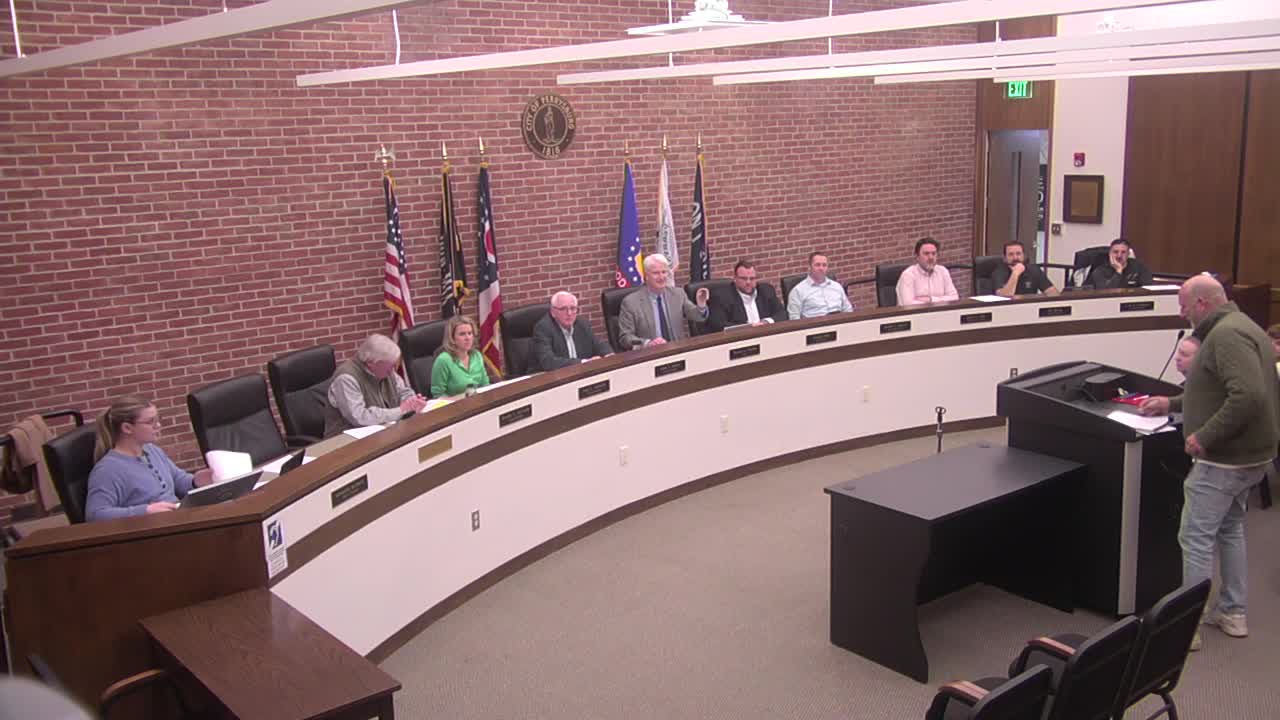
PERRYSBURG, Ohio — Perrysburg City Council held a second reading on Ordinance 7-2025 on Feb. 18, 2025, a proposal to add 3 percentage points to the city’s lodging tax, which would raise the total lodging tax to 6% if later approved.
The measure drew public comment from John Krancheck, owner of the Bellarmine Suites Hotel and a long-time member of the city’s Convention and Visitors Bureau (CVB). Krancheck told council he supports funding for safety and economic development but said the proposed 3% on gross receipts “penalizes the hotels who have a higher average daily rate” and suggested a $3–$5 flat fee per room as a nondiscriminatory alternative.
Krancheck also urged the city to address what he described as uneven application of the current lodging-tax rules: “There are over 30 to 40 locations that charge for accommodations in Perrysburg through VRBO, Airbnb, private homes… All of the above do not even pay the 3% lodging tax that is now on the books,” he said, arguing that short-term rental operators do not bear the same regulatory and safety costs as licensed hotels.
Council members asked for more information before a final vote. A council speaker clarified that under the Ohio Revised Code the existing 3% lodging tax requires part of those receipts be directed to the convention and visitors authority; the speaker explained the city currently retains about 1.5 percentage points and that the newly proposed 3% would be retained entirely by the city for economic development and other local uses.
Council indicated it will collect written responses from lodging businesses and circulate a document answering the questions raised, including (1) how the current 3% is distributed under state law; (2) whether short-term rentals are currently remitting the tax; and (3) whether a flat per-room fee would be permitted under state law. Council scheduled a third reading and potential vote at the next meeting.
Krancheck’s remarks were the lengthiest public comment on the item; he gave examples of his hotel’s marketing costs and asked the city to consider the competitive effect of taxing higher-rate rooms on a percentage basis. Council members said they would prepare a written response and additional data for members and the public before the next reading.
Votes and formal action: the item was presented for its second reading; council suspended the rules to allow the second reading by number and title only. No final approval of Ordinance 7-2025 occurred at the Feb. 18 meeting.
The council also discussed administrative work on short-term rental (STR) regulation on the administrative side and said staff would report back with clarification on what the city can and cannot do under state law and whether a flat per-room fee is permissible.