Get Full Government Meeting Transcripts, Videos, & Alerts Forever!
Get email alerts on the Legislative Update topic
No spam. Unsubscribe anytime.
Bennington lawmakers outline education overhaul and housing measures as federal funding uncertainty looms
Summary
Sen. Seth Bongard and Rep. Jonathan Cooper briefed the Bennington County Regional Commission on the legislature's shift from passing new environmental laws to implementing recent reforms, the governor's two-pillar education proposal (district consolidation and a new foundation funding formula), and housing measures that include expanded rental rehabilitation grants and infrastructure funding.
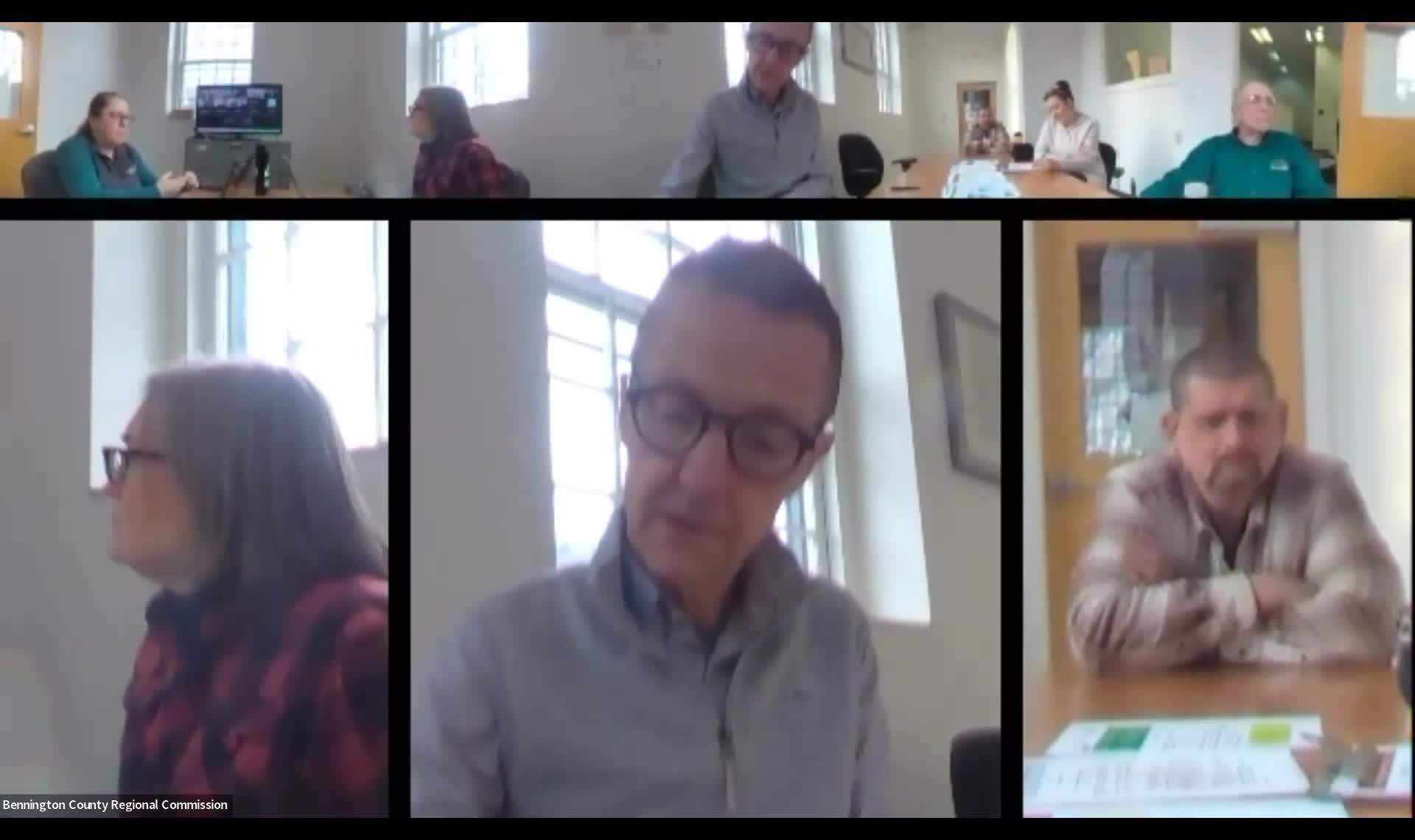
Sen. Seth Bongard, chair of the Senate Education Committee, told the Bennington County Regional Commission Tuesday that the Senate will focus on implementing recent education and environmental reforms rather than introducing major new measures this year. "Over the course of the last 4 years, we passed about 20 years worth of really critical, groundbreaking environmental legislation," Bongard said, adding that the legislature will prioritize monitoring and assisting implementation rather than new bills.
Why it matters: The remarks map how the General Assembly plans to shift from passage to execution of recent laws — a choice that affects municipal planning, school budgets and regional natural-resource permitting. Speakers also warned that much depends on unstable federal funding for K-12 education.
Bongard summarized two core elements of the governor's education proposal: consolidation of supervisory unions and districts, and a switch to a simpler funding model. "There's 2 major pillars... collapse our 52 supervisory unions at 119 districts into something significantly smaller," he said. On funding, he described the proposed move to a foundation formula — "a weighted per-pupil block grant" — intended to make school finance more understandable and to place clearer responsibility for funding levels.
Bongard said consolidation is aimed primarily at improving specialized services rather than producing large immediate savings. "You can have... the right people in there that you can't afford to have in little tiny districts," he said; "it's more for those reasons than savings." He also pushed back on a proposal discussed in testimony to mandate uniform statewide class sizes: "I am loathed to do that... a 1-size-fits-all approach across the state of Vermont is really... a recipe for bad things happening at the local level."
Federal funding and independent schools: In response to a question, Bongard said roughly one-third of Vermont public school funding is federal, and that the state will have to "monitor as best we can" because federal appropriations timelines and uncertainties make planning difficult. On the fate of independent schools, he said the House approach was more restrictive than the Senate’s; his Senate construct would "pair back choice" in some places but preserve independent-school tuition options in geographic areas where they are integral to the system, such as parts of the Northeast and the Southwest.
Housing, infrastructure and brownfields: Rep. Jonathan Cooper (Bennington-1), a member of the House Commerce and Economic Development Committee, reviewed housing-related bills moving in both chambers. He said House Bill 479 and Senate Bill 127 share many goals, including expansion of the Vermont Rental Housing Improvement program (allowing rehabilitation grants of about $50,000 plus $20,000 specifically for accessibility upgrades in some proposals) and increased reporting requirements for recipients. "We want a little bit more... reporting from recipients of that as well to get a feel for where this money is going," Cooper said.
Cooper described other items under consideration: a Manufactured Home Improvement and Repair program (grants up to about $20,000 for park owners and $15,000 for homeowners), and competing proposals for a Vermont Infrastructure Sustainability Fund (House proposal roughly $15 million vs. a Senate figure around $9 million) intended as a loan fund for water, sewer and other infrastructure tied to housing.
On brownfields funding, Cooper said the Senate had proposed an additional appropriation (discussed in committee as roughly $4 million) while the House version did not add additional funds; he noted recent federal freezes on some EPA brownfields grants and said the state-level funding conversation has become more urgent. Cooper also described a $2 million appropriation in a House bill for the Vermont Economic Development Authority to use for non-disaster-declaration disaster recovery assistance.
Community Housing Investment Program and tax increment financing: Cooper summarized a Senate-origin Community Housing Investment Program (CHIP) proposal that would adapt tax-increment-like tools to smaller parcels and mixed-use development. He said the program was still taking shape in appropriations discussions and noted an open question about affordability requirements for CHIP projects.
Small-scale food manufacturers: Cooper highlighted House Bill H-401, a revived bill to ease regulations for small food manufacturers and home-based bakeries. "It didn't just make it out of House Ag — unanimous vote — it left Ways and Means in the House at 11-0," Cooper said, adding he expected it to move to the Senate next.
Meeting context and next steps: Several commissioners asked follow-ups on details, including class-size policy and the distribution of brownfields funds. Appropriations work in both chambers remains live, and attendees were reminded that some funding numbers and program details could change as budget negotiations continue.
Votes at a glance: The commission approved the minutes from Jan. 16, 2025 during the meeting. Sheila moved to approve; Walter seconded. The motion carried on a voice vote; Commissioner Tiffany abstained because she was not present at the Jan. 16 meeting.
Ending: Lawmakers and staff asked the commission to monitor state budget activity and to relay local concerns about school-district configuration and housing infrastructure as committee work proceeds.