Get Full Government Meeting Transcripts, Videos, & Alerts Forever!
Get email alerts on the Public Safety topic
No spam. Unsubscribe anytime.
Muskego police chief outlines staffing, school-safety changes and possible public-safety referendum; commission votes to enter closed session
Summary
At a regular Police and Fire Commission meeting, the police chief summarized an internal employee survey and announced changes to dispatch and school resource officer schedules, warned a public-safety referendum may be forthcoming, and the commission voted to move into closed session to discuss a letter of reprimand.
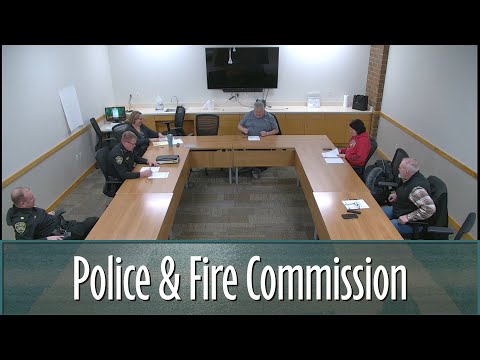
The Police and Fire Commission of Muskego City on Oct. 12 heard an extended report from the police chief about internal staffing, school safety and dispatch scheduling, and voted to convene a closed session to discuss a letter of reprimand for an officer.
The police chief told commissioners the department conducted an employee engagement survey whose results were “mixed to poor,” and said the department will focus this year on clearer communication, improved change management and “move the needle” on leadership and performance. “If somebody doesn't understand something, I need to engage those employees,” the police chief said. He said the department pulled command staff off-site to set three specific goals for the year.
The chief described a change to dispatch staffing that places more employees between about 7:30–8:00 a.m. and 6:00 p.m., the hours the department tracks as the busiest. He said the department has implemented minimum staffing standards on some shifts — including a minimum of two dispatchers during certain hours — and reported a reduction in overtime in the first month after the change. The chief acknowledged trade-offs for dispatch staff: “Understand that there's a sacrifice that is had by my dispatchers,” he said, and said he will seek internal adjustments before requesting additional budget resources.
School safety and school resource officer (SRO) staffing took up much of the discussion. The chief said SRO rotations will continue, noting one SRO’s four-year assignment is ending and the position has been posted. He described a plan to require a minimum number of SROs in place when schools are in session: if one SRO is off, the other two must remain available. He said the district pays 65% of SRO wages and that SRO schedules include about 24 non-student-contact days between September and June, plus the summer, when officers are encouraged to take time off.
The chief said calls for service at Muskego High School and other district buildings have risen and include frequent incidents such as vaping-related arrests and online threats. “We probably average about one [online threat] a month,” he said, and added that a recent day involved five juvenile vaping arrests. He said online threats require the department to “stop everything” while investigators identify and address the threat.
On enforcement of off-road and neighborhood vehicles, the chief compared UTVs with golf carts and said local enforcement will follow the city’s existing direction: “If you pay attention to Captain Fox and see him riding around in the summertime, he'll be on a ruckus… We can enforce the same rules with his ruckus that is legal on the roads,” he said. He said he does not favor imposing new restrictions unless a problem develops.
The chief also described a new tool to address chronic nuisance properties that gives the department additional techniques to cite problematic addresses and assist landlords. He characterized the tool as something that likely will not be used frequently but could help in persistent cases.
The commission approved routine minutes for the Nov. 21 meeting earlier in the agenda by voice vote; the mover and seconder were not specified in the record. Later in the meeting a commissioner moved to convene a closed session to discuss “a letter of reprimand to an officer,” citing Wisconsin statute §19.85(1)(c) as the authority for a closed personnel session. Commissioner Boyer seconded the motion. A roll-call vote followed; the meeting record shows the motion carried with all voting members present voting yes and one commissioner absent.
The meeting then went into closed session for the personnel discussion authorized under state statute. No action from the closed session was recorded in the public portion of the transcript.
The police chief said a public-safety referendum is likely at some point and urged the commission and city leaders to note internal changes the department has made — schedule adjustments, reductions in command layers and restored patrol staffing — to demonstrate the department has taken internal steps before requesting outside funding. He said the city will need marketing and communication work if a referendum is scheduled.
The chief closed by inviting commissioners to an upcoming employee appreciation event and reiterated the department’s near-term priorities of communication, change management and moving performance forward.
Votes at a glance: the minutes for Nov. 21 were approved (mover/second not specified; outcome: approved). The commission voted to convene a closed session to discuss a letter of reprimand under Wisconsin Statute §19.85(1)(c) (mover: meeting chair, name not specified; second: Commissioner Boyer; outcome: approved by roll call).