Get Full Government Meeting Transcripts, Videos, & Alerts Forever!
Get email alerts on the Capital Formation topic
No spam. Unsubscribe anytime.
House Financial Services hearing advances wide-ranging ideas to send VC capital beyond coastal hubs
Summary
Lawmakers and witnesses at a House Financial Services Committee hearing debated proposals to expand access to capital outside coastal tech hubs, including extending the JOBS Act 'IPO on-ramp,' loosening the accredited‑investor definition, raising private‑fund caps and strengthening programs that funnel federal backing to regional funds.
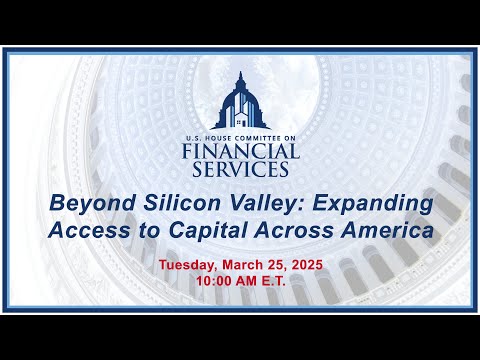
The House Committee on Financial Services heard bipartisan testimony on expanding access to investment capital beyond coastal venture hubs at a hearing titled “Beyond Silicon Valley: Expanding Access to Capital Across America.” Committee leaders and a panel of venture investors, biotech executives and state regulators described a suite of policy options under consideration — from extending the JOBS Act easing for newly public companies to rethinking who qualifies as an accredited investor — and debated tradeoffs between making capital more widely available and preserving investor protections.
Why it matters: Witnesses said concentrated venture funding in California, Massachusetts and New York leaves promising startups in the Midwest, South and non‑metropolitan states short of growth capital that can spur job creation. Committee members framed the hearing as a chance to update securities‑law and programmatic levers so that regional funds, fund‑of‑funds and public plans can direct more capital to local entrepreneurs without eliminating anti‑fraud safeguards.
Most significant proposals and the debate
- Extend and scale the JOBS Act “IPO on‑ramp.” Multiple witnesses urged Congress to lengthen or expand the emerging growth company (EGC) relief created by the Jumpstart Our Business Startups (JOBS) Act of 2012 so newly public firms face lower compliance costs during their early years on public markets. Joel Trotter, a lawyer who helped write IPO provisions in prior legislation, told the committee the JOBS Act “is a bipartisan success story” and argued guardrails such as Sarbanes‑Oxley 404(b) remain in place for larger firms even if ramp relief is extended.
- Reform the accredited investor test. Bill Newell, senior business adviser and former CEO of Sutro Biopharma, and other witnesses pressed for replacing strict wealth‑ or income‑based thresholds with measures tied to knowledge, sector experience or limited exposure (for example, a cap on the percentage of an investor’s assets invested in private offerings). Newell said the current test “is entirely predicated on wealth and the ability to absorb total loss” and supported an SEC exam or education pathway as an alternative.
- Raise investor caps for private funds and modernize fund rules. Candace Matthews Brocken, founding partner of Lightship Capital, described structural barriers that make fundraises difficult for regional managers. Her proposals included raising the 250‑investor cap on certain venture funds (the DEAL Act was cited in testimony) and equalizing Investment Advisers Act exemptions so fund‑of‑funds and regional venture firms avoid unnecessary registration burdens. Matthews Brocken said the existing 250‑investor ceiling “effectively excludes 99% of Americans” from participating in many large funds.
- Strengthen programmatic vehicles that channel public support. Witnesses highlighted the role of federal programs in mobilizing local capital: the SBA’s Small Business Investment Company (SBIC) program, the State Small Business Credit Initiative (SSBCI), and the Community Development Financial Institutions (CDFI) Fund. Several members and witnesses warned that proposed executive changes to the CDFI and Minority Business Development Agency (MBDA) budgets could undercut capital for underserved communities and urged continued program funding.
- Make Reg A, Reg D and crowdfunding more workable. Lawmakers and panelists discussed shortening SEC waiting periods for offerings, raising Reg A caps, and adjusting Reg D rules so demo days and pitch events do not chill entrepreneur outreach. Several witnesses said added pre‑filing requirements would chill use of Rule 506(c), which many first‑time and diverse fund managers rely on.
What witnesses said (selection of on‑record quotes)
- Chairman Hill, opening the hearing: “The committee on financial services will come to order.”
- Steve Case, founder of AOL and chair/CEO of Revolution: “Talent exists everywhere.” Case urged policies that create local incubators and capital so entrepreneurs need not migrate to coastal ecosystems.
- Bill Newell, senior business adviser at Sutro Biopharma: “Bringing a new medicine to approval is very, very expensive and risky,” testimony that underscored biotech’s long timelines and why lower compliance costs for small public companies can matter.
- Candace Matthews Brocken, Lightship Capital founder: “We unintentionally support geographic bias” when institutional investors exclude first‑time managers and fund‑of‑funds from public plan consideration.
- Amanda Seane, director of the Alabama Securities Commission: State regulators “serve as the early warning detectors for new and emerging threats to investors” and urged Congress to preserve a role for states in oversight of local offerings.
What was not decided
Committee members signaled support for a broad set of bills (the hearing referenced roughly three dozen proposals and several named measures such as the Accredited Investor Definition Review Act; the Deal Act; the Small Entity Update Act; and bills to expand Reg A). No committee votes or final legislative actions occurred during the hearing; members requested additional materials for the record and asked witnesses to submit written comments and background data.
Discussion vs. direction vs. formal action
Committee discussion: Members focused on tradeoffs — how to widen investor access while avoiding increased fraud risk, and whether scaled reporting can preserve protections without imposing prohibitively high costs on smaller issuers.
Direction: Several members called for follow‑up: (1) more detailed cost estimates from the SEC on extending EGC relief; (2) agency feedback on accredited investor alternatives (tests, percentage caps, or education pathways); and (3) written material from witnesses on SBIC/SBIC licensing, Reg A revisions, and Reg D usage by emerging managers.
Formal action: None recorded at the hearing.
Context and next steps
Witnesses emphasized that the problems are structural and long running: venture capital remains geographically concentrated, public listings are fewer than in prior decades, and private markets have expanded. The committee’s nearly three dozen pending bills span statutory updates, SEC direction, and program changes; several members indicated eagerness to move markups after written submissions and staff briefings. Any statutory changes will require follow‑up rulemakings at the SEC and coordination with state regulators and federal agencies that administer SBIC, SSBCI, and CDFI programs.
Ending
The hearing assembled a wide set of technical and programmatic proposals to broaden capital access beyond coastal venture hubs. Lawmakers agreed on the goal — broader participation by investors and geographic diversification of capital — while differing over the best route to preserve investor protections. The committee left the record open for additional materials and signaled forthcoming legislative work on multiple fronts.