Get Full Government Meeting Transcripts, Videos, & Alerts Forever!
Get email alerts on the Crime Victim Fund topic
No spam. Unsubscribe anytime.
Federal crime‑victim fund volatility is shrinking victim‑service grants, presenter tells commission
Summary
An official from the judicial branch’s Office of Victim Services told the commission that the federal Crime Victim Fund and VOCA assistance grants are highly volatile, driven by a small number of very large settlements, and that Connecticut has relied on ARPA and state support to stabilize service funding.
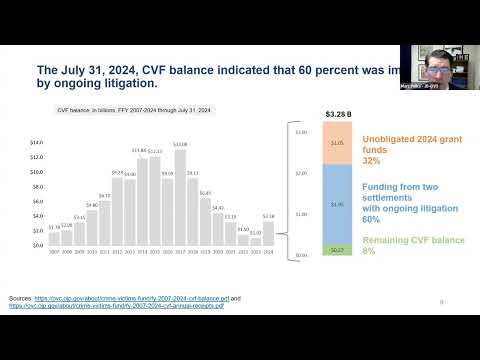
Mark, a representative of the Judicial Branch Office of Victim Services, told the commission that federal deposits are the main driver of the Crime Victim Fund and that a handful of large settlements determine year‑to‑year grant levels. “It's a small number of these cases that drive the volume. And that's the, the unfortunate part,” he said.
The presentation explained why VOCA (Victims of Crime Act) assistance — the part of the Crime Victim Fund that pays for direct services — has been both a “bedrock” of victim services and highly unpredictable. Mark said VOCA assistance makes up the largest portion of grants from the fund and that states receive allocations proportionate to population.
Why it matters: Connecticut and other states rely on VOCA assistance for services such as victim compensation, crisis intervention, case management and legal assistance. Sudden drops in federal VOCA awards can threaten nonprofit and government programs that serve victims of violent crime, including survivors of gun violence.
Key details from the presentation:
- The Crime Victim Fund balance grew sharply from 2007 to 2017, peaking at about $13.1 billion in 2017, and has since fallen. The presenter said the fund’s average annual balance has been about $6 billion, with a low near $1 billion and a high near $13.1 billion.
- Large corporate or international settlements have an outsized effect. Mark said that, in certain years, a small set of defendants accounted for a large share of deposits to the fund.
- The VOCA Fix Act (federal legislation enacted in 2021) expanded sources of deposits, bringing substantial one‑time inflows, but the presenter called those funds a partial and still‑uncertain fix because some deposits came from unsettled litigation.
- Connecticut’s VOCA awards mirrored national volatility: the state peaked around $30.6 million in 2018 and has seen large year‑to‑year swings since.
- Connecticut used federal ARPA funds to fill VOCA gaps. According to the presenter, ARPA covered roughly 43% of subawards in 2023 and rose to about 71% of contractor subawards by 2025; the commission was told the ARPA commitment window expired Dec. 31, 2024.
- Service scale: the presenter said VOCA‑funded contractors in Connecticut serve a broad range of victimizations and that in federal fiscal year 2024 the program served 103,530 victims. Demographic snapshots included that 61% of reported victims were ages 23–59, and 74% of service recipients who reported sex were female; the presenter noted substantial nonresponse in some demographic fields.
Program and procurement notes: Mark said Connecticut’s VOCA assistance allocations to nonprofit and public recipients are determined through a request‑for‑proposals (RFP) process. He said the current RFP is live, closed in January, and proposals are under review; he described the awards timetable as “weeks and months to come.”
Quotes and source limits: The article quotes only statements attributed in the meeting transcript to the presenter identified as Mark and to commissioners who asked questions during the presentation. Where counts or exact vote totals were not recorded in the transcript, this report does not supply them.
Next steps: The presenter said the judicial branch will complete RFP reviews and communicate grant awards in the coming weeks. Several commissioners asked about advocacy options for stabilizing state funding; the presenter and others said providers and coalitions have been briefing lawmakers about service‑level impacts.
Ending: Commission members and subcommittees raised concern about federal volatility and noted Connecticut’s recent use of ARPA and state appropriations to steady service levels while awaiting the next federal VOCA allocation.