Get Full Government Meeting Transcripts, Videos, & Alerts Forever!
Get email alerts on the Molst Training Materials topic
No spam. Unsubscribe anytime.
DPH reviewers tighten MOLST slide deck language, flag pediatric eligibility and legal review
Summary
Connecticut Department of Public Health staff and clinicians reviewed a draft slide deck to train providers and the public on Medical Orders for Life-Sustaining Treatment (MOLST), clarifying portability, provider eligibility, witness-signature changes, pediatric caveats and next steps for legal review and production.
Connecticut Department of Public Health staff and clinical advisers met to finalize a MOLST (Medical Orders for Life-Sustaining Treatment) slide deck for training and public-facing education, agreeing to send an edited master for production and to request legal review of pediatric eligibility language.
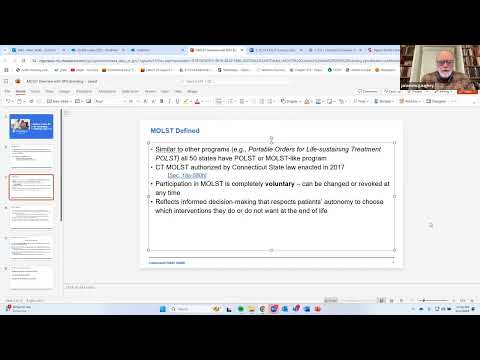
The meeting matters because the slide deck will be used statewide to train eligible clinicians and to explain how MOLST forms function differently from living wills and advance directives, including that MOLSTs are portable medical orders and that a recent statutory change removed the universal witness-signature requirement.
Attendees spent most of the hour simplifying slide text, aligning terminology to statute, and flagging three items for immediate follow-up: (1) refine provider-eligibility language to match the statute and DPH-prescribed training requirements; (2) send the deck to the production studio so Rich Cayman can build the EMS-facing materials; and (3) have DPH counsel review proposed pediatric eligibility language before those slides are finalized.
Staff and clinicians agreed the slides should use plain language and consistent terminology (for example, “eligible health care provider” instead of the looser term “provider”). The draft will explicitly note that MOLSTs are medical orders documented on a state‑approved MOLST form and that they are portable across care settings. Participants also discussed how the deck should explain the difference between MOLST forms and living wills or advance directives so that probate and clinical audiences do not conflate the documents’ legal roles.
On clinical eligibility, the group agreed to list eligible clinician types consistent with statute (physicians — MD, DO — and advanced practice clinicians such as APRNs and PAs) and to add a parenthetical that clinicians must complete the DPH-prescribed educational program before signing a MOLST. The group instructed slide editors to keep language brief on the main slides and place additional detail in presenter notes and linked resources.
Pediatric-specific language drew extended discussion. Carrie Moss (pediatric oncology) supplied a draft slide proposing eligibility caveats for some pediatric conditions. Several participants recommended simplifying that content and routing it to legal review so any expanded eligibility language does not conflict with the statute. The team agreed to consolidate pediatric eligibility points into the main eligibility slide with an explicit caveat: "pediatric considerations to be finalized after legal review and subject-matter refinement." Participants asked that Carrie Moss and her colleagues produce a shorter, clearer version for the next draft.
Participants also emphasized a recent statutory change removing the routine witness-signature requirement for MOLST forms. The group agreed to make that change visible in the deck (for example, an italicized or left-aligned note) and to ensure presenters call attention to the legal change during training so audiences accustomed to older forms will not be confused.
Operational decisions recorded during the meeting: Malia (Melia in parts of the transcript) will be the keeper of the master slide deck (version labeled 03/24/25), Barbara (DPH staff) will send the approved overview slides to Rich Cayman so he can proceed with EMS materials, and the team scheduled a follow-up meeting for Tuesday the 8th at 11 a.m. to review edits and any legal feedback.
Next steps assigned during the meeting include finalizing slide wording to match statutory language, routing pediatric eligibility text to DPH legal counsel for review, asking Carrie Moss to simplify her pediatric slide, and producing a studio or narrated recording for CT Train with a voiceover (Cindy O'Sullivan and other named presenters were discussed as possible narrators). The group also agreed to publish the working copy and send it to all participants once final edits are made.
The discussion was procedural and editorial; no formal votes or regulatory changes were taken during the session. The group recorded the working version as "03/24/25" and agreed that Malia will maintain the primary working copy and distribute the edited slide deck to the team and to Rich Cayman for EMS production.