Get Full Government Meeting Transcripts, Videos, & Alerts Forever!
Get email alerts on the Licensure Reciprocity topic
No spam. Unsubscribe anytime.
Board tables one reciprocity review, denies another and approves multiple licensure requests
Summary
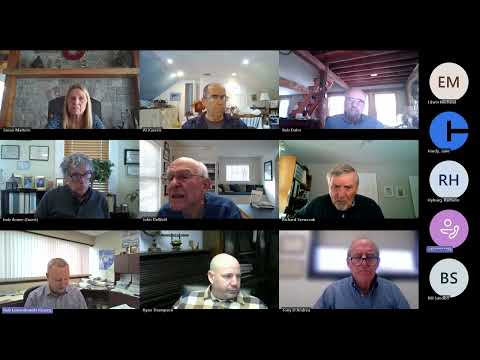
The Connecticut Board of Examiners for Professional Engineers and Land Surveyors on Feb. 11 tabled reconsideration of one reciprocity application because of unresolved professional violations, reaffirmed a prior denial for another applicant who lacks a qualifying undergraduate engineering degree, and approved multiple reciprocity and exam‑credit applications across engineering and land‑surveying categories.
The Connecticut Board of Examiners for Professional Engineers and Land Surveyors on Feb. 11 tabled one class-4 reciprocity reconsideration, reaffirmed a denial for another applicant who lacks a qualifying undergraduate engineering degree, and approved scores of reciprocity and exam-credit applications across engineering and land-surveying categories.
The board tabled reconsideration of Roy Karuba’s class-4 reciprocity application after reviewers found seven recorded violations spanning 1994 to 2018 and outstanding questions about where and how those violations were resolved. Rob Lewandowski, who reviewed Karuba’s file, said a summary of the citations initially attached to the application was submitted by Karuba himself only after staff follow-up. Lewandowski recommended the item be postponed “pending a receipt of additional information as to the background and resolution of the violations.” The board voted to table the item to allow staff to request official records from the relevant credentialing body and to ask the applicant for clarifying documentation.
In a separate reconsideration, the board voted to deny reciprocity for William Sandoval, restating a prior determination because Sandoval does not hold a qualifying undergraduate engineering degree. John DeWolf, a board member and former engineering professor, said “the breadth is very important,” describing why an ABET-like undergraduate curriculum provides essential exposure across subdisciplines. The motion to reaffirm the denial carried.
The board approved reciprocity for Brandon Rexford after a reviewer reported that Rexford’s technical civil engineering degree and subsequent experience met the board’s requirements. The motion to grant reciprocity for Rexford passed without recorded opposition.
Board members also discussed how to treat applicants from the United Kingdom under a proposed mutual-recognition or Memorandum of Reciprocal Agreement (MRA). John DeWolf moved and the board adopted a policy position that applicants from the U.K. should be evaluated under the same standards as other foreign-educated applicants: a qualifying four‑year undergraduate engineering education (or an evaluated equivalent), passage of the required NCEES exams, and applicable experience. DeWolf summarized that position as: “the 4 year undergraduate engineering degree, both exams and the experience should be the basis for consideration for all applicants.”
On routine licensing business the board approved multiple grouped motions to grant reciprocity and exam credits. Reviewers recommended approval of numerous class‑4 reciprocity applicants (lists appear in the board’s supplemental agenda). The board approved groups of land-surveying reciprocity candidates (Amanullah through Craig; and a separate motion approving Amanullah, Arabia, Bishop, Chado/Chato, Chen, Craig, Dow and Frederick, subject to verification of David Arabia’s current license). The board also approved groups of class‑4 engineering reciprocity applicants across several agenda pages after staff verification and credential evaluation.
On exam-credit items, the board approved Class 1 (exam-credit part 1) applicants grouped as reviewed by John DeWolf (e.g., MEO through Visser) after confirming transcript details, and approved a Class 2 exam-credit determination for an applicant identified as Patel after an education evaluation found the foreign bachelor’s equivalent and a qualifying graduate degree and experience. The board also acted to reinstate three professional-engineer licenses (Andrus, Bashir and Hoffman).
Board staff said a hearing involving a surveying matter is scheduled for March 11 and asked members who can attend to be available for that hearing; staff did not provide further details about the case in advance. Janita (board staff) reported there was no new monthly report for engineers and land surveyors beyond material already presented at the January meeting and that a new two‑month report will be prepared for the March meeting.
Votes at a glance
- Motion to accept minutes from Jan. 7, 2025 — approved (motion carried). - Motion to table reconsideration of Roy Karuba’s class‑4 reciprocity pending additional documentation — approved (motion carried). - Motion to approve reciprocity for Brandon Rexford (class‑4) — approved (motion carried). - Motion to reaffirm denial of reciprocity for William Sandoval (lack of qualifying undergraduate engineering degree) — approved (motion carried). - Motion adopting review standard for applicants from the U.K.: require an evaluated four‑year undergraduate engineering degree, both NCEES exams and applicable experience — approved (motion carried). - Motion to approve grouped land-surveying reciprocity applicants Amanullah through Craig (and related grouped approvals) — approved (motion carried); approval of David Arabia conditioned on verification of current licensure. - Motion to approve multiple class‑4 engineering reciprocity applicants listed on the supplemental agenda — approved (motion carried). - Motion to approve Class 1 exam-credit (part 1) applicants MEO through Visser — approved (motion carried). - Motion to approve class‑2 exam-credit (Patel) — approved (motion carried). - Motion to reinstate PE licenses for Andrus, Bashir and Hoffman — approved (motion carried).
Context and why it matters
Decisions on reciprocity and exam-credit determine who may practice engineering and land surveying in Connecticut and under what scope; the board repeatedly emphasized consistency with its long-standing interpretation of the national model law and with credential evaluations performed by NCEES or other accredited evaluators. Board members stressed that exceptions are difficult to apply consistently and that maintaining predictable standards protects public safety and preserves fairness across applicants.
What’s next
The board will revisit any tabled reconsiderations when staff returns the requested documentation, and members flagged a March 11 hearing involving a surveying matter for possible attendance. Staff will prepare a new two‑month report for the March meeting.