Get Full Government Meeting Transcripts, Videos, & Alerts Forever!
Get email alerts on the Economic Development topic
No spam. Unsubscribe anytime.
Montgomery council reviews VCS Capital mixed-use proposal, questions infrastructure reimbursements
Summary
At a March 24 workshop the Montgomery City Council and developer representatives from VCS Capital Group discussed a proposed multi‑family and mixed‑use project, focusing on stormwater detention, permitting risks and the size and structure of city reimbursement proposals tied to sales and property tax revenues.
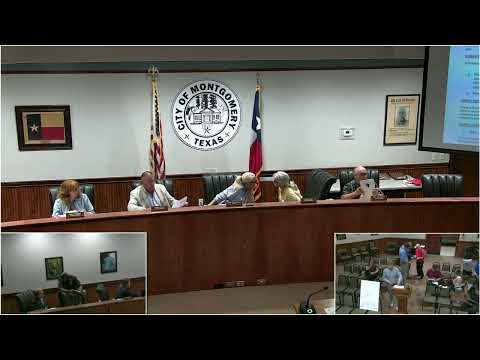
At a March 24, 2025 Montgomery City Council workshop, city officials and representatives of VCS Capital Group discussed a proposed multi‑family and mixed‑use development on a roughly 32‑acre site southeast of the intersection of Saint Easter Drive and Buffalo Springs Drive and north at Eva Street. The presentation and subsequent discussion focused on stormwater detention and permitting, proposed infrastructure reimbursements, and existing economic development reimbursement agreements the city already has in place.
Council members and staff heard that state permitting through the Texas Commission on Environmental Quality could delay off‑site detention plans for the project — a factor that would push the developer toward on‑site detention — and that delay could extend project timelines. Developers and engineers also reviewed roadway and utility layouts and asked for city participation in reimbursing a portion of utility and road infrastructure costs.
Why it matters: the size and terms of any city reimbursement affect Montgomery’s budget and the developer’s financial model. Council members questioned the duration and totals of proposed paybacks, whether sales tax or ad valorem tax should be used for reimbursements, and how the proposal would interact with existing reimbursement agreements the city already has with past projects.
City finance staff summarized the city’s outstanding reimbursement agreements and caps. Finance Director Marianne Karl reported the following items as part of the presentation: Wilbert Town Creek (maximum reimbursement $400,000; 15‑year term expiring 2027), Estates of New Largo (maximum $100,000; 12‑year term expiring 2029), and a set of other agreements financed in part by sales tax and ad valorem revenues. Staff said Home Depot’s agreement involved a tiered structure and that the city is still awaiting its first local sales tax report to determine the precise amount owed under that contract. Finance staff gave a combined current reimbursement cap across active agreements of $7,773,676.92 and said remaining balances on specific projects vary; one figure mentioned as remaining on a project was $881,798.
Council members pressed the developers on the total reimbursement request and the proposed repayment timeline. The developer team presented a reimbursement model and indicated flexibility on duration; they said stretching payback out reduces the present value of any lump sum to the developer but could be considered if it better suits the city’s budget. One councilmember said they would not support a $4,000,000 payback as presented. The transcript records questions about whether the city would reimburse 50% of certain utilities and an unspecified percentage of roadway costs; exact percentages and totals for the VCS proposal were discussed but not finalized during the workshop.
The workshop also covered practical matters tied to new retail anchors discussed as part of the project narrative. Presenters and councilmembers referenced nearby and proposed retailers — including Home Depot and Academy — and said those stores could increase traffic and local sales tax receipts. Staff noted the city is roughly 40% developed with about 60% remaining, and that Montgomery’s population footprint was described as approaching about 10,000 in projection comments during the discussion.
Council and staff discussion also touched on process questions: whether certain retention or detention infrastructure qualifies as city infrastructure eligible for reimbursement, whether memorandum of understanding language needs revision (a Granby Lake parcel was cited as referenced in the memorandum of understanding and raised questions), and how to structure an ordinance or agreement to ensure project‑specific, quantifiable goals and defined reimbursement schedules.
No ordinance, contract, or final reimbursement agreement was adopted at the workshop; staff and developers were directed to continue negotiating and to provide clarified cost breakdowns and payback scenarios for future consideration.
Votes at a glance: The only formal vote recorded in the transcript was a procedural motion to adjourn the workshop at 7:04 p.m.; the motion was moved by Cheryl, seconded by Casey, and carried on an affirmative voice vote.