House subcommittee examines VA access problems, community residential treatment and proposed Veterans Access Act
Loading...
Summary
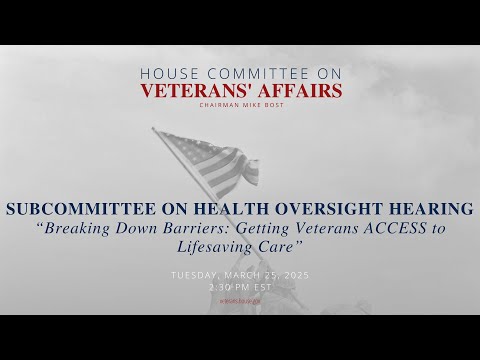
Chairwoman Miller Meeks convened an oversight hearing of the House Veterans' Affairs Subcommittee on Health to examine veterans' access to mental health care and residential substance use disorder treatment, focusing on VA processes, community provider roles and proposed changes in law and reimbursement.
Chairwoman Miller Meeks convened an oversight hearing of the House Veterans' Affairs Subcommittee on Health to examine veterans' access to mental health care and residential substance use disorder (SUD) treatment, focusing on whether VA policies, processes and partnerships with community providers expand or impede timely care.
The hearing opened with Miller Meeks highlighting federal funding and suicide statistics: “VA's problem is not a lack of resources. VA's problem is not a lack of funding,” she said, noting that the Veterans Health Administration's budget grew from roughly $20,900,000,000 in February 2001 to about $121,000,000,000 in 2024 while reported veteran suicides remained near 16–17 per day.
The subcommittee heard sharply personal testimony and national-scale policy testimony. Missy Jarrett, whose son Landon Holcomb sought VA care and died May 2, 2024, told the panel: “The VA is killing our soldiers.” Jarrett described multiple canceled appointments, a months‑long gap between an initial consultation (December 4, 2023) and a follow‑up (April 10, 2024), and said her son had fentanyl in his system when he died. She said she was not told how to access community care and that she believed timely community care would have changed the outcome: “Yes. He would be with us today.”
Michael Urban, an Army veteran and licensed clinical social worker who has both provided and overseen SUD programs, described inconsistent practices across VA medical centers and urged adoption of industry clinical standards: “Community providers are required to operate following ASAM, a standard of care which is much higher than that of VA.” Urban said access delays — he cited waits of “2 to 3 months for a bed” in earlier experience — and variable local interpretations of referral rules drive veterans away from the VA or leave them untreated.
Dr. Shankar Yalamanchali, CEO of River Region Psychiatry, described a private practice model that he said can increase capacity and reduce per‑patient costs while integrating with VA EHRs. He characterized parts of the community care network as episodic and insufficiently continuous for chronic mental health needs.
VA officials acknowledged gaps while defending elements of the current system. Dr. Maria Lorenti, acting assistant undersecretary for health for integrated veteran care at the Veterans Health Administration, said the Mission Act of 2018 and a 2020 standardized episode of care for MHRRTPs expanded community residential capacity: “This law expanded access to eligible veterans who can elect to receive care in the community in certain situations.” Lorenti said VA requires community residential programs to hold appropriate accreditation (for example, Commission on Accreditation of Rehabilitation Facilities or Joint Commission) and reported that as of March 2025 there were more than 260 MHRRTP programs across 125 locations providing over 6,600 operational beds, with roughly 32,000 veterans using MHRRTP care in FY24.
Members of both parties raised concerns about oversight, reimbursement and quality. Ranking Member Brownlee warned of workforce impacts from recent federal staffing actions and repeatedly pressed private‑sector witnesses on whether community providers had financial incentives that could encourage overbilling. Several members, including Dr. Dexter and Dr. Morrison, urged a fee schedule for residential community care before expanding referrals, citing examples cited in testimony of reimbursements “as much as $6,000 a day” and an Office of Inspector General fraud alert that flagged patient‑brokering and other abuses in late 2024.
VA witnesses described steps taken or underway: TriWest implemented a per‑diem reimbursement policy for RRTPs within its network in December (per testimony), and VA officials said they are reviewing policies, directives and staffing to improve consistency and reduce barriers. Committee members pressed VA leaders on data gaps — for example, Dr. Weikers said she did not have national figures on resignations or early retirements following January 20, 2025 personnel actions — and asked how VA would ensure uniform application of policy across facilities.
Discussion at the hearing separated three types of items: (1) documented process failures and personal accounts of delayed care (exemplified by Jarrett's testimony), (2) operational proposals from community providers to expand capacity and integrate with VA systems, and (3) oversight and policy fixes sought by lawmakers (including a fee schedule, clearer adoption of clinical standards such as ASAM and steps to identify and remove bad actors from community networks).
The hearing did not record a committee vote. Chairwoman Miller Meeks said VA officials supported the Veterans Access Act of 2025 as introduced before the full committee and pledged continued work with Congress on offsets and implementation details.
Members urged a combination of measures: standardize and enforce access timelines, promulgate a community‑care fee schedule to limit excessive reimbursements, require or verify accreditation and integration with VA records, and improve frontline training so national policy is applied consistently across VA facilities. VA officials said a multi‑pronged review has been initiated to identify why policy is not being uniformly implemented and to reduce administrative barriers that delay care.
The panel's testimony underscored a persistent tension: veterans and some members argued that community care can provide timely, lifesaving access when VA capacity is limited, while other members and witnesses warned that without clear fee and quality controls community referrals risk creating incentives for fraud, inconsistent quality, and unsustainable costs. The committee asked VA to provide additional data and follow‑up on reimbursement schedules, staffing impacts and investigations into provider misconduct.
The hearing record will include full written statements from witnesses; the subcommittee concluded without formal votes and said it will continue oversight and follow‑up with VA leaders and third‑party administrators on the outstanding data and policy questions raised during testimony.