Get Full Government Meeting Transcripts, Videos, & Alerts Forever!
Get email alerts on the Agriculture Protection Areas topic
No spam. Unsubscribe anytime.
Committee advances bill clarifying agricultural-protection-area applications; substitute to delay fails 3-12
Summary
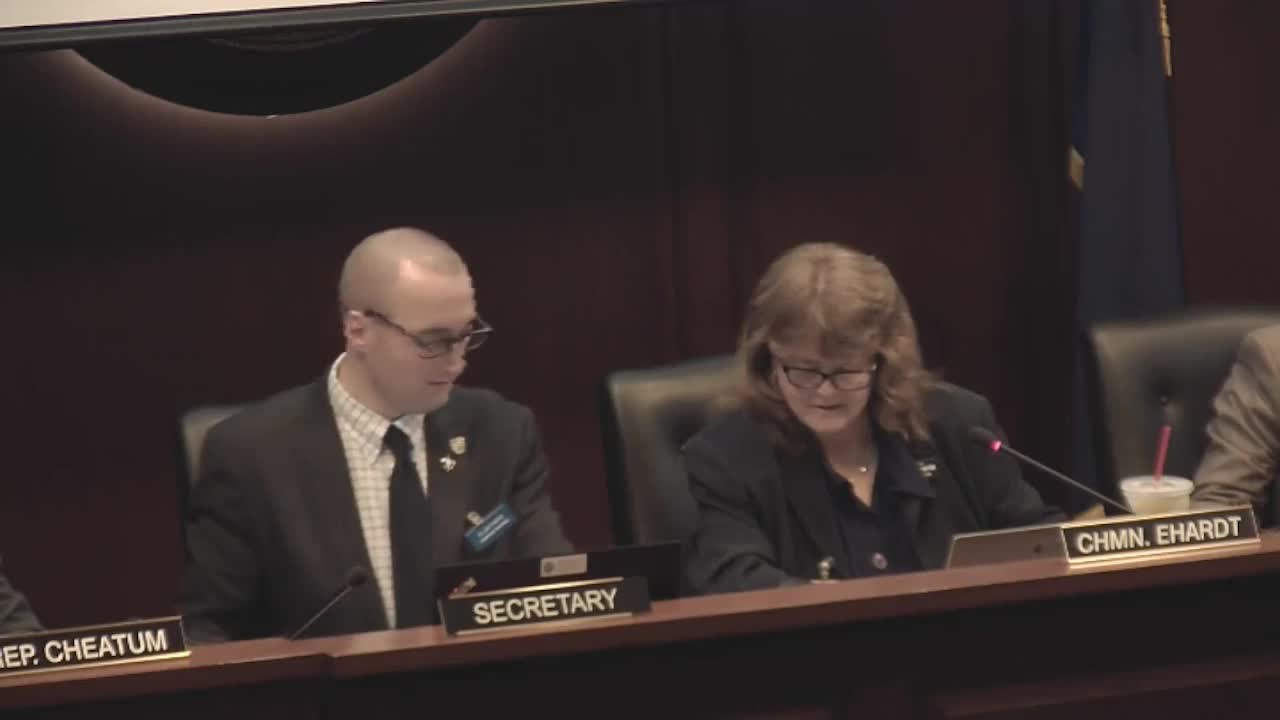
Representative Kevin Andrus, the bill sponsor, opened the committee hearing on Senate Bill 1133 and told the Local Government Committee the measure is “just a minor little cleanup from the bill that we passed last year.” The committee voted to send the bill as amended to the House floor with a do-pass recommendation after testimony from farmers, seed-industry representatives and a city association representative.
Representative Kevin Andrus, the bill sponsor, opened the committee hearing on Senate Bill 1133 and told the Local Government Committee the measure is “just a minor little cleanup from the bill that we passed last year.” The committee voted to send the bill as amended to the House floor with a do-pass recommendation after testimony from farmers, seed-industry representatives and a city association representative.
The bill amends the statutory framework created by last year’s House Bill 608 for agricultural protection areas (APAs). Sponsor Kevin Andrus said the changes clarify that: administrative application fees “shall not exceed the administrative expenses that it incurs,” APA maps are created separately from county zoning so designation does not require rezoning or a comprehensive-plan amendment, and applicants retain judicial-review rights. Roger Batt, executive director of the Bridal Eastern Oregon Seed Association, told the committee the bill reverses a Canyon County zoning practice that prevented otherwise-eligible landowners from applying for APA designation.
“This clarifies that you’re not restricted from applying for an agriculture protection area either inside or outside the boundary,” Roger Batt said, describing local ordinances that, in his view, blocked applications in some parts of Canyon County. Testimony from seed-industry and grower representatives emphasized the industry’s need for field isolation distances and predictability. John Hoadley, representing the Coalition for AGS Future, said isolation rules and shrinking acreage are already pushing seed production out of the Treasure Valley: he told the committee that, in his figures, alfalfa seed production in Canyon County fell from about 18,000 acres to about 3,000 acres in recent years.
Industry witnesses described APAs as a voluntary tool for landowners who want to keep land in production. Samantha Parrott, executive director of the Snake River Sugar Beet Growers Association, said sugar-beet growers view the measure as a step to preserve working acres near processing facilities: “sugar beets alone, we’re a billion dollar industry in the state of Idaho,” she said.
Jonathan Wheatley, deputy director of the Association of Idaho Cities, supported APAs in principle but urged a narrowly targeted amendment to address city planning and infrastructure concerns created by existing “areas of impact.” Wheatley said a separate law requires cities to redraw areas of impact by the end of the calendar year and limits those areas to locations of expected growth within five years and to a maximum two-mile radius. He proposed an amendment requiring that applications for land inside a city area of impact be submitted by Dec. 31, 2026, to give affected landowners a short window to apply before infrastructure investments proceed.
Committee debate centered on balancing private-property choices and local planning authority. Some committee members said APAs help clarify long-term land use for cities; others warned that allowing late APA applications could frustrate planned infrastructure investments and impose taxpayer costs. Sponsor Andrus opposed the Wheatley amendment and said the bill preserves local control because county commissioners retain final approval of individual APA applications.
Votes at a glance
- Substitute motion (Representative Cheatham): send Senate Bill 1133 as amended to General Orders (roll-call). Result: failed, 3 yes, 12 no. (Roll-call recorded in committee minutes.)
- Main motion (Representative Price): send Senate Bill 1133 as amended to the House floor with a do-pass recommendation. Result: approved by the committee (voice vote); bill sent to the House floor.
What the bill would do and next steps
Senate Bill 1133 makes several clarifying changes to the APA statute: it limits administrative application fees to actual administrative expense, separates APA mapping from county zoning maps so rezoning or comprehensive-plan amendments are not required, clarifies appeal and judicial-review rights, and restates that nonagricultural structures may be allowed inside an APA only if they “contribute to agricultural production.” The committee advanced the amended bill to the House floor for consideration; the Wheatley amendment (deadline for applications inside areas of impact) failed in committee.
Formal committee action does not change county ordinances; county planning and zoning and county commissioners retain the authority to approve or reject APA applications under the bill as written. The bill now proceeds to the full House for consideration.